Cut to the chase:
The FX5 camera is the camera to get if only for any one of these 3 exceptional reasons:
- Higher 16.6 MP resolution
- Internal 16-bit X-OCN RAW
- EVF (OLED — 7.07 million dots) that tilts from horizontal to vertical and detaches. This is my favorite thing.
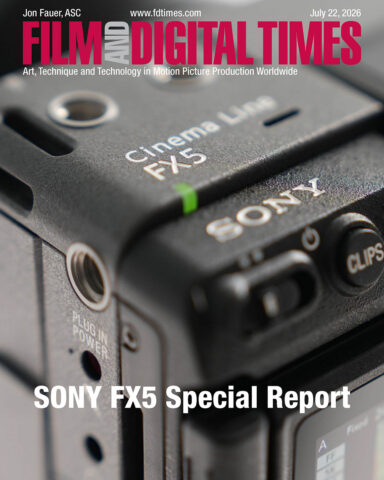
Of course, there are many more things to applaud. Download the free FDTimes Sony FX5 Camera Report. It’s a 13MB 40-page PDF.
There’s also an ind-depth interview with Gareth Edwards who tested the FX5 a few weeks ago in Asia.
The Sony ILME-FX5 is the latest Cinema Line camera. The family goes high and low, to paraphrase the Kurosawa film, from high-end Hollywood blockbuster to entry-level solo and independent production. Each family member is defined by intention and affordability. At the top of the line, there’s VENICE 2, VENICE, their respective Rialto tethers and the imminent RIALTO 65. Next comes BURANO. FX9, beloved by documentarians, has retired. FX6 is next in the family tree.
With a pre-release proposed price under US $4,899 (body only), the new FX5 is positioned between FX6 and FX3. It’s not a replacement for the FX3 nor is it an FX3 mark II.
The FX5 has a new 16.6 Megapixel Full Frame, Full Height, Stacked Exmor RS CMOS Sensor.
Maximum 5K Open Gate (3:2) 36 x 24 mm resolution is 4992 x 3328 — available only when recording in X-OCN.
Pixel pitch is approximately 7.2 microns. (FX3 is about 8.4 µm.) These are unofficial specs, derived by dividing sensor width by horizontal resolution.
It has higher frame rates for slow motion: up to 60 fps in 5K, 120 fps in 4K and 240 fps in Full HD.
Recording in 5K 120p and 4K 240p is slated for firmware V2.0— planned to be available in August 2027 or later.
FX5 can record internal X-OCN LT 16-bit linear RAW to CFexpress Type A cards in dual CFexpress card slots. (Type A are the smaller ones.) 16-bit X-OCN provides 65,536 tonal gradations per color for a total of 280 trillion shades. Grading worked seamlessly on a beta version of DaVinci Resolve Studio. The release update is expected to be ready when the camera ships.
In addition to X-OCN LT, there are two additional “compact” modes: X-OCN C1 and X-OCN C2.
BASE ISO gets an additional 4,000 ISO in the middle. It’s called THREE BASE ISO: 800, 4,000 AND 12,800. 4,000 BASE ISO is helpful when shooting in low light exteriors and dim location interiors where you don’t need 12,800 dark-as-night.
THREE BASE ISO is automatic—it adjusts when you change the camera’s ISO sensitivity manually or the camera does it with Auto ISO. Three Base ISO reduces noise, provides cleaner shadows, wider latitude and helps to maintain a consistent look over the very wide expanse of sensor sensitivity.
BASE 800 covers 200 to 3200 ISO. Base 4,000 covers 1,000 to 16,000. Base 12,800 goes from 3,200 to 51,200 ISO.
FX5 also has Dual Gain for more stops of exposure latitude.
The new accessory EVF attaches and detaches from the camera’s hot shoe on top. It tilts from horizontal to 90° vertical. It has a stunningly sharp 7.07 million dot OLED display that’s sharp like an optical groundglass to focus even without peaking. It’s extremely bright—and dimmable.
The FX5 Menu layout is similar to VENICE with Big 6 and deep -dive menus. Push the MENU button once and you see the familiar Big 6: Project, TC/Media, Monitoring, Audio, Info, and Project Details (full menu). Press the MENU button again to get to live picture view. Long-press the MENU button to get to the deep-dive full menu pages.
There are additional nice VENICE touches on the FX5. The familiar dial jog-wheel to navigate menus and settings is on top. There’s a BACK button when you need a hasty tactile escape instead of using the touch screen.
The rear LCD touchscreen monitor is big and bright: 3.5″ diagonal. It swivels, swings and tilts in 4 axes—almost every positional permutation from vertical to horizontal, snuggled against the camera body or pulled out to the camera left side.
Display of status information on the rear monitor is similar to VENICE 2: black border all around the picture area with white text. You can also turn the DISPLAY function off (via menu or user-button) to hide the text and enlarge the image to full screen.
Anamorphic desqueeze is available for the LCD rear screen, EVF and external monitors. Settings are 1.3x, 1.5x, 1.6x, 1.8x and 2x.
FX5 has improved IBIS — In Body Image Stabilization. It works well, reducing vibration and smoothing slow moves. But if you’re Claudio Miranda or Dan Ming putting cameras in F1 cars or Top Gun jets, or rigging on a drone, gimbal or bouncing around in the Baja 1000 road race, Sony provides an IBIS locked-off sensor conversion at their customer service offices. This is an irreversible process: once completed, IBIS cannot be restored.
The XLR audio top hand connects to contacts in the hotshoe and attaches with the same two 1/4-20 screws as the EVF. So it’s a choice of one or the other. However, MID49 has an accessory setup and cable that lets you have both. Tilta has an EVF extension cable and cage.
Autofocus is responsive, fast (or adjustably slower when wanted) and excellent in low light. I used it more often than ever before. It employs AI recognition of people, animals and birds for focus and exposure tracking.
ProRes RAW and Blackmagic RAW can be recorded externally via the camera’s full-size HDMI Type A port.
FX5 connects remotely via new tri-band Wireless LAN 2.4GHz, 5GHz or 6GHz Wi-Fi, Wired LAN (Ethernet), Bluetooth and USB tether. Camera functions and remote monitoring can be controlled with a smartphone, tablet or computer using the Sony Monitor & Control (M&C) app for iOS (iPhone, iPad or Silicon M-series Mac) and Android. The M&C app provides wired and wireless monitoring, camera menus, exposure and focus control on the larger screen of your smartphone, tablet or Mac.
The new NP-SA100 battery lets you shoot longer: about 105 minutes of actual start-stop shooting or 170 minutes of continuous recording. That could be a very long “oner”—an almost 3-hour single take when recorded in XAVC S-L 422 FF 5K 16:9 23.98p.
Great thanks to Nobu Takahashi and Keita Yasui for all their help and hard work making this report possible. Also thanks to Keita for his great BTS stills and meticulous proofreading. And thanks to the Sony teams in Japan and USA — Stuart Cram and Jie Song — and to Kish Sawh and the team at the Sony PR Team.
So, please download the FDTimes 40-page FX5 Camera Report.