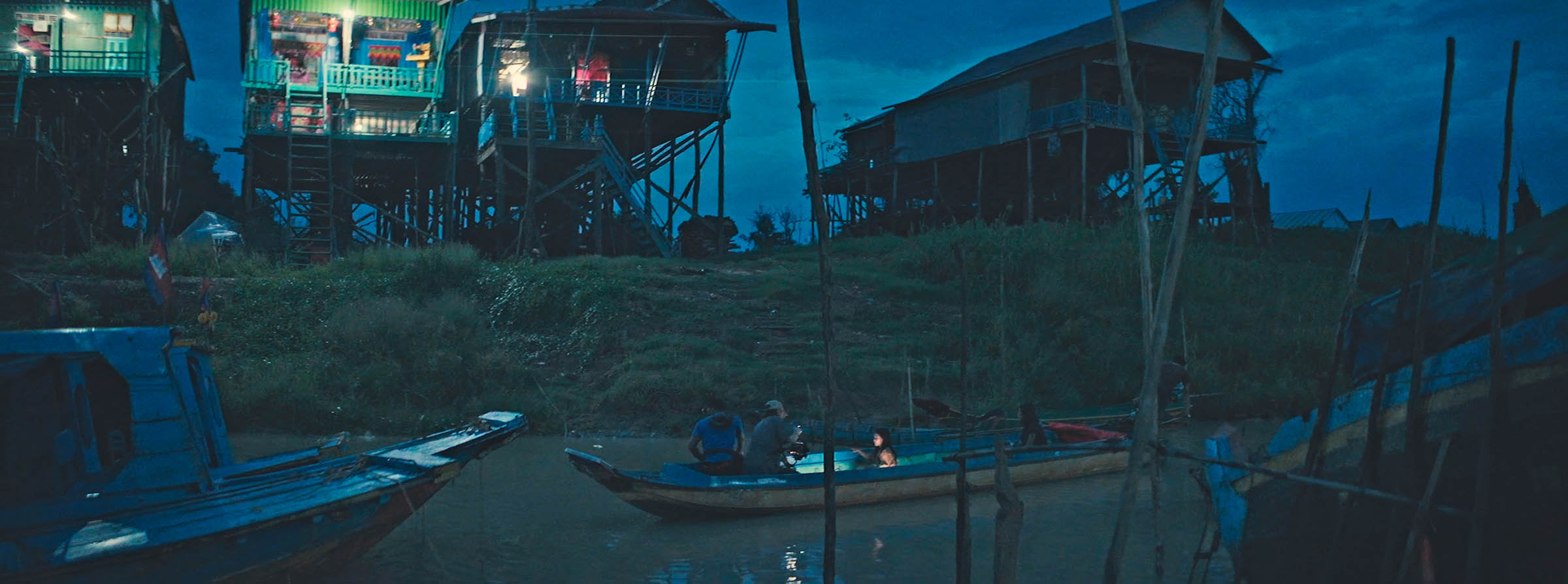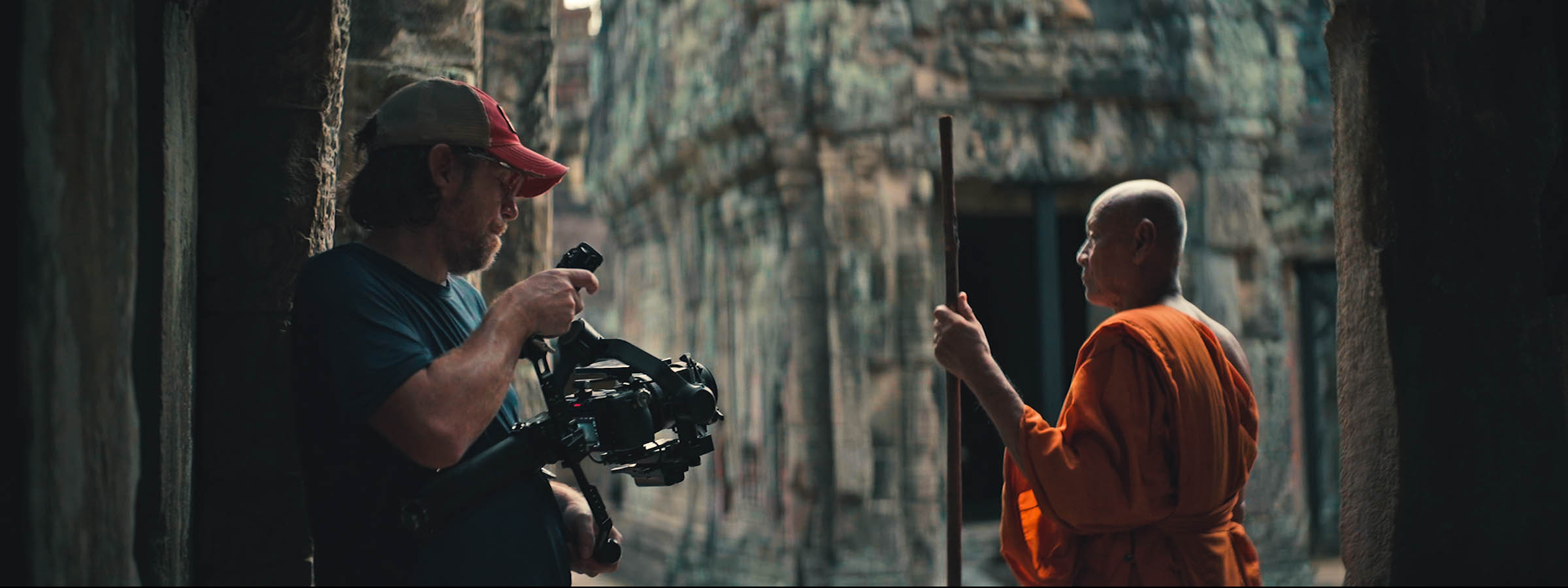
All BTS images by Mark Bone.
A few weeks ago, director Gareth Edwards and a pre-release Sony FX5 returned from an adventure in Angkor Wat, Bangkok and Katmandu. Our discussion follows, accompanied by great BTS images by Mark Bone. (I can’t wait to get Gareth’s frames.)
The FX5 launched today and the FDTimes Camera Report PDF is ready to download here. But for anyone without patience for PDFs, here is Gareth’s great interview unencumbered.
Jon: It’s 9:00 AM in Los Angeles. Sorry if you’re jetlagged, having just returned from an adventure in Asia with a pre-release Sony FX5 camera. How did this happen?
Gareth Edwards: In 2022, we made a film called THE CREATOR as soon as the rules allowed us to travel after the pandemic. It was a crazy ambitious thing with at least 80 locations in Thailand, Cambodia, Nepal, Indonesia and Vietnam—all shot with the Sony FX3.
I embraced the FX3 so enthusiastically to be able to work as run-and-gun guerrilla-style as possible, using a gimbal but not having the whole movie feel like a documentary. The gimbal enabled a way of achieving a cinematic look. The problem is the bigger the camera on a gimbal, the more difficult it is to hold. You add more paraphernalia. You need batteries, monitors and things. But I was really looking for the smallest possible device.
The Sony FX3, launched in February 2021, was everything we wanted. I bought a bunch of them. And so that’s how we shot THE CREATOR. It got a bit of attention as a prosumer camera that shot a movie with a major theatrical release. We even had an IMAX release.
One day, I received an invitation from Sony to attend an event. While there, I tried to find someone who would let me speak to the engineers about future cameras. After annoying the hell out of them for about a week, I was invited to a join the biggest video conference I’ve ever been on. The team of planners and engineers at Sony Japan asked “What would you want in the next camera? What kind of things would you want it to do?” I was like a kid in a candy store and just started listing all the ingredients of a dream camera. It went from realistic expectations to completely blue sky fantasy.
And at the end of it all, I said, “If you only do three things, please have internal RAW, a flip-up monitor and a good viewfinder.” I wanted internal RAW so that I wouldn’t need an external drive that just makes things bigger and more complicated.
I wanted a monitor that you could just flip up and look down upon, with some of the ergonomics of a Hasselblad and not something you unfold to the side where it can catch on your body. I wanted to hold the camera like a child in my hands.
And the third request was for a good EVF viewfinder. This was before the FX2 came out. I said all this stuff and everyone was very polite. The call ended and I just thought that nothing would happen but it was worth asking.
Two years later I was contacted by Stuart Cram at Sony. I knew him from his previous time at DJI. Stuart said, “Sony is in town. They have something they want to show you. Do you want to pop over to the Sony DMPC?” I live nearby in Burbank. And so I went over half wondering, “Is what I think it is?” When I got there, it was indeed.
Incredibly, the first things I noticed about the new FX5 camera when they revealed it were those three things that I really wanted: internal RAW, flip-up monitor and EVF. They said that THE CREATOR had helped some of their sales and while developing this camera.
And Sony asked you to do a short film with a pre-release FX5?
I don’t want to call it a short because it puts too much pressure for it to be a thing. If you just call it a camera test, that would be all right, wouldn’t it?
The footage you showed me is much more than a test. It looks great. A test usually reminds me of twinkly lights in the background in a dingy studio with someone’s girlfriend in front of camera trying to smile. Maybe call it a Camera Adventure? I expect you enjoyed some other new things in the new FX5?
Yes. It can do 16-bit internal recording—Full Frame, full height, open gate. Crucially important was that it retained the 12,800 ISO.
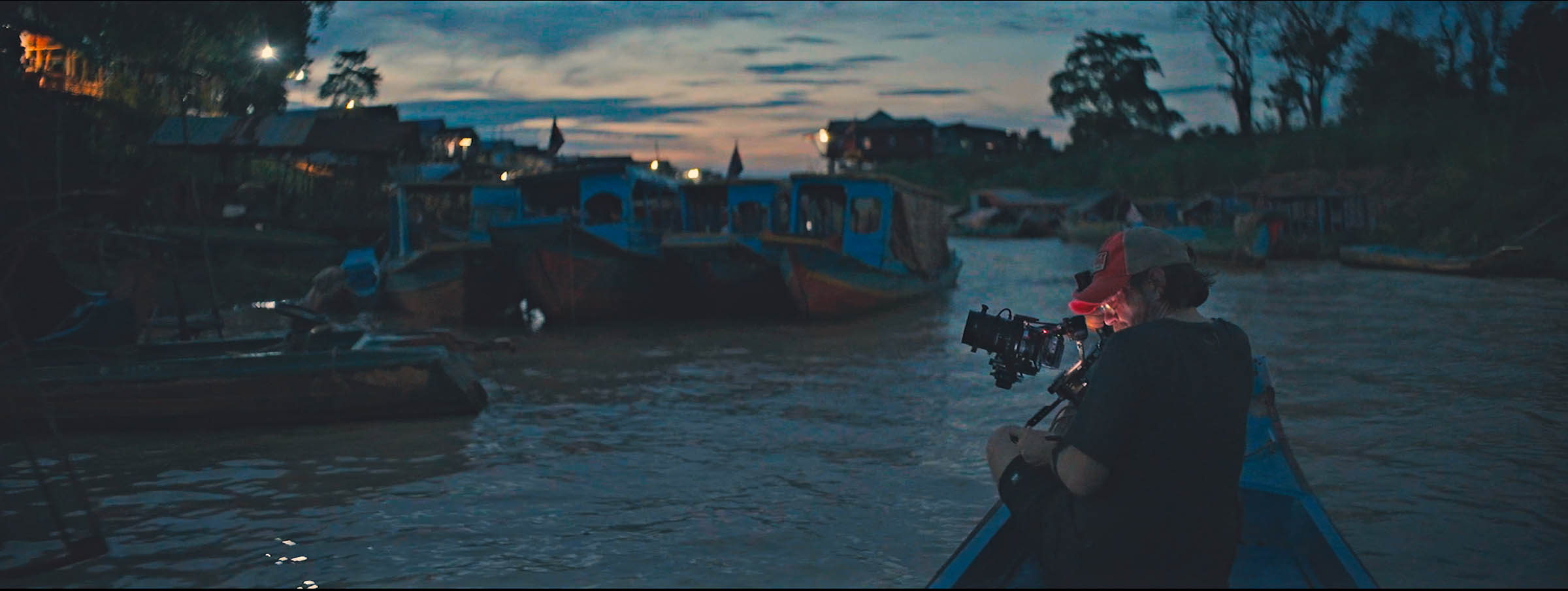
After getting the FX3, I started to wonder what other cameras were out there. I bought a few to test and play with. The dotted line in the sand for me was very high ISO. It allows you to shoot in available light, during magic hour and when the sun goes down. Things are beautiful in twilight as the lights come on and you can still make out the horizon. I can’t let go of that.
The incredibly high ISO of 12,800 is important to me because if you can see it with your eye then you can film it—even at night. The other thing Sony added was a middle ISO of 4,000 which is in between the base ISO of 800 and the high ISO of 12,800.
I didn’t really understand why that would be so useful until we took it out on our shoot. I found that I was living at 4,000 ISO most of the time because it was very useful in bright exteriors. I had a variable ND in my E-mount to PL adapter. That meant I could be outside and then run inside, quickly adjust the ND and suddenly get the right exposure there as well.
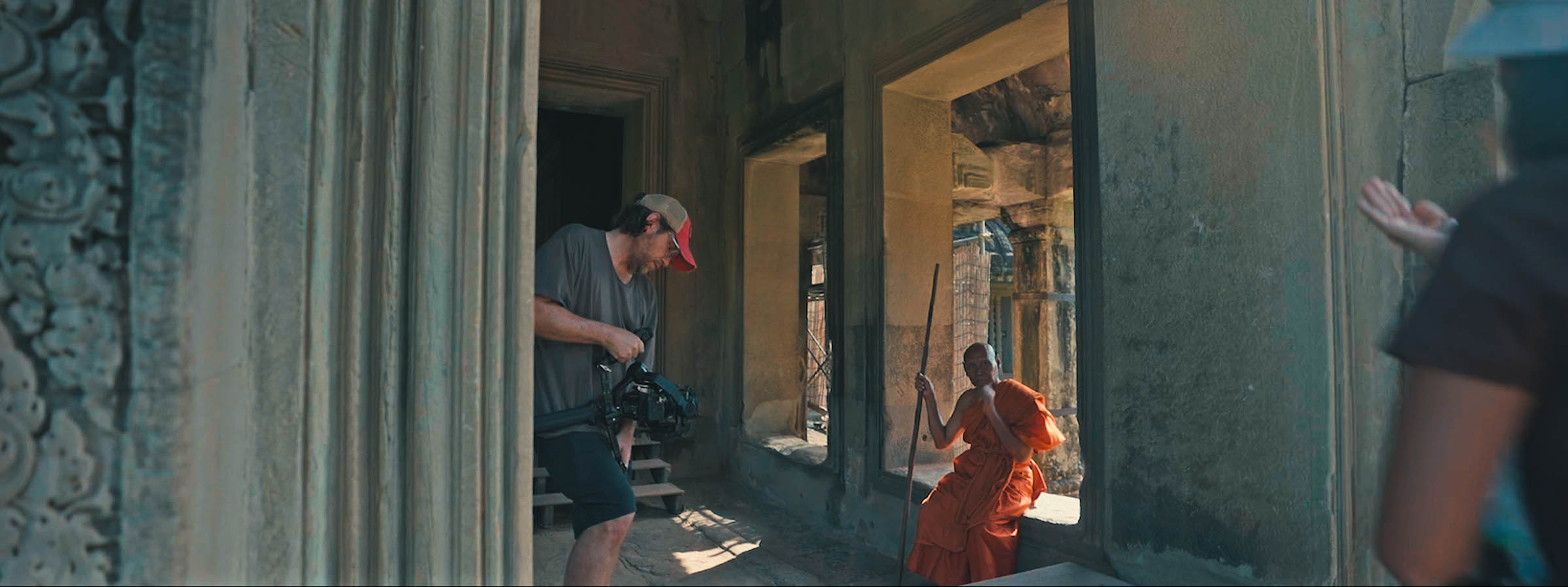
Were you both the director and cinematographer of this FX5 adventure in Asia?
I made some mistakes because I don’t consider myself a professional cinematographer. One day, I didn’t realize that the camera was set to 12,800 ISO and I was shooting midday sun in the tropics with maximum ND calming it down. I didn’t even notice. The quality was so good. It was only when I looked at the rear display that I realized that the camera was at 12,800. But the images weren’t screaming with grain or noise. I’ve looked at all the footage on a big monitor and I can’t tell which ones they are. There’s so much latitude.
I like the classical film look. Almost everything I do digitally involves chasing the vintage film stock look that I grew up loving as a kid at the movies and wanting to get into filmmaking. One of my favorite things is to work with complementary colors, eliminating some colors but keeping good skin tones. I’m screening the FX5 footage now and it’s impressive.
I didn’t realize how good this camera looked until I got home because you’re shooting and looking at a five-inch monitor at best. I was actually using my phone. That’s the other amazing thing about the FX5: because it has internal Wi-Fi, you can do away with an external video transmitter. You can just log in to the camera using the Sony Monitor & Control app.
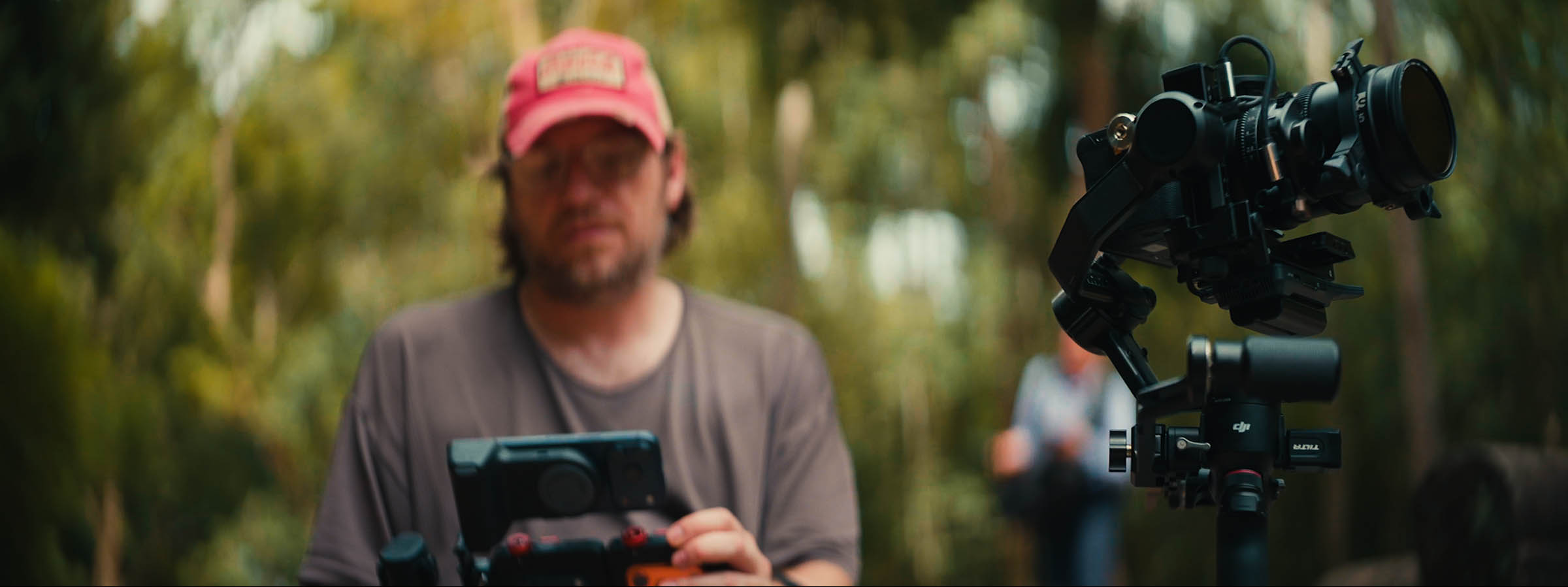
Controlling FX5 on RS 5 via three iPhones.
So your onboard monitor is a phone?
Yes, I was viewing on my iPhone 17. I specifically bought some new iPhones because they’re so bright in sunlight. They’re actually as good as some of the best professional monitors and they’ll last all day without charging. Since the iPhone has MagSafe (built-in magnetic ring), I attached it to the top of the FX5 with a little magnetic mount. If I wanted to use a gimbal, I could pull the iPhone off the camera and stick it on my arm with a magnetic wrist band. That’s all I used the whole time.

What lenses did you have?
I used a Kowa vintage 2x anamorphic 75mm lens, rehoused and in PL mount. As a filmmaker, I prefer to reduce and isolate information for the audience. I’ve come to appreciate how these vintage lenses blur and obscure the things you don’t want to pay attention to. But paired with this camera, the area that you do want to pay attention to is really crisp with high detail.
Where did you get your Kowa anamorphics?
After THE CREATOR, I was concerned that everyone would try to rent or buy the Kowas because they’re so good for gimbals, they’re so light and small. I was worried I wasn’t going to be able to get them again. So, I contacted every company in the world that rented Kowas and said, “Would you sell yours?” And they’d say, “No.”
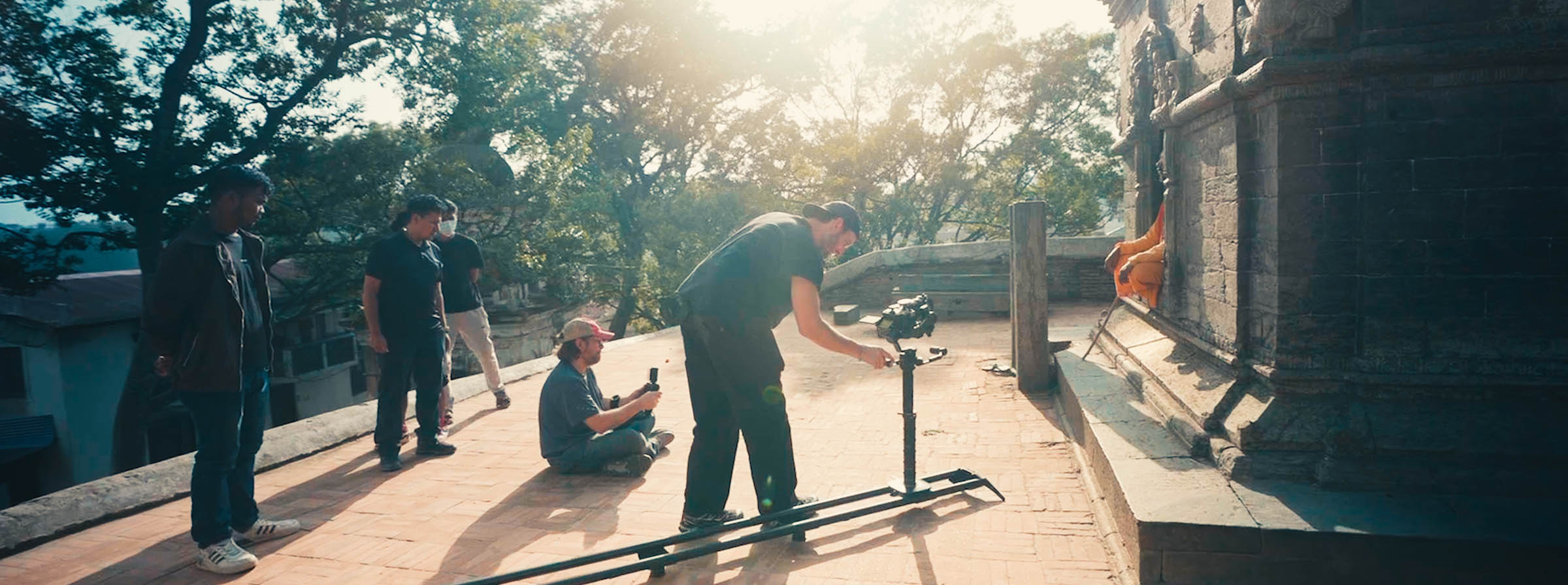
Eventually, I got four and had them rehoused at PS Technic. I wanted to have four: one fully rigged for handheld, one fully rigged on a gimbal, one on a drone and the other one on a slider. That way, when you decide to do a certain type of shot, you’re not slowing things down by swapping the lens on and off the cameras.
You just grab and go with whatever kind of shot you’re doing so you can go very fast.
Any other lenses?
No, that was it. I shot the whole thing with that Kowa 75mm anamorphic. I’m very happy with that lens. If it got stuck on the camera forever, I wouldn’t complain.
Does the Kowa anamorphic cover Full Frame?
Yes, it does actually. Open gate, full height. There’s a slight darkening toward the edges. It’s not vignetting, but I like that bit of character. It’s interesting because I didn’t really realize I needed open gate until I had it. Full height anamorphic squeezed two times onto the FX5 sensor covers more pixels than the FX3.
Does the FX5 have anamorphic desqueeze viewing?
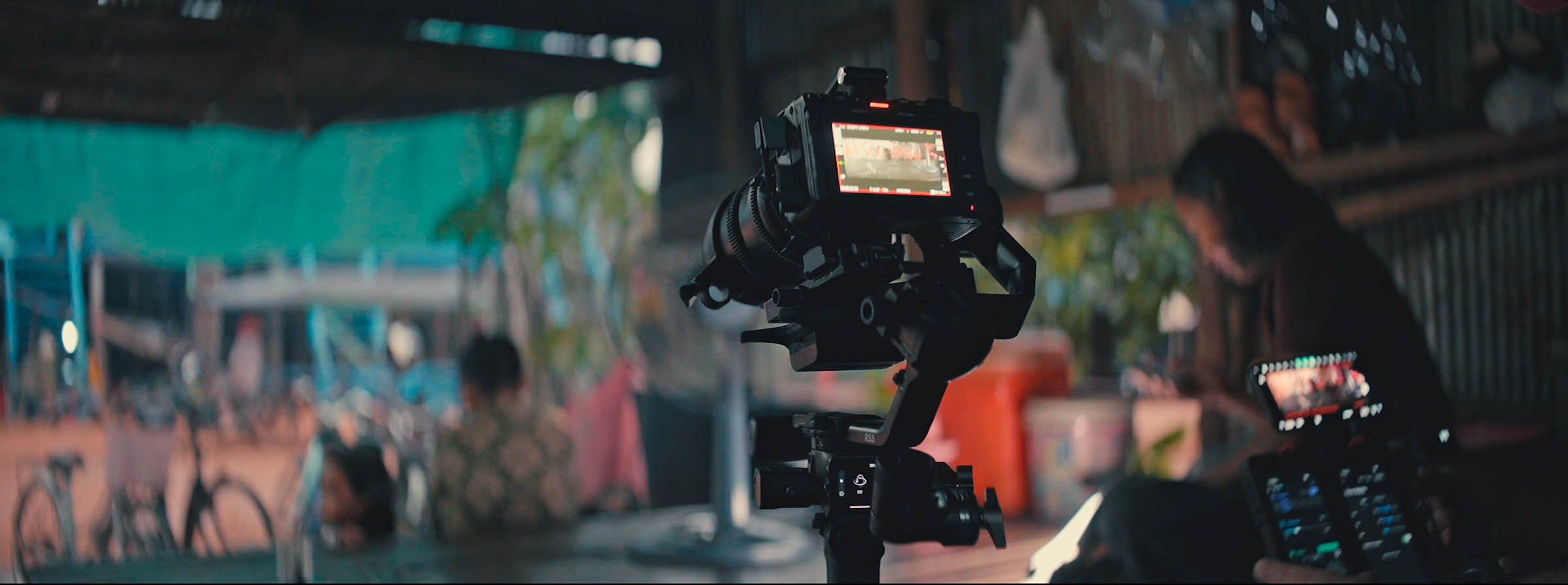
Yes, it has anamorphic desqueeze settings in the menu and also on the iPhone app.
Is there a story or theme to your film with the FX5?
No, it’s just me running around Asia looking for nice shots. It’s about the people, faces and landscapes. I don’t know if this will happen in time, but I would love to try and test some visual effects and see if I can make it blend in with the look.
I just call it a camera test for now. It’s a stack of footage, but dropped on the timeline, I had 24 hours of footage and now I’ve managed to get it down to about 12 minutes.
Are you editing it yourself?
I wouldn’t call it editing, but I’m just condensing and putting it in order and playing.
Are you grading as well?
No, we’re going to Fotokem. I already bought an analogicalab LUT off the internet that looks great with our FX5 footage.
Did you have a crew in Asia?
Not really. Jim Spencer was my producer. He was there when we did MONSTERS, JURASSIC WORLD: REBIRTH and THE CREATOR. Mark Bone was filming behind the scenes.
And then, in each country, we had a fixer—a local who would ask random people “Do you mind being in this documentary? We’re just testing a camera.”
So, you operated the camera yourself?
Yes, I operated the camera. And pulled focus as well, which is tricky when working solo.
What gimbal were you using?
The new DJI Ronin RS 5. It’s good because you press the button and it locks all axes. You can put it down or just lay it in a car without having to set it all up again, which is good.
How did you focus the Kowa lens with the FX5 on the RS 5?
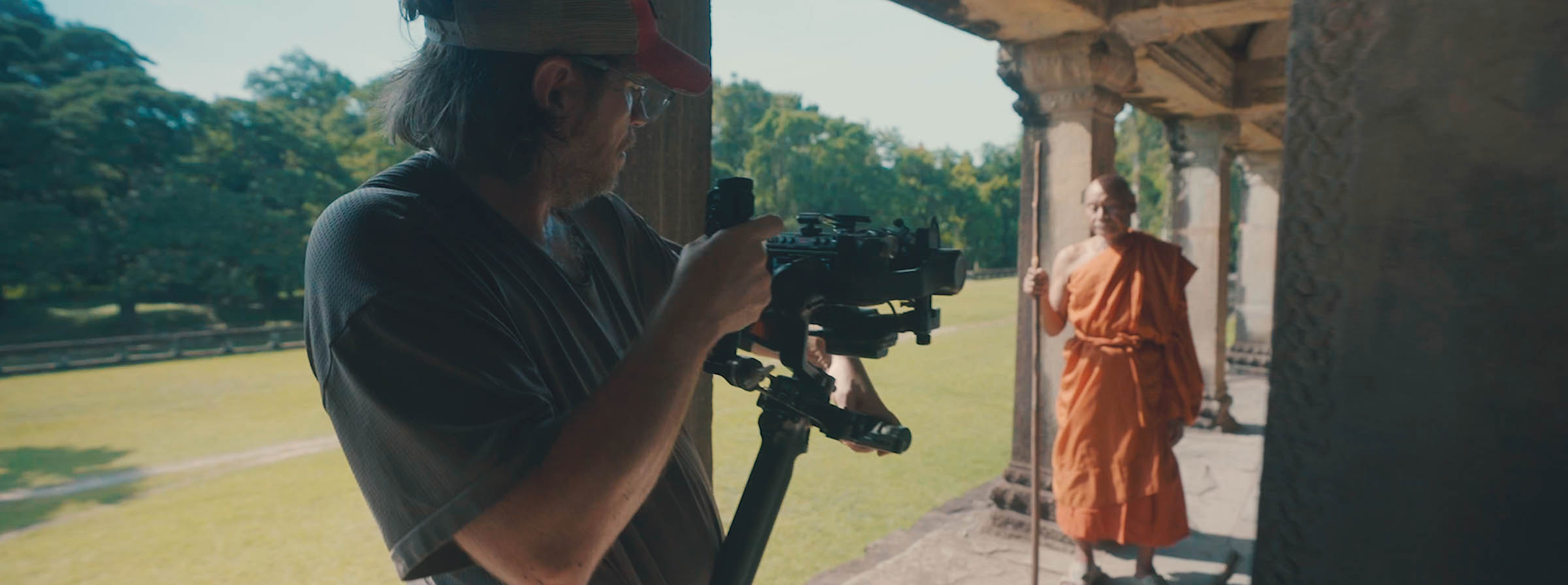
It was a bit of an expedition figuring out which focus system to use because I needed the control to be on the rear handle of the Ronin RS 5, but I also needed it to come off and work handheld.
I had three iPhones. One had the Sony Monitor & Control app setup. The second iPhone had an app to trigger a motorized slider. The third iPhone had the DJI Ronin app which [in conjunction with the DJI SDR Transmission Module] acted like a virtual joystick and remote monitor.
This was a quick way to hopscotch between smooth dolly shots and then a more verité style of working. You could film with the gimbal, then quickly pull off the focus handle, sit down and do dolly shots. And then, as soon as you finish the dolly shots, go back and reattach the focus handle for more gimbal work. I took the viewfinder off for the gimbal shots, but if I was going handheld, I definitely would use the viewfinder.
When you took the camera off the gimbal, were you still using the same focus motor?
Yes, the same Tilta Nucleus Nano II motor and Nano II hand unit.
For someone who tells me you’re not technical, you’re being very modest.
I buy a lot of equipment.
Meanwhile, back in Asia with the FX5, where were your locations?
We went to Angkor Wat in Cambodia, the ancient temple [built around 1113 – 1150 and now a Unesco World Heritage site] wher we filmed monks and local people in a stilt village.
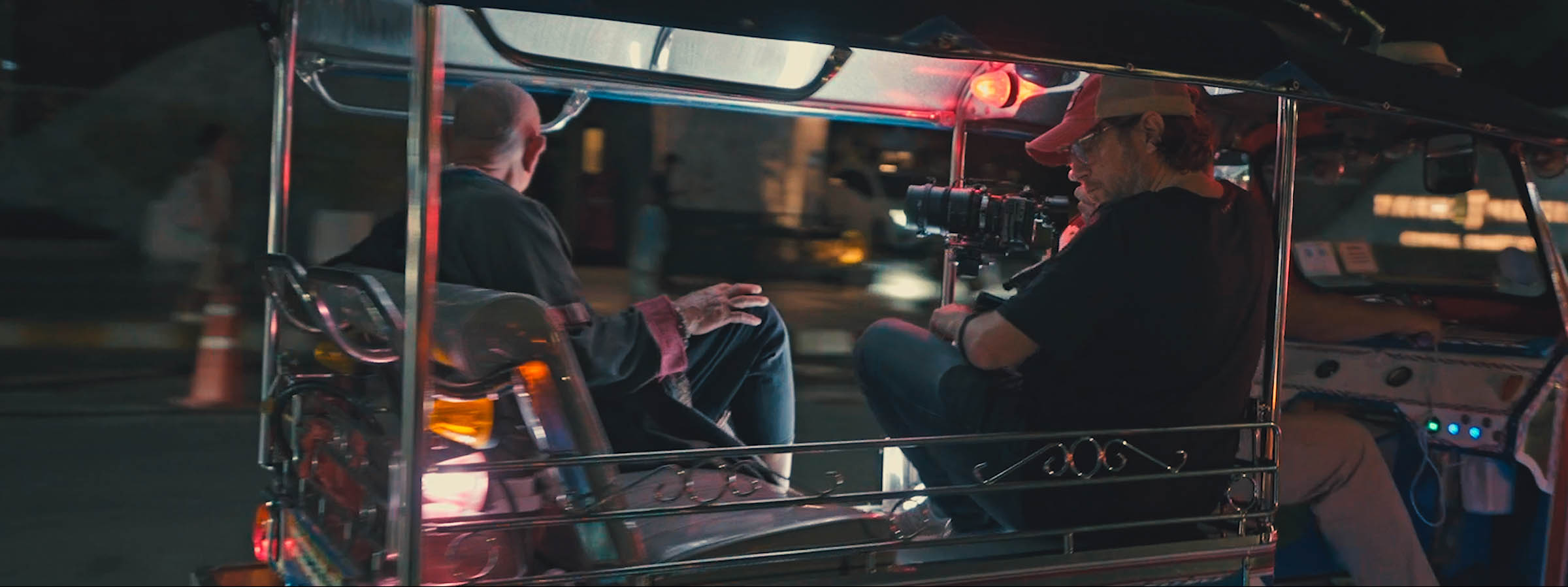
Then we went to Bangkok and shot in the city at night because I wanted to show the contrast between something ancient and something a bit more futuristic. We rode around on tuk-tuks through Chinatown and elsewhere.
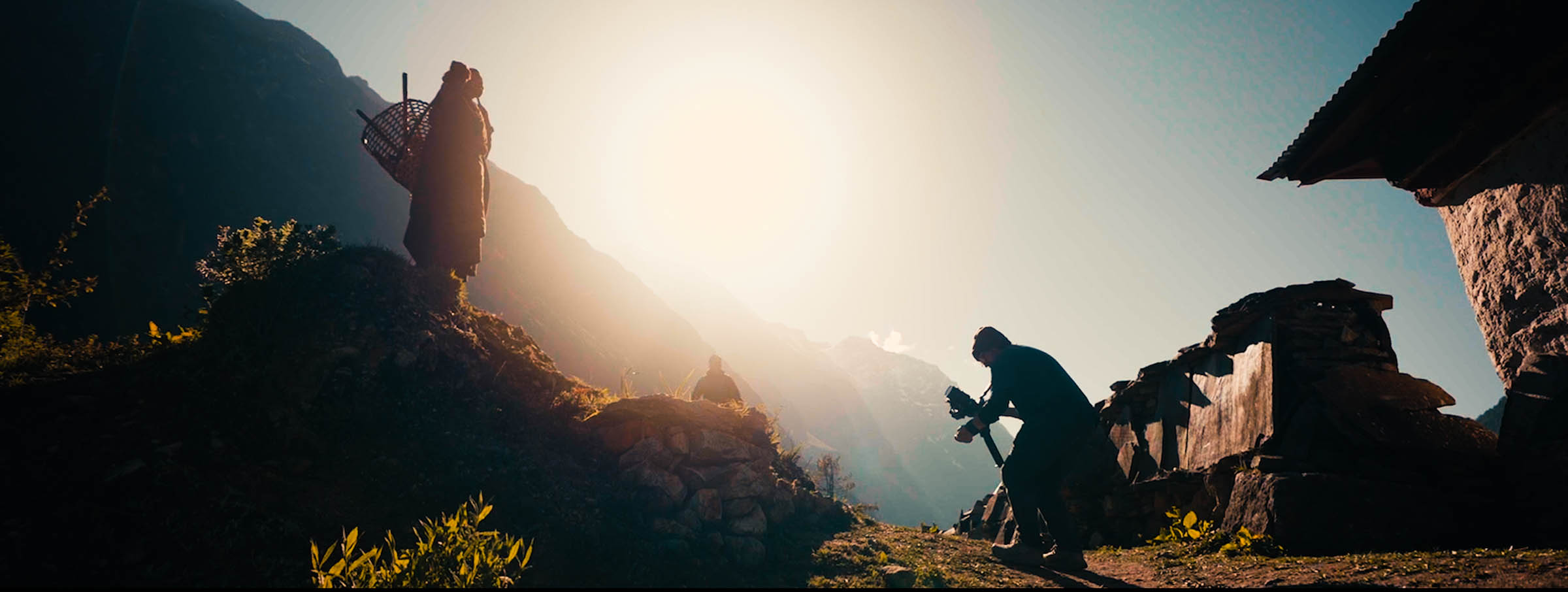
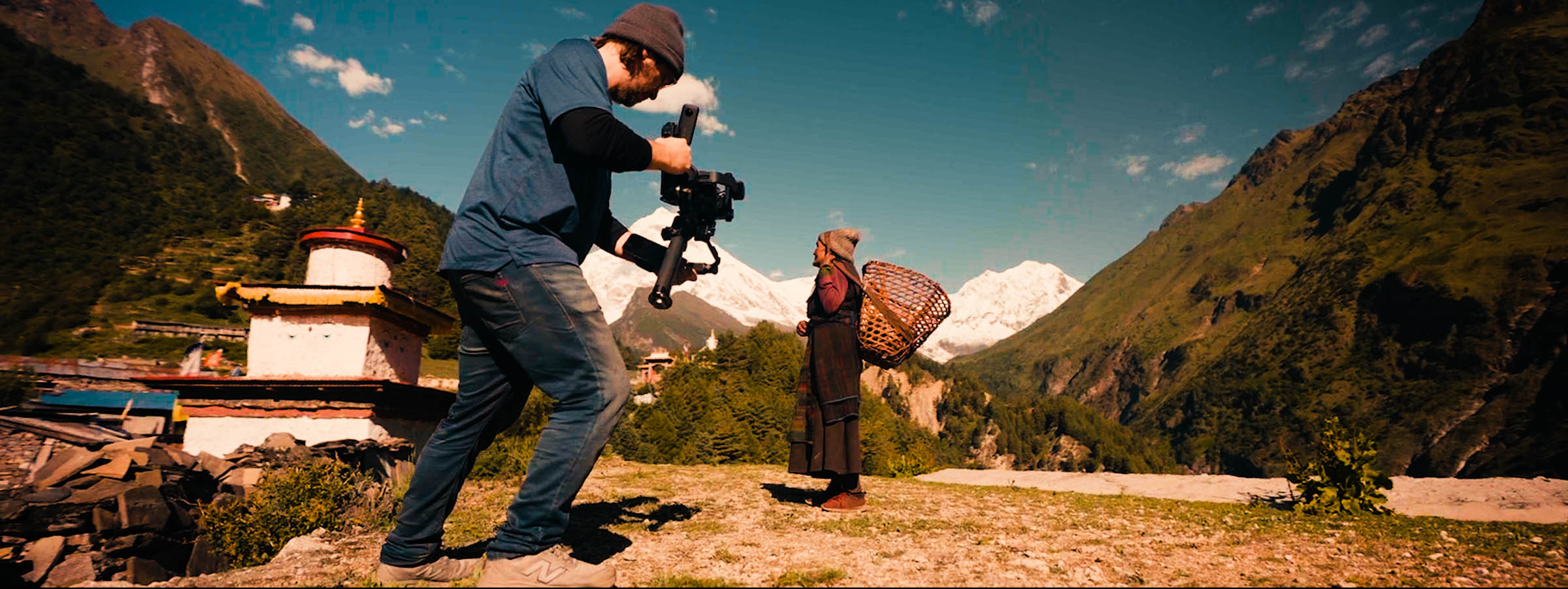
In Katmandu, we went to all the heritage sites, the main square and temples and then went up by helicopter into the Himalayas. We filmed in a monastery near Mount Manaslu [eighth tallest mountain in the world at 8,163 m]. It’s beautiful there and the people are amazing. We stayed the night filming interiors, villagers cooking, illuminated only by fire light with the camera at 12,800 ISO. The only lighting I took were some small, lightweight, bright, rechargeable Inkee Gold Crow Air 30W RGB LED fixtures. You can quickly inflate them and they are ready to go. I’d carry them everywhere from now on. But they were only used on occasion where you just wanted to see someone’s face a bit better. Quite often I was dimming them down to 2%.
How many cases of equipment did you have?
We had a rule: bring nothing you can’t carry up a mountain. Everything was in backpacks. There was a backpack for the camera and gimbal, a backpack for the slider. And there was a backpack we called assistant camera, which was basically batteries, filters and whatever else was needed. But we didn’t need very much.
Did you shoot internal X-OCN [Sony extended tonal range Original Camera Negative, 16-bit linear encoding].
Yes, we recorded everything internally in X-OCN LT. And the camera also recorded proxies simultaneously. That’s what I’ve been editing with.
Could this FX5 be your future “A” camera or would you use something bigger?
If I were doing my own movie, like THE CREATOR, this would definitely be my camera of choice. This is what I would shoot it on. If it was a studio film, I’d be showing them some of this footage.
Leading question: what defines a studio camera?
It’d be purely the cinematographer’s choice. It’s really about how you want to work.
I personally like to have the camera as small as possible with the least paraphernalia necessary to service it. The more run and gun it is, the less intrusive it is in the process of making a film, in my opinion. And so I gravitate to a small camera like this FX5. It has a massive sensor. Of course, there are always things you can improve, but I feel like we’re at a place now where people without massive resources can shoot something beautiful. It’s literally down to the artist.
The fact that you can shoot in available light and have it look so beautiful with so much latitude and with color science that you can bend to make it feel like film—I think the FX5 is going to be a camera to beat.
With its ease of use, there’s no big downside. If you ask someone to list the problems with it, I don’t know what they would list.
Maybe someone would nitpick, “Oh, it ‘only’ has 15+ stops of dynamic range instead of 17…”
But I’m always compressing the contrast anyway, crushing the dynamic range to a film look of maybe 8 stops anyway. You still have enough dynamic range to swing left or right if your exposure’s not spot on; it gives you confidence to have that leeway. But I don’t like the look of things when you can see a massive amount of latitude. I prefer a beautiful image that has more contrast.
It seems the FX5 resonates with you because of size, ergonomics and having a small crew—going into the mountains and all kinds of places with backpacks.
Also, when filming local people and local situations, you look more like tourists or YouTubers. People don’t bat an eyelid or stop you from filming. You don’t “infect” what you’re filming as much. The street can carry on, cars can move on, people pass by and you get a lot more naturalistic footage that way.
Are we being too enthusiastic in praise of such a small, affordable cinema camera?
What I really like about Sony is they’re not afraid to make the best cameras on either side of the spectrum and they’re willing to put all these features in a prosumer affordable camera. Logic would tell you to just save many of these features for the big, expensive cinema camera. The fact they’re willing to do this, and obviously the math must work out, makes it exciting because it democratizes filmmaking even more, which can’t be a bad thing.
Rhetorical question. If it democratizes film, does that hurt your future as a top-of-the-line, A-list director?
No, I’m all for it. I couldn’t be happier for some young person to come along and be successful. That’s what I was fighting for early in my career. We did a very low budget films to try and break into the industry. I find this approach very exciting. People are often scared and afraid to take risks on a movie. Anything that helps you take more risks and be more creative and swing for the fences is good for the art.
It is now about the artist and visual storytelling in that you can give the same camera to another person and you get very different results. It’s like providing pencils or brushes to artists. We’ve reached a point with the cameras where the main effort is up to the artist. The cameras are there and now it’s mostly about the person holding it, operating it, that is going to make the big difference.
You proved that with THE CREATOR. In film school, I assume you were influenced by the French New Wave?
Yes, we learned about it. The person who influenced me was the filmmaker Peter Watkins. I worked at the BBC and he was legendary as the first person really to do a faux documentary and make it feel real, getting naturalistic performances from people, feeling a strange hybrid between “this must be a documentary, but it can’t be because the story is absurd and impossible.” I love that blend between chaos and reality, where it looks like the actors in front of the lens are not blocked out and feel very naturalistic, but then the camera is doing something very considered that feels preordained. That marriage really messes with your head in a good way where it feels like you would never get it again, when a second take would never happen.
When I was younger, I often went to the Natural History Museum. Every year there was the Wildlife Photographer of the Year award. You’d look at all the amazing photographs and start to wonder what makes one of them the best. I came to the conclusion that the best ones couldn’t be repeated. It was a one in a million opportunity, but the more you can control the elements, the luckier you might get.
I like visuals, imagery and footage that looks like you just got lucky. I love that this FX5 camera can get you into the middle of a monastery in the Himalayas where you are so inconspicuous that the monks invite you inside the temple and they start a ceremony and I’m just walking around with my shoes off just getting these shots that normally would feel very intrusive, but I know that I’m not really bothering them because it’s such a small setup. I don’t need lights or anything. Then you get these little moments within a situation where it looks like they’re doing it for us. It looks like we’ve set it up, but we had nothing to do with that. We just walked in 10 minutes earlier as it was going on and things happened.
In some ways, it goes back to when you and I were in film school and cameras were small and light and you could run around doing cinéma vérité. It reminds me of young Raoul Coutard filming BREATHLESS with a small Éclair Caméflex camera and then in the opening shot of CONTEMPT he’s sitting on a dolly behind a massive 70-pound Mitchell.
It’s funny, these days, even with smaller cameras, there’s the desire by some people to start adding bigger batteries and all kinds of other additions and suddenly it looks like the silhouette of a Panaflex. And then, you ask, why did they go with the mirrorless camera in the first place? Surely the goal is to make it as small as possible.
How did you get into film?
I grew up in Warwickshire, which is the county that Shakespeare is from. I saw films like STAR WARS and ET and wanted to join the Rebel Alliance and become a filmmaker. I went to film school at Farnham in Surrey, but then I couldn’t get a job after graduating. My flatmate was studying computer animation at the same film school. It opened my eyes to the future of filmmaking. I bought a computer and started learning. The goal was that six months later I would go make a movie with this new technology.
Cut to 15 years later and I still hadn’t. I got massively sidetracked doing visual effects as a freelancer. That paid off because I could basically do the visual effects on a movie and make it look a lot bigger and more ambitious than it was. I made my first film for very little and we were very lucky it got in South by Southwest. Then, for reasons I can never explain, I was offered the GODZILLA film and that’s how it all happened.
Having worked with both cameras, how would you compare the look of the new FX5 to the FX3 in terms of images?
With the FX5, I feel that there’s more ability to bend the color, getting a little bit closer to film, especially with the skin tones. I didn’t ask for the extra resolution. I didn’t think I wanted it. But now that I’m looking at the 5K 1.5:1 image on a high res monitor, I wouldn’t go back. It’s not shouting out for your attention, but the area that your gaze gravitates toward has something about it that’s even more magnetic. It reminds me of my favorite movies when they’ve gone back to the camera negative and re-scanned it in higher resolution.
I’m not a camera salesman. The reason I was happy to do this demo film was because I would genuinely have bought the FX5 after it launched because of what it can do, because this could be the camera for my next film. Some other cameras get close, but none have such a small body with this big sensor, internal RAW and 12,800 ISO. Those are my checkboxes now.
But rather than talk about the differences between cameras, perhaps it’s best to consider the differences between the artists, the cinematographers. That’s really where the importance is now. It’s essentially down to the people, the artists.