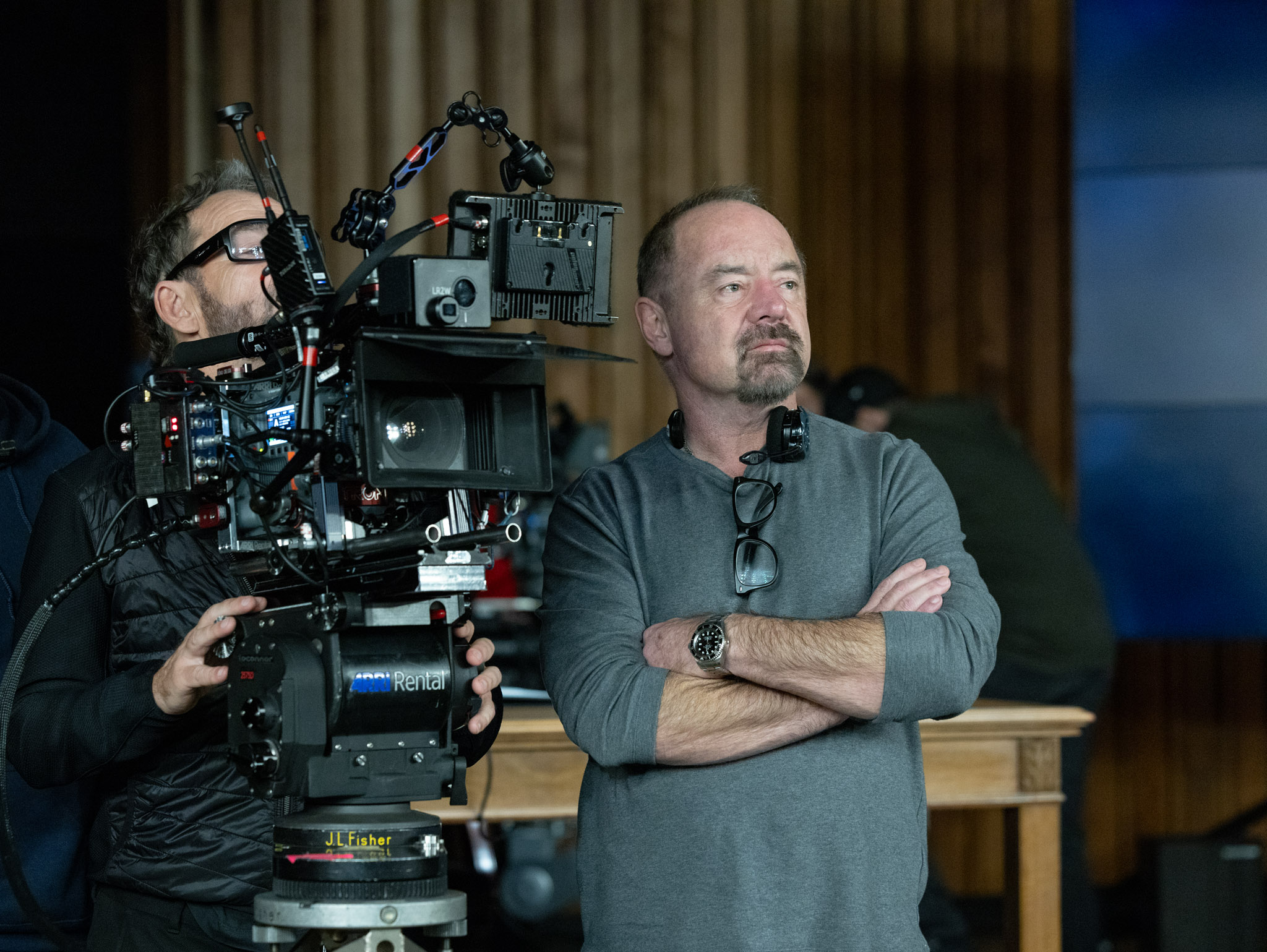
Jeff Cronenweth, ASC on THE SOCIAL RECKONING. RED V-RAPTOR XL [X] 8K VV camera, ARRI DNA LF prime, Preston Light Ranger, Teradek, OConnor, Fisher. Photo: Leah Gallo c. 2026 CTMG Inc.
Jon: Congratulations on THE SOCIAL RECKONING and your superb cinematography. How did you get started on this project?
Jeff: I’m kind of connected because I photographed THE SOCIAL NETWORK for David Fincher, which was written by Aaron Sorkin. Aaron was on the set quite a bit. That’s quite remarkable: to have the writer there every day, mostly to observe and watch David’s technique. Even back then, Aaron had aspirations of moving from writing into directing and wanted to be part of the whole project. A friendship and a collaboration started there. When he wrote and directed BEING THE RICARDOS, an amazing and fun project, he asked me to shoot it.
Then, 15 years after THE SOCIAL NETWORK, he wrote this. It’s not a sequel; it’s more like a film adjacent to the original SOCIAL NETWORK, and it’s called THE SOCIAL RECKONING. Since I photographed the first one, it made sense for him to reach out, and our collaboration kept growing. It was encouraging that David was on board and encouraged Aaron to direct it.
Then the conversations started. We decided to keep a few things from the original. There are a few Easter eggs and tips of the hat to it. But it’s 15 or 16 years later. Zuckerberg has been the CEO of one of the largest companies in the world by now. In our original film, he was still a college student, only a couple of years into Harvard, which is surrounded by brick buildings and dark wood dormitory interiors.
This film takes place in San Francisco, with more modern office spaces of glass and steel. It’s a much colder kind of story, too, and we wanted to embrace all those aspects. Our approach was slightly different from THE SOCIAL NETWORK. This guy has been in front of the Senate or Congress at least 20 times by now, and he’s been sued 10,000 times. He’s quite a different character than he was.
There’s that line where they ask his profession and he says, “Professional defendant.”
It’s a great line. In addition, on every project we’ve done together, Aaron has been adamant about becoming a more visual director in his storytelling. Writers sometimes get trapped in a box where the camera doesn’t move because they want to make sure you see and hear all the words. He didn’t want to be in that box. The idea was to push the camera movement, as long as it was motivated by the actors’ movement. Blocking became much more detailed and important to allow that. It gets challenging when you have eight pages of dialogue because you have to find motivated ways to create energy through movement without running out of space or direction.
What camera did you use on the original film, THE SOCIAL NETWORK, and what did you use on this one, THE SOCIAL RECKONING?
THE SOCIAL NETWORK was the first time David Fincher and I both embraced the digital format. It was the RED ONE camera with the new Mysterium-X sensor. We were the first ones with that new chip. One of David’s best friends is Steven Soderbergh, who owned two RED ONEs that had just been upgraded to the new sensor, so we borrowed his cameras to shoot THE SOCIAL NETWORK.
Of course, it was scary going into it. Soderbergh’s 2008 film CHE was one of the first RED ONE features, but ours was the first film with the new chip. The studios were nervous about digital. Nobody knew what the long-term outcome would be or how to preserve the material. If there’s a solar flare, does your investment go up in smoke? All those kinds of questions. After it was released, I was most happy when people didn’t know and asked whether we shot it on film or digitally. To me, that meant we had achieved something where the difference became imperceptible. That was a proud moment for us.
It has been the same number of years for us and for RED. On this one, it was the V-RAPTOR XL [X] 8K VV camera — the global shutter 8K VistaVision size sensor. I used ARRI DNA LF lenses with some special tuning. I love the ARRI DNA glass. It has quirky personality, artifacts and nuances that keep it from being just a pristine image. I thought it helped with the kind of tension we were trying to create. That, along with light and camera movement, helped support the visual story and the words.
What lenses did you use on the original SOCIAL NETWORK?
We used ARRI/ZEISS Master Primes (Super35 format). The RED ONE was barely a 4K sensor. The RED V-RAPTOR XL VV 8K sensor is bigger with more resolution, but it has the same kind of color science that I really appreciate. That’s what works for me.
You had Harvard and Boston night exteriors in the original film. SOCIAL RECKONING also has nights and dark interiors. How do the two cameras compare 16 years later in low light?
I think we were learning on the first one. It actually worked out because we were transitioning to digital from analog film. The latitude of the RED ONE with the Mysterium-X chip was something like six stops, which is a lot closer to trying to get proper exposure with a film camera. So we modeled it after film. I made one LUT and treated it like one film stock.
Now, with 8K resolution and at least 16.5 stops of latitude, it’s such a different beast. You go from wondering whether there’s enough light outside for night exteriors to asking how you can get the streetlights darker and turn off the signs and windows that now become problematic. If you don’t have control, you have to balance them so they don’t steal the scene, because your eye goes right to the brightest source.
My dad never got to see the digital revolution, but he said a long time ago, “It’s not what you light, it’s what you don’t light that separates the men from the boys.” That holds true today even more than it did back then. Now it’s a mandate, because the cameras are so sensitive. It’s a bonus, (because) you can get into the low end and see into the shadows, but it also creates new challenges.
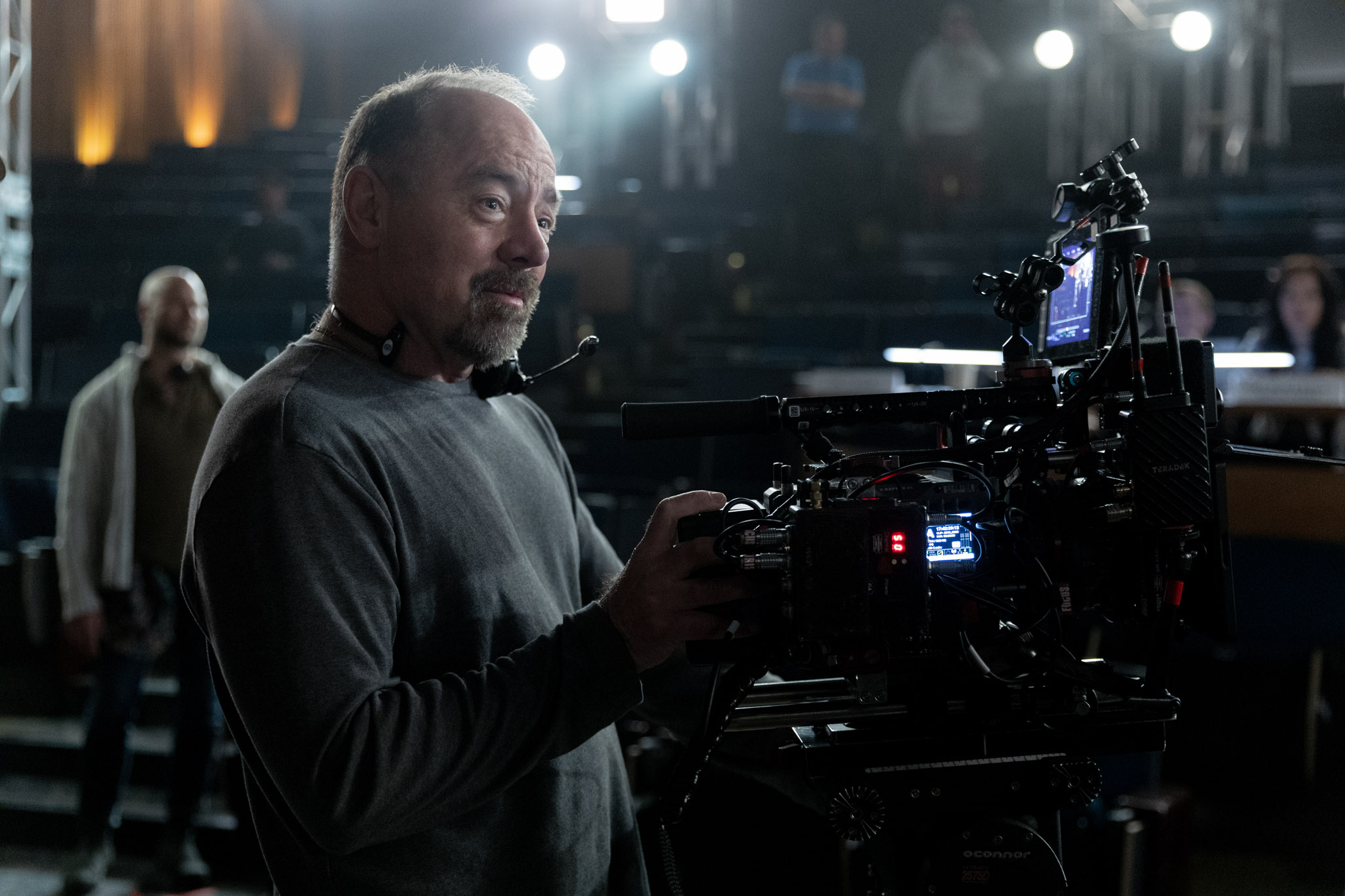
Jeff Cronenweth, ASC. Photo: Leah Gallo – c. 2026 CTMG Inc.
How did you rate the V-RAPTOR XL [X] VV?
I like to rate it at 800 ISO. Not on this particular picture, but often the DIT I work with will set it at 640 ISO to give me a slightly fatter image to manipulate later, instead of me pushing it to the boundaries and then regretting it. I’m certainly aware of it because I see it, but my mind is still processing 800 when I’m looking at the monitor.
With this sensor, I think 800 is an understatement. David Fincher has been rating it at 1280 ISO and even 1600 ISO on his last two movies, without using any noise or grain reduction. I really feel the sensors are probably underrated for how fast they are. I still carry a meter. I don’t take readings often. But when you’re pre-lighting without a camera they are very useful, I always find there’s a lot more there than my traditional meter leads me to believe. That’s a good thing, because you can light to a certain level and then take it away, which is a lot easier than trying to add light if you don’t have the proper tools with you.
You’re viewing the monitor, so you’re not operating yourself?
I did operate on the toughest ones, all of David’s films. I operated B-camera. Not that I “had to” — that makes it sound like a chore. As we all know, operating is one of the key jobs on any set, and it’s the most fun.
Best job on the set.
On those movies, David is meticulous, and everything is about putting the money up on screen. He appreciated the way I operated. He doesn’t want to spend money on things he believes are not essential. We don’t have a DIT or video playback. Also, when I’m shooting with him, I’m comfortable not being at the monitor all the time watching the images and compositions, because I know he’s focused on that.
On projects with Aaron Sorkin, I am with him at the monitor. Whereas David will see single pixel artifacting, or a pan that’s one inch too far to the right. It depends on whom you’re with, and on THE SOCIAL RECKONING, I needed to be at the monitors.
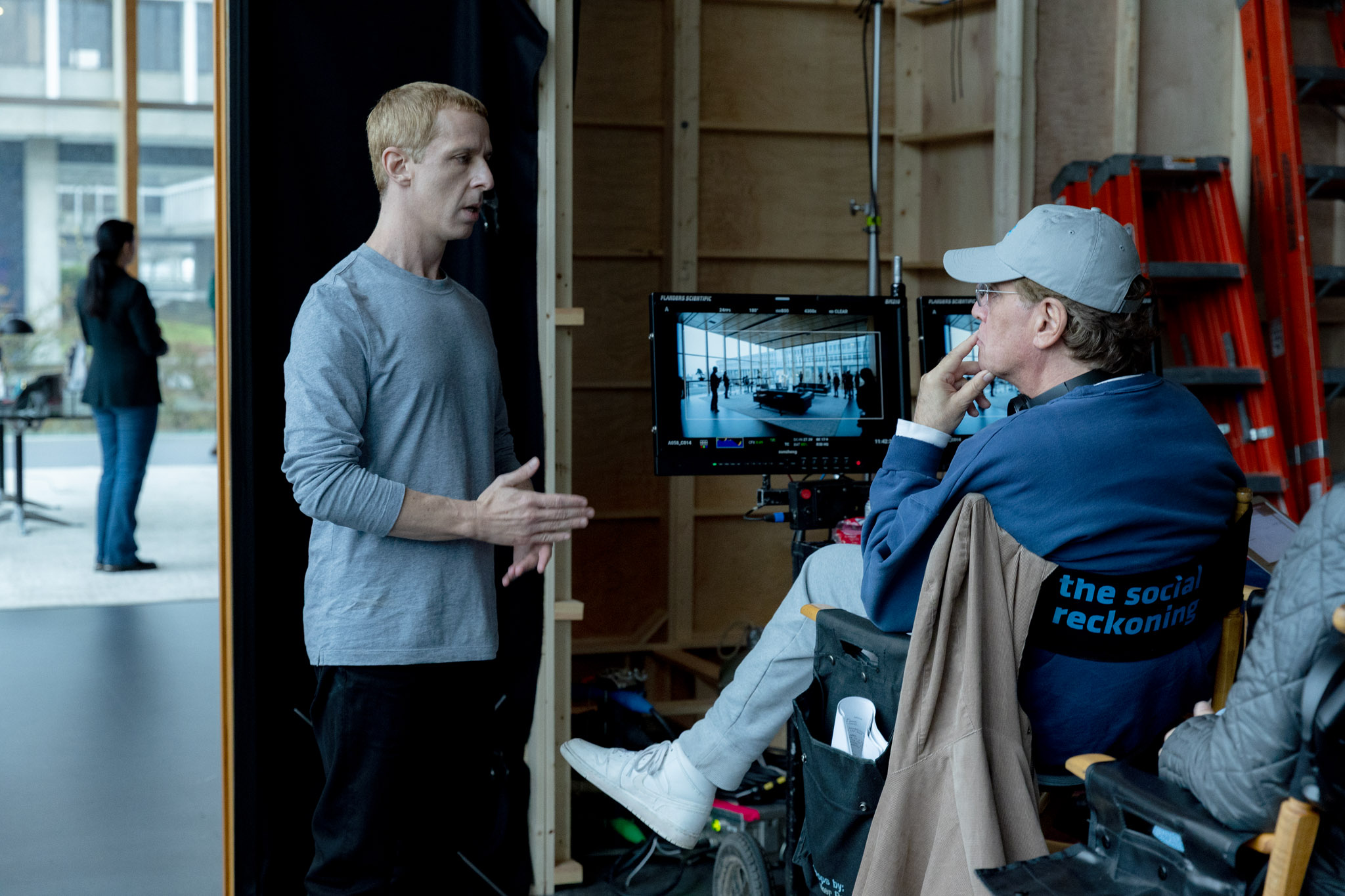
Jeremy Strong and Director/Writer Aaron Sorkin. Photo: Leah Gallo – c. 2026 CTMG Inc.
Were you and Aaron with the DIT or in your own video village?
Side by side. Sometimes we’re in video village, sometimes I’m in the DIT tent. It depends on what the location demands.
Were you viewing in HDR?
No. Regular SDR.
Tell us about grading.
Aaron has definite ideas about what it should be and what he doesn’t want, but a lot of it is handed off to me. That’s half of our job nowadays anyway.
The way it should be.
It’s the way it should be and the way it has always been, and it’s more important now than ever because of how much can be changed in a DI suite. It’s imperative that you get to finish what you started.
With all the tools now, you can make economic or time choices on set. Let’s say there’s an exit sign above everyone’s head in the back corner, and it would take 20 minutes or an hour to make it less bright. Or it has a small flicker that you can’t get to and a shutter change doesn’t stop it. That will take less than a minute in a DI session: put a window around it, make it darker, stop the flicker, freeze it in the background. Over the course of a movie, all those little things stack up and you’re deciding on set what to deal with. Of course, anything you can do on set is always going to be best. But sometimes the right choice at that moment is to do it later in post, in a much simpler, controlled and possibly more aesthetically pleasing way.
Good point. Who did the grading, and where?
Stefan Sonnenfeld at Company 3.
Did you develop a show LUT in advance?
I did. It’s funny. A few years ago, I shot the pilot of a TV show with the Panavision Millennium DXL, and we were doing the DI at Light Iron, which had done the original SOCIAL NETWORK. They gave me two choices. I picked the one I thought was more in my aesthetic world and right for that show. They said, “It’s your LUT from THE SOCIAL NETWORK.” I said, “Well, that explains why I’m partial to it.” So I started with that LUT on this film and made a few adjustments.
I’m simple. I pick one LUT. Obviously, if something special is happening, an out-of-the-ordinary sequence, you do what you need to do. But I try to limit it to one or two LUTs, like having two film stocks to choose from. That way, if something is green or magenta, I know it’s coming from a light source I chose rather than from a leftover LUT. It’s just a simpler way for me to look at it, like a single film stock.
The LUT you used on THE SOCIAL NETWORK still worked today on THE SOCIAL RECKONING?
With some modifications. It’s in the same world. The tonality is the same and so is the way it reacts to warmth, shadows and highlights. However, it has changed with the sensitivity of each camera, but it’s in that world.
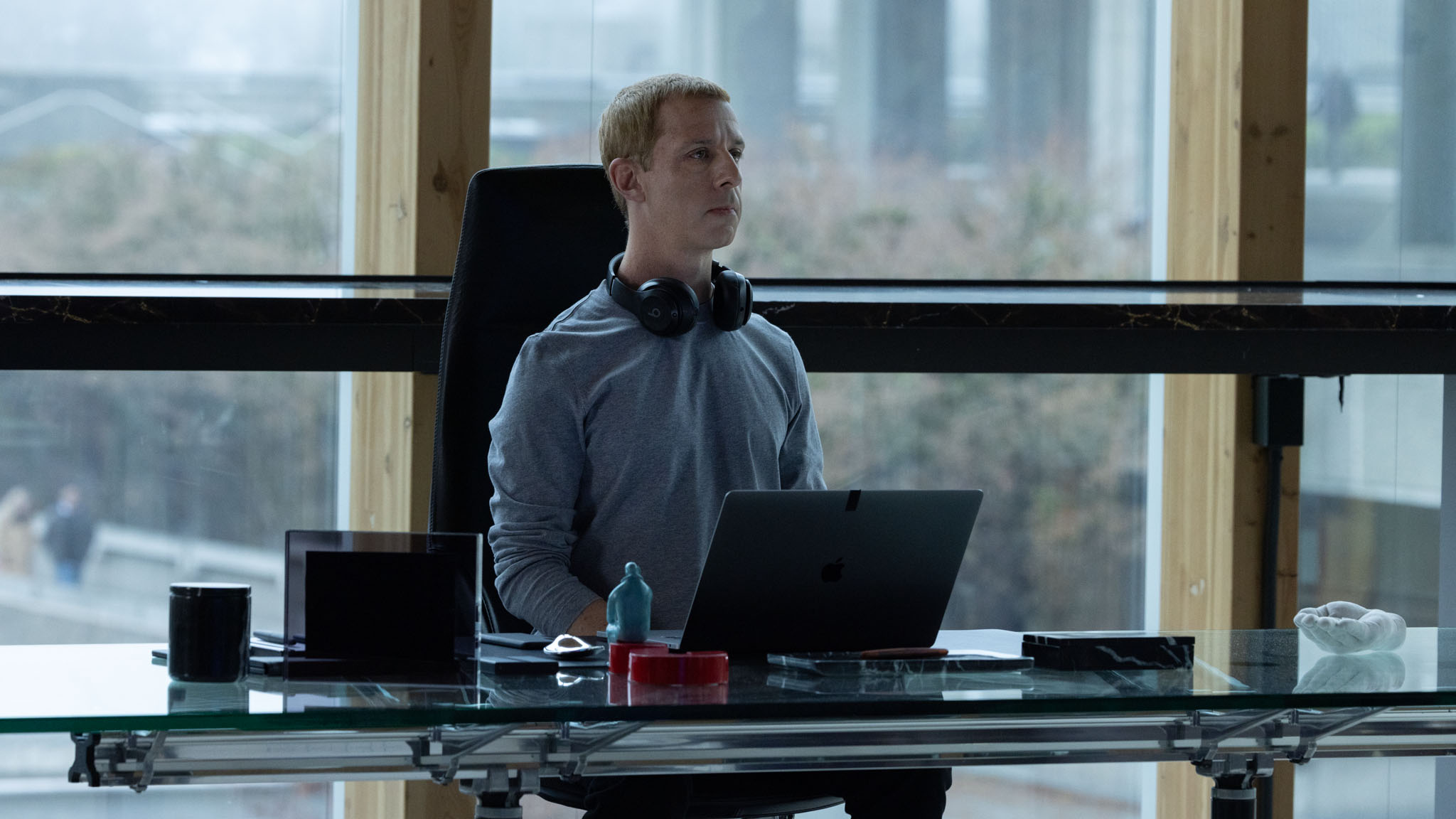
Mark Zuckerberg (Jeremy Strong) in THE SOCIAL RECKONING. Photo: Leah Gallo – c. 2026 CTMG Inc.
How would you describe that look?
There’s a warmth to it in the shadows that I really like. I thought it was so appropriate for the original SOCIAL NETWORK. It’s very flattering to skin tones. There’s a good deal of contrast, which is lovely. You have to control the highlights. When we started, I didn’t completely understand that. I thought that if something clips, it just clips. That’s not true. If it clips, it pulls your curve over and compromises the rest of the image. Mitigating that and managing blown-out windows was a learning curve, but super important. As the cameras get more sensitive and the latitude expands, that part gets a little simpler in terms of how much managing you have to do.
Did you have live grading on set for the Director?
We had our DIT there, so you can adjust on the fly and they’re seeing what you’re doing. I make nuanced adjustments, but it’s still the same LUT.
When you were prepping, did you and Aaron Sorkin talk about the look? What references did you have?
We started with the first film and talked about its evolution and the new locations. He wanted to push his visual storytelling further. He wanted me to go for it. We had some interesting opportunities. There are about 45 or 50 pages of dialogue in a rehearsal where they’re trying to simulate a Congressional hearing. It’s in a university amphitheater that is supposed to be on the Facebook campus. We worked with the production designer to turn a bland amphitheater into something visually exciting with tension. The idea of these work lights causing flares, backlight, shadows and edges, and people walking in and out of them, provided a really nice counter-look to the rest of the film.
There was some black-and-white material. When you’re telling a story with the passage of time and flashbacks, it’s been done a thousand different ways. Because this is so heavily driven by words and technology, we didn’t want to risk confusing the audience, so we thought black-and-white was a good, obvious delineation between present and past. We started off with a lot of grain, to the point where Aaron was pushing for it to be moving, almost boiling. The editor and I kept saying there was something not right about that. It was incongruent with the rest of the film’s visual style. During the DI, we showed different versions, including clean black-and-white with no grain or noise whatsoever. When Aaron saw it, he agreed 100%. We were all in unison that it was much more elegant and in the vein of the rest of the piece, so we went that way.
We also had a wonderful chance to do riot scenes. It’s not necessarily January 6th, but it alludes to those riots, and that was a completely different style and look. Aaron is known for heavy dramas with a lot of exposition. The first day of the riots was also our first day of production. We had smoke, handheld camera movement, action, people falling over and fighting. At the end of the day, he looked at me and said, “Now, I’m an action director.” He was excited about it. It’s not something he’s done very often. He did it in THE TRIAL OF THE CHICAGO 7, which had some rioting as well. But this was a new incarnation of that, and it was really fun.
Going back to your original question about references, I sent Aaron clips and stills of ideas. For the riot scene, I sent him the storming of the beach in SAVING PRIVATE RYAN. I wanted to introduce him to the narrow shutter and show him how that staccato can create more tension, especially since we were building it around a small area without many extras. We had to make it feel larger than life and create the tension, and that was one of the techniques we used. For the black-and-white, there were a whole array of references.
Your RED V-RAPTOR XL [X] VV camera has a global shutter. Did that change your approach to the narrow shutter angle ?
Jeff: The same principle applies. In fact, a global shutter can produce an even more precise, aggressive version of the effect. You get the staccato and the absence of motion blur. I even went down the path of step printing: shooting at six frames per second and then printing back to add frames, which gives you motion blur. That seemed a little too heavy for what we were trying to accomplish. But the narrow shutter and some different off-speeds came together nicely.
How did you do the black-and-white: in camera or in grading?
Jeff: On this picture, we did it in grading. On BEING THE RICARDOS, also with Aaron, I used RED Monochrome cameras for all the broadcast footage of the I LOVE LUCY show.
Where was the Congressional hearing rehearsal location?
The whole picture was shot in Vancouver. That was one of the public museums in the middle of downtown. With some smoke, clever angles and a few false walls to give us perspective, it came together really well. Everyone was very excited about it.
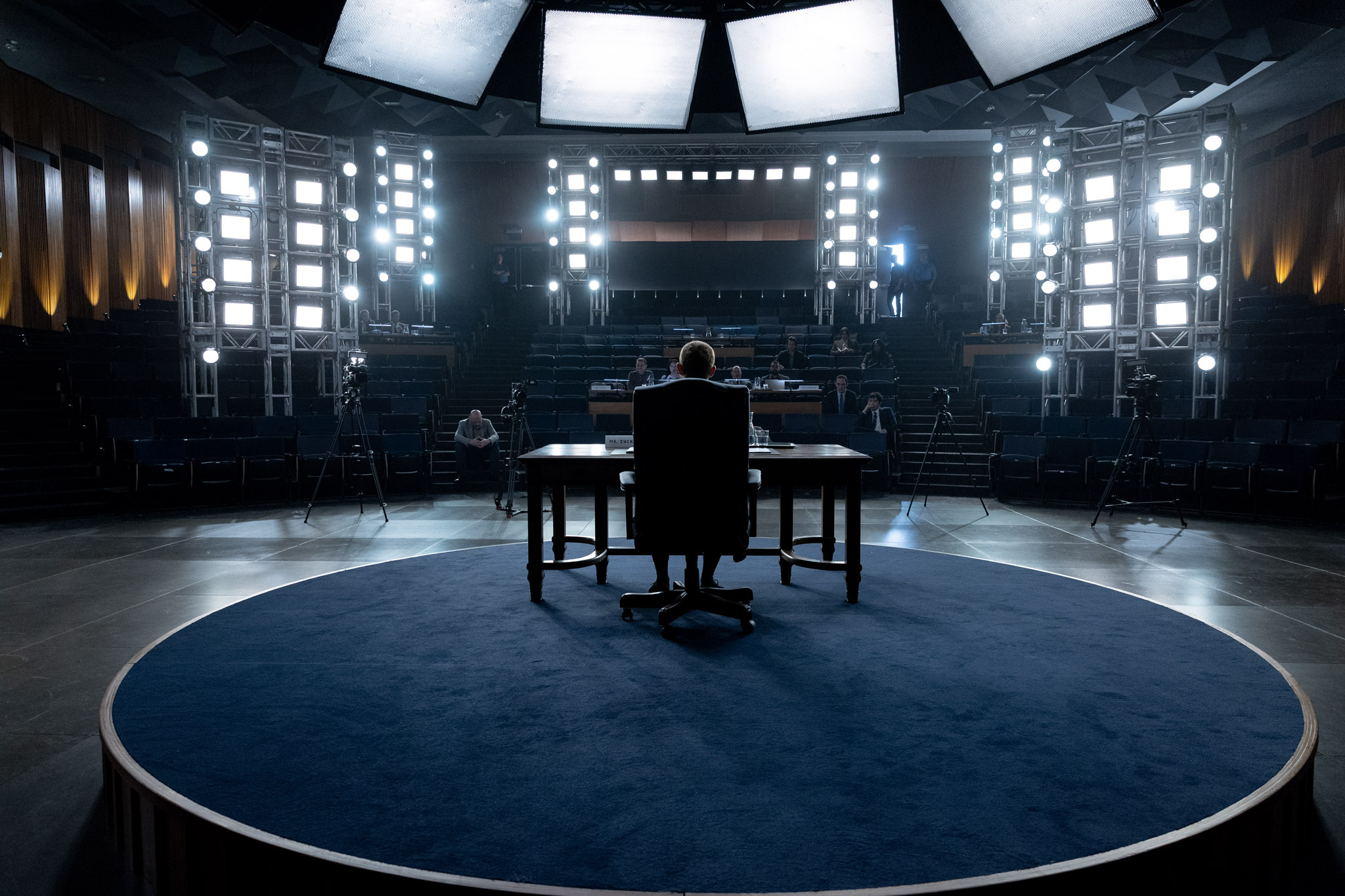
Mark Zuckerberg (Jeremy Strong) in Congressional hearing rehearsal. Photo: Leah Gallo – c. 2026 CTMG Inc.
Let’s talk a little about lighting. How did you light the rehearsal scene?
I had a rough sketch of the actual Senate hearing where Frances is testifying. We wanted to take elements of that so it would make sense as a practical rehearsal. You’d want it to have some of the same characteristics so that Zuckerberg is more comfortable. So, we built towers in the amphitheater and added hard lights, and we tried to light mostly with those hard lights. Then we staged and blocked the talent so they’d be in and out of those hard lights, with edges and a lot of silhouettes.
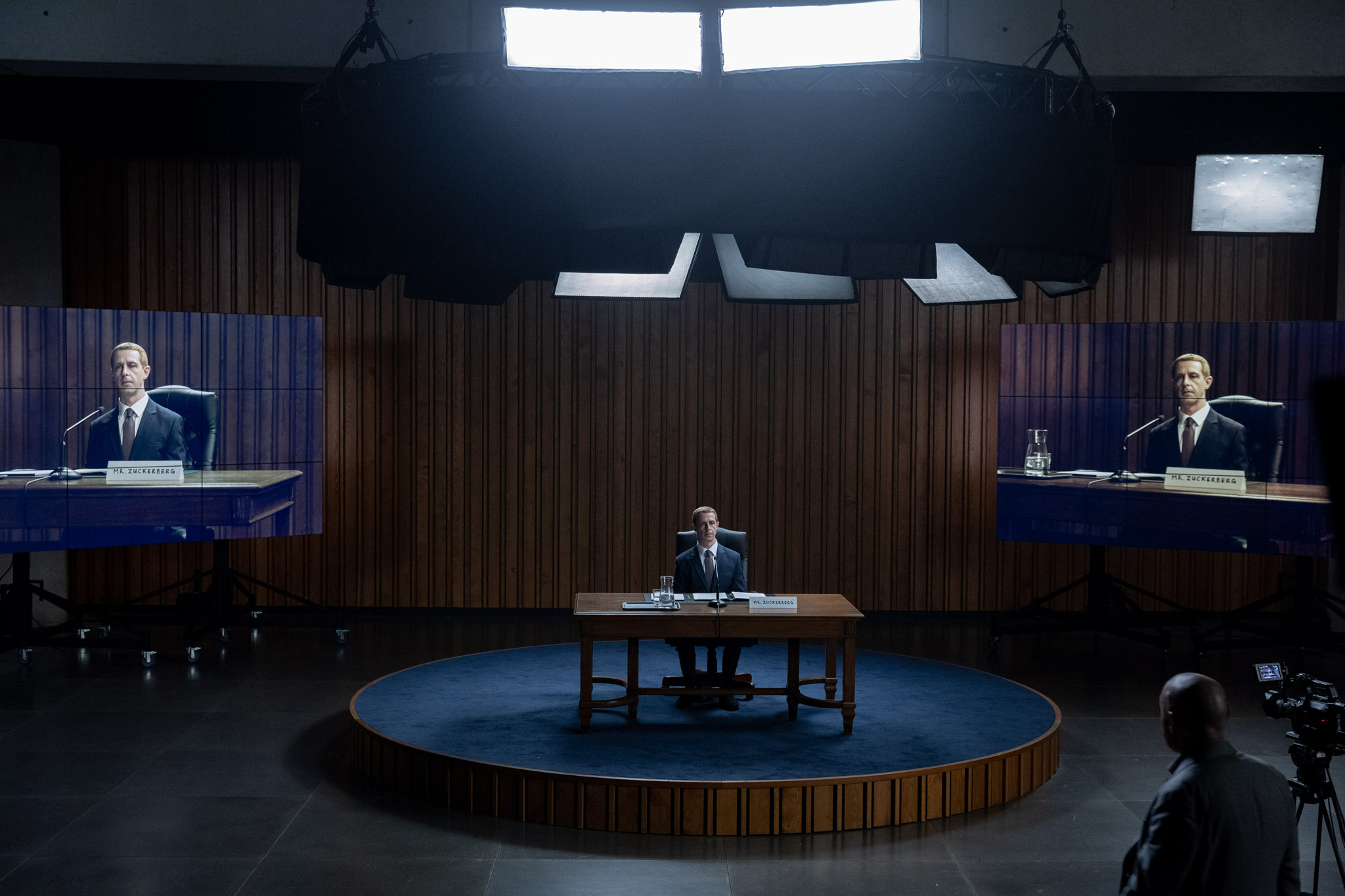
Photo: Leah Gallo – c. 2026 CTMG Inc.
There are some very intimate, heated conversations in that room: Bill Burr and Jeremy Strong going at it head-to-head, and then they come out of the shadows. It proved to be a visually interesting, tension-building part of the film. We had to do so much in there. I needed something that would break it up and still carry the weight of everything else in the film.
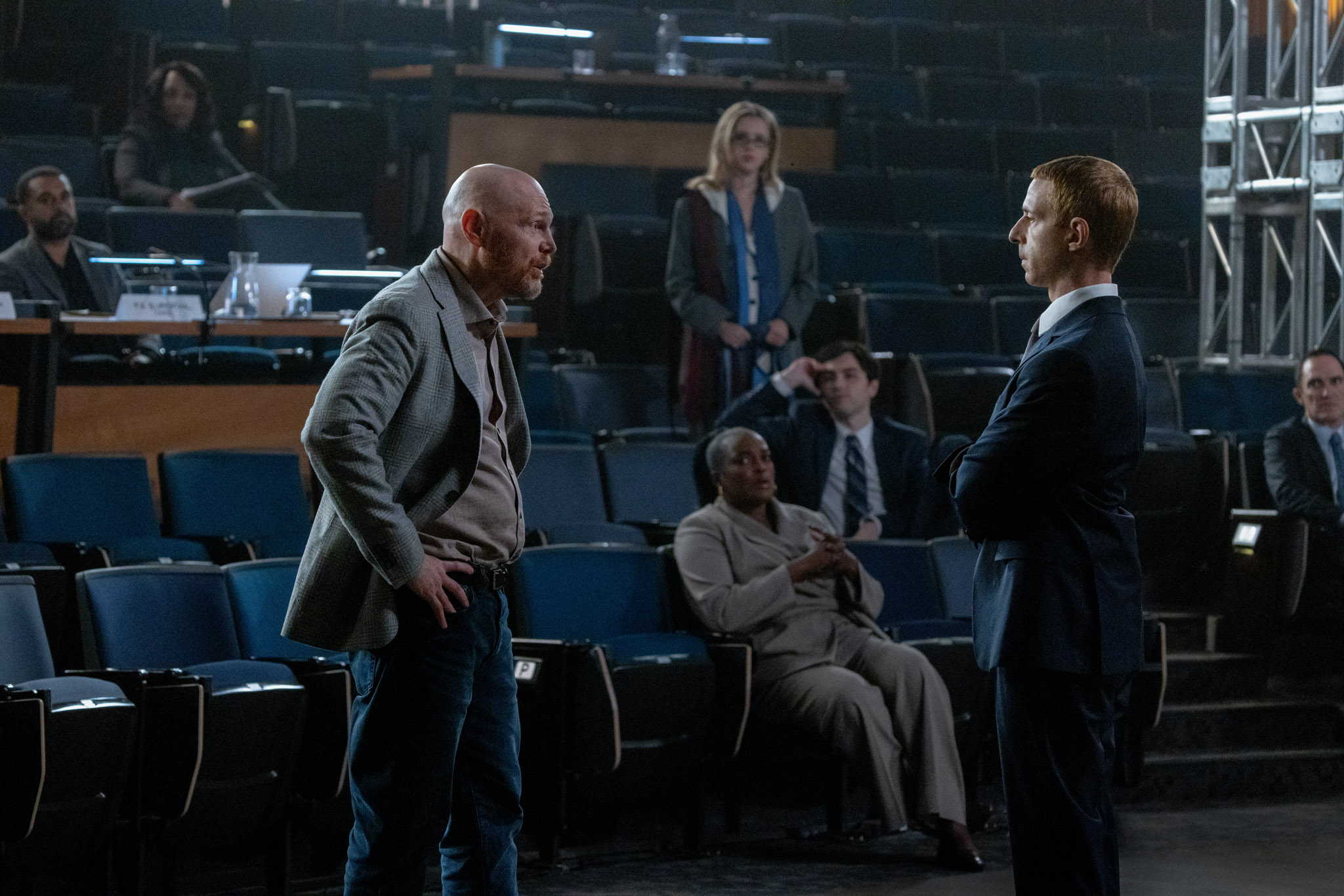
Charlie Garrity (Bill Burr) and Mark Zuckerberg (Jeremy Strong). Photo: Leah Gallo – c. 2026 CTMG Inc.
How did you keep it so dark? You see projectors that are like practical spotlights.
They are. I tried to shoot into them all the time. Because Zuckerberg was sitting in the middle of the stage, I did a medium-soft wrap around him with soft lights that simulated what a newsroom would have. If you’re really watching, you can see that the source moves around sometimes, depending on the camera angle. It was an interesting and fast way to work. Sometimes I had to see the whole place and sometimes we needed to get right in. Rather than light from afar, I decided to incorporate it all into the scene. That freed us up to wrap the camera around and look wherever we wanted, so we could make the moves better without worrying about lighting units being in the shot.
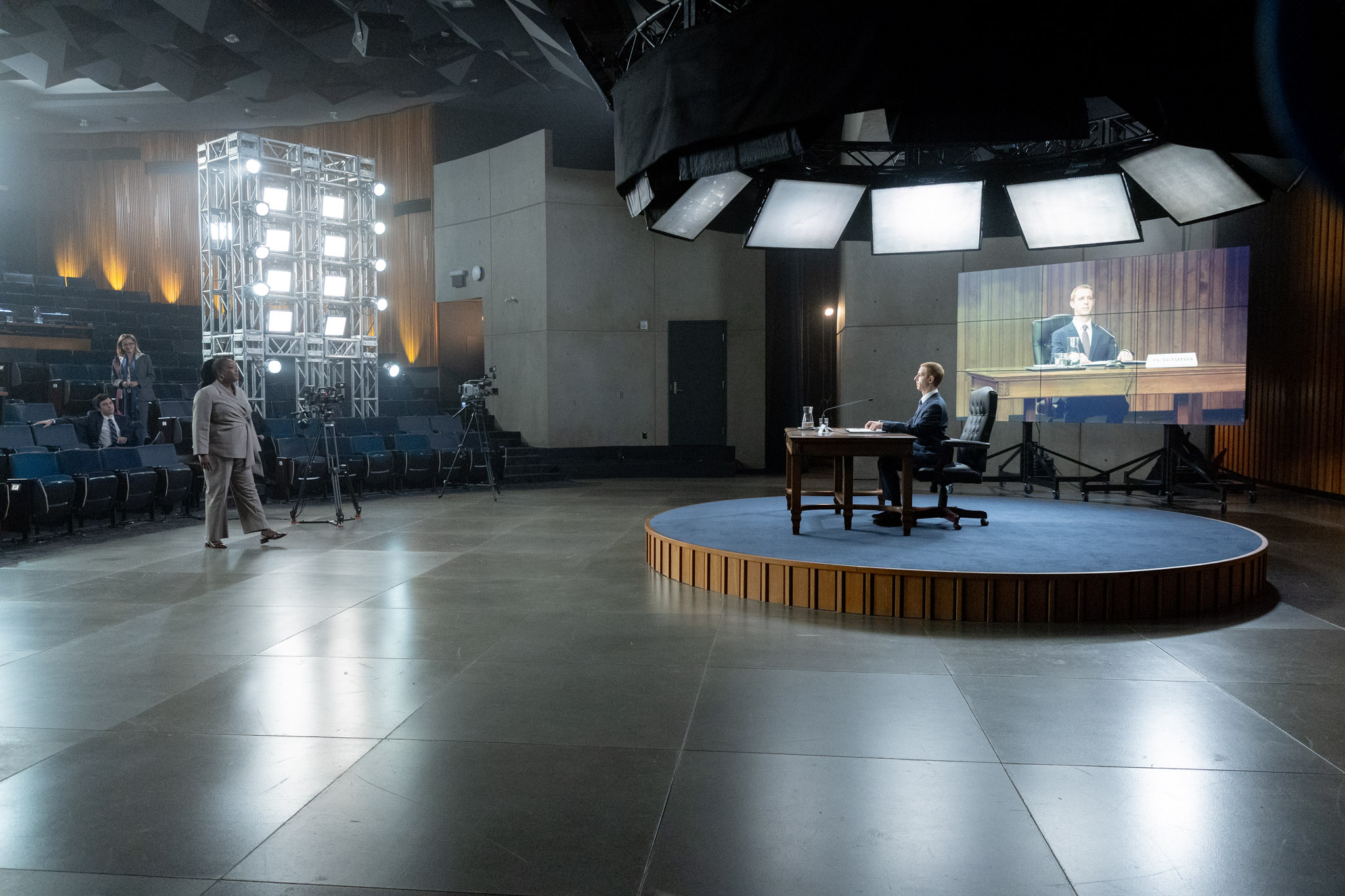
Raya (Wunmi Mosaku) with Mark Zuckerberg (Jeremy Strong) in Columbia Pictures’ THE SOCIAL RECKONING.
For sure, it was lit beyond that. We’d pick one corner we weren’t going to use, and that would drive the fill. The rest of the theater was ready for us to wrap around, follow characters and keep the camera moving as much as they did.
The soft lights on Zuckerberg are on the floor and in the shot? Or are they hanging.
They’re hanging from a truss in an array, all art-directed as part of the stage.
You were probably wide open. Your camera assistants must have loved you there.
They didn’t. But our camera is so fast. Like I said, I kept it at 800, but 1600 would easily have been fine if somebody needed a little more depth of field now and then.
Who were your focus pullers and crew?
I had more or less the same team I had on TRON: ARES, which was a year and a half earlier. Dan Morrison and Alex Martinez were the A and B camera 1st ACs. The A camera operator was Lucas Bielan, who came with me from LA. Sasha Proctor, from Vancouver, was the B camera and Steadicam operator. Same gaffer, Stuart Haggerty. Troy Sabotic was the key grip. The production designer was Jon Hutman. Aaron likes to keeps the same family around him.
How did you move the camera in general, and in particular in that rehearsal room?
There are two parts to that question. The first is the relationship between Jeremy Allen White’s character, the Wall Street Journal reporter Jeff Horwitz, and Mikey Madison’s character, Frances.
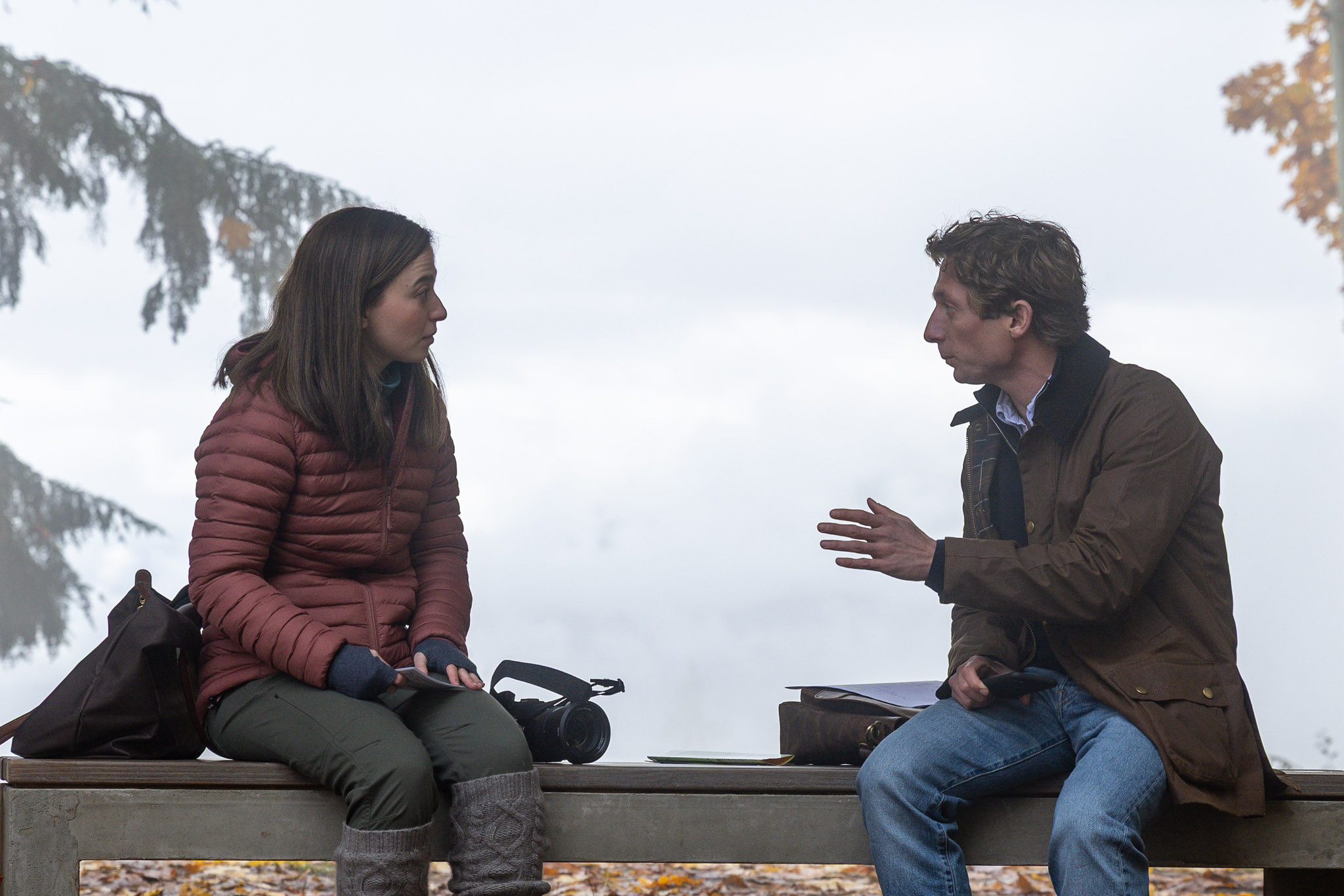
France Haugen (Mikey Madison) and Jeff Horwitz (Jeremy Allen White). Photo: Leah Gallo – c. 2026 CTMG Inc.
The first time they meet is in a park. I kept the camera back and started some of the shots through branches. We were very observational. She’s so afraid of being caught and trying to be mysterious. There are many Facebook employees around, so I wanted it to feel like there’s a third person watching to add some mystery.
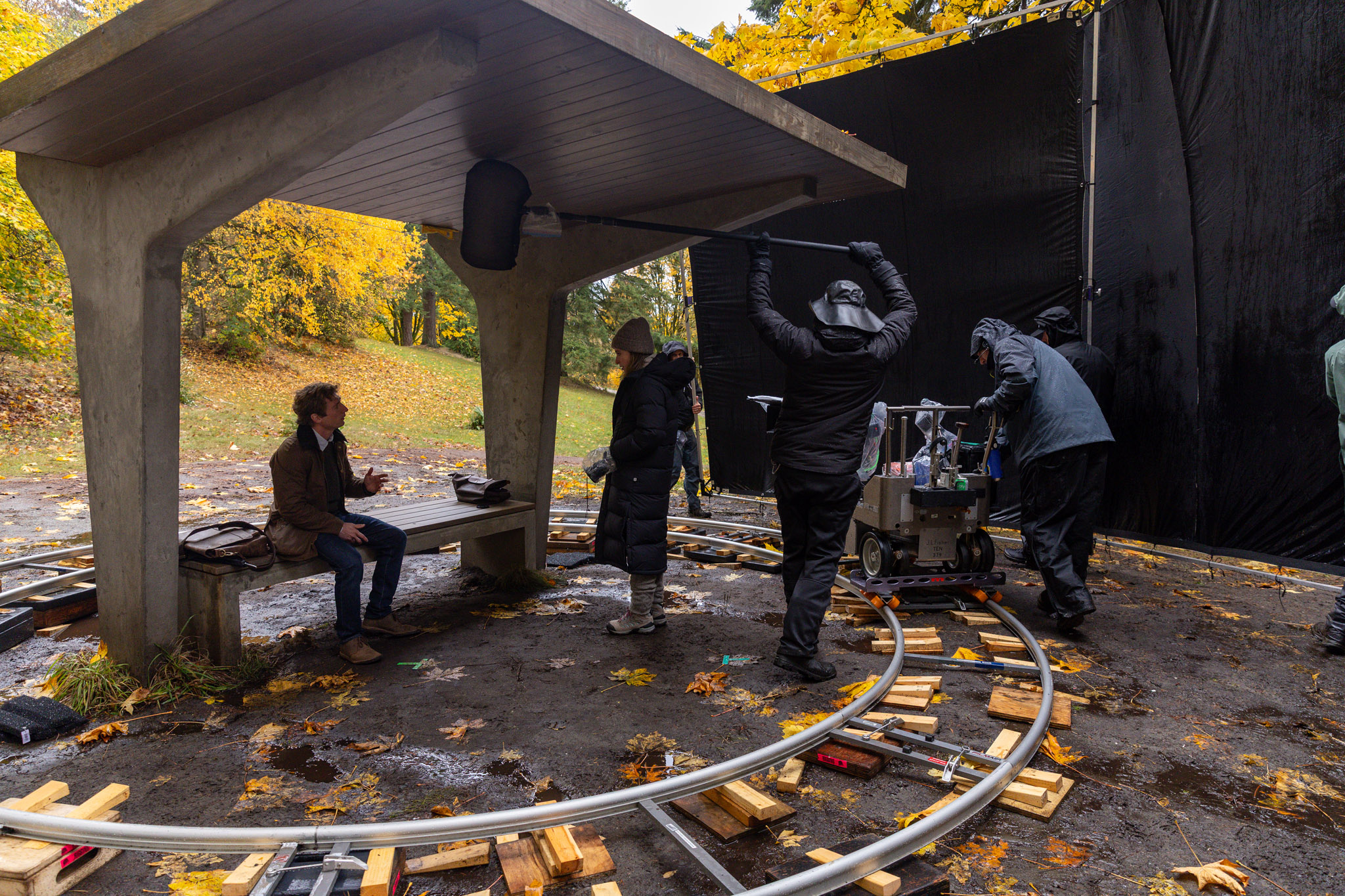
Circular track. Photo: Leah Gallo – c. 2026 CTMG Inc.
The second time they meet, we did the scene on a circular track and kept going. We’re in different places at different times, and they weren’t always good frames. They were a little awkward sometimes. That continues throughout the entire movie until the end, when she testifies and he grabs her hands. The camera stops, it’s the closest they’ve been, their guard is down, and the camera resolves with them. That was their language and the evolution of it.
The rest of it was more practical. The January 6th-style riot material was always about keeping the camera moving: handheld, energy, high intensity.
Steadicam or just handheld?
Some Steadicam, but in those scenes it was more handheld or riding the dolly handheld. Lots of energy. There are other scenes, like the black-and-white flashbacks where they’re arguing about whether to do this, and Mark says, “I want to monetize it,” with back and forth whip pans that create tension and energy.
We used a Technocrane quite a bit. We had one on stage with us and we always had a Steadicam on call. We did a long walk-and-talk on the beach. We started with the notion of laying platforms down and using a Technocrane on a base we could drive on the sand. That worked for about eight feet, and then it got stuck. They quickly brought in more platforms and built it up.
There were about six pages of dialogue, maybe more. When I originally scouted it with the production designer and the AD, we figured a minute per page, so you’d walk for six minutes. That’s half the beach! I had planned all this elaborate coverage for a sequence that long. When we scouted with Aaron, he said, “No, there’s a pause here, and three pages, then a pause here, and three pages.” It became a little less than the length of a football field, which is much more manageable. We used both Steadicam and the Technocrane, and they played off each other nicely.
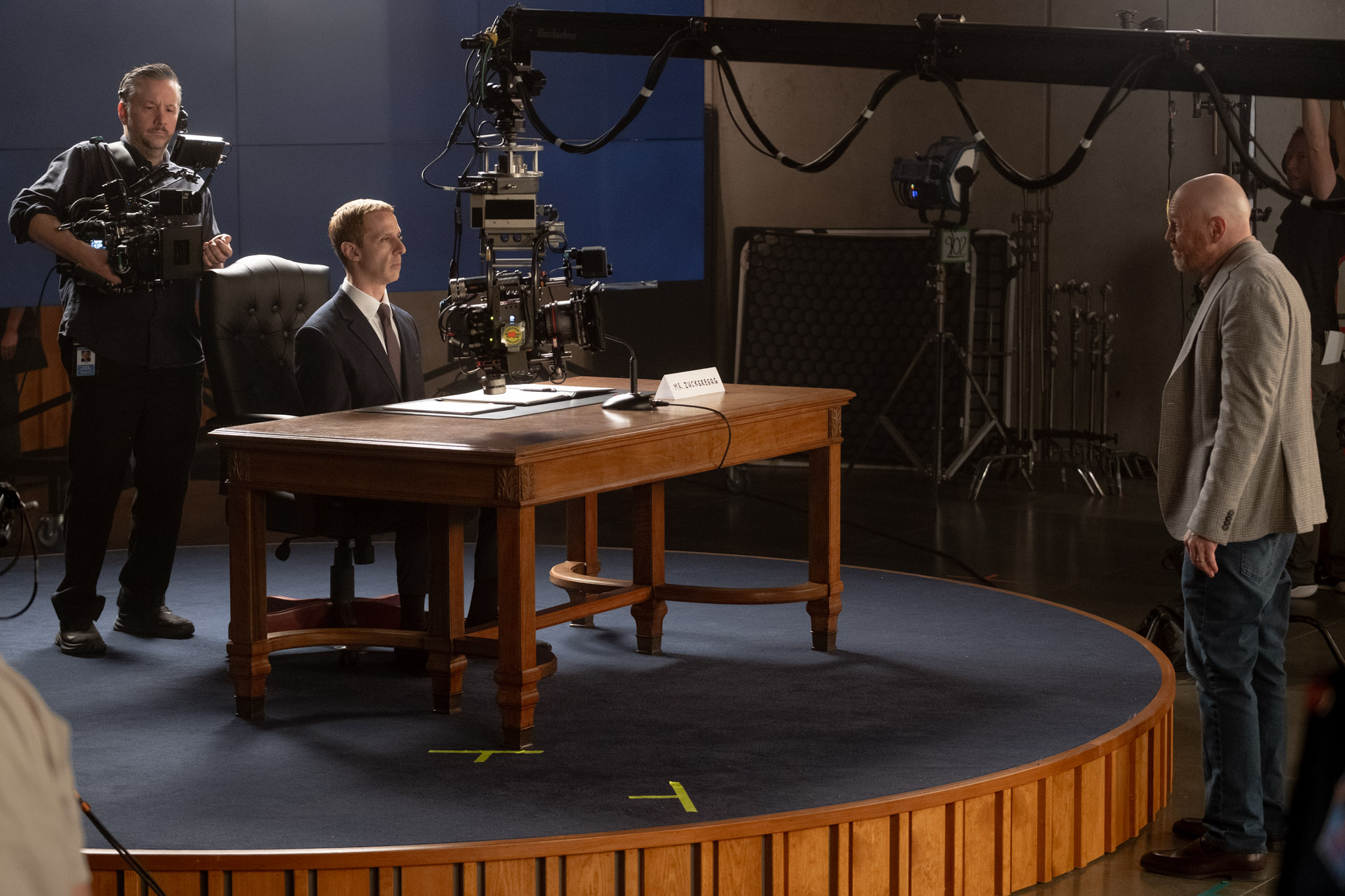
Steadicam and Technocrane. Photo: Leah Gallo – c. 2026 CTMG Inc.
How many cameras did you have on the show?
We had three, but we rarely used all of them. We did during the riots and during some coverage in rooms with multiple cast members and cutaways. But it was predominantly a two-camera show.
Do you often shoot two cameras simultaneously?
Always. Fincher and I started doing that on FIGHT CLUB and it’s embedded in my head. Obviously, for lighting, the ideal scenario is one camera. But in the interest of being (responsible) economical and getting additional coverage, if you stay relatively close to the same line, the compromise is minimal. You can also help things match in the DI. Shooting with Aaron, the coverage isn’t as prescribed as with Fincher. Aaron tends to take a simpler route and I want to support him. I want him to have more rather than less in the cutting room so he many options. Therefore, two cameras proved really useful for us.
A few reviews were not kind. But, I thought the film was terrific and extremely well directed.
I did too. The first one is now considered a masterpiece. People had it in their minds, almost before this one was released that it would not live up to the first one. They came up with some odd rationales. People were also disappointed that Jesse Eisenberg wasn’t going to play the role again. Think about it. Zuckerberg is such a different person at this point in his life. And I thought Jeremy Strong’s performance was solid and good.
It’s also a daring movie at this point in history. It took a lot of guts from all of you.
Absolutely. It’s a David and Goliath movie. You are going up against the giants. I feel the majority of traditional reviewers or critics were pretty kind to it. They had their creative criticism. What’s interesting to me is what has changed over the years. When you get beyond The Hollywood Reporter, The New York Times or Variety, and more into the internet, those critics are competing against so many other informal critics who aren’t part of the big outlets. The only way to stand out is to get clicks, and the way to get clicks is to be outrageous. So they’re motivated to be more personal and vindictive. Siskel and Ebert would give you critical commentary, but they wouldn’t tell you not to go see a movie. Now these people are saying, “Don’t see this.” My question to them would be: if we don’t go to the movie theaters, there won’t be any movies left to critique. Let people come to their own conclusions. If you don’t like a film, that’s fine. I’m not saying you should tell people a movie you don’t like is good. But avoid the vindictiveness, be supportive of the industry in general, and encourage people to go to the theaters.
Good point, and it plays right into the theme of this movie about social networks and the populism of “anybody can do it.” We see the same thing with rental houses on social media, where any little rental house in the world has two guys trying to be funny, talking about the latest outrageous setup or checkout. It gets a lot of clicks, but it’s not always helpful.
Jeff: Exactly. That’s the new dilemma. I don’t know how you get more people into theaters if you don’t give movies a fairer chance to succeed. Fortunately, the exit reviews are really high. If you can get someone into a seat to see it, they enjoy the film. The important thing is getting people to those seats.
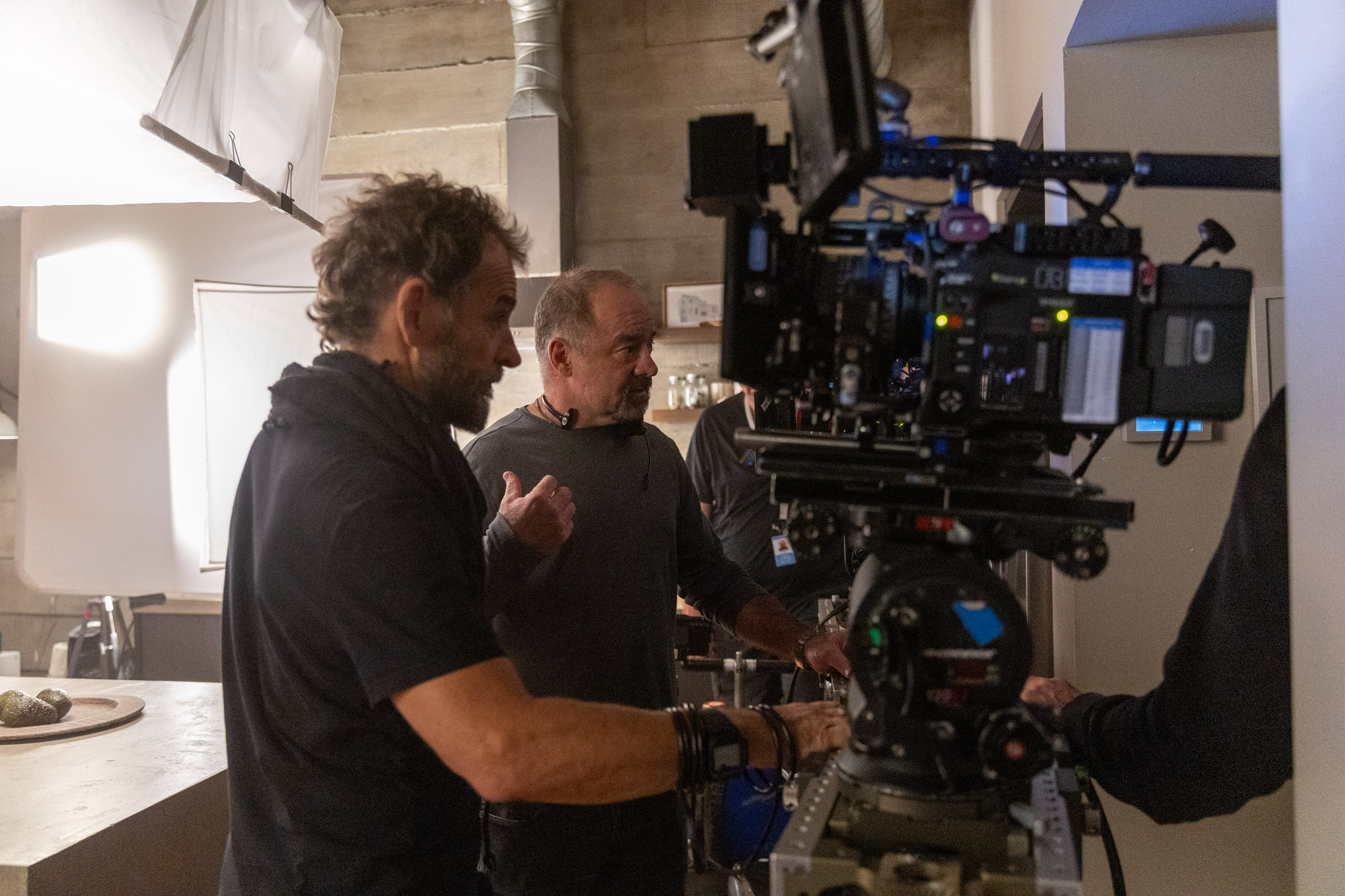
Photo: Leah Gallo – c. 2026 CTMG Inc.
Where did you rent the equipment?
It was all from ARRI Rental Vancouver.
They have RED cameras?
They do.
And you own some cameras yourself?
I have a few different ones. I still have a couple of film cameras sitting at Keslow, too: an ARRIFLEX 435 and a 235. The funny thing is that someone will use it three or four times a year, and I’ll get a small rental fee back from Keslow. But it’s always followed by something breaking, and the repair costs as much as I got for the rental. So they’re basically just storing it for me. I never really make anything.
Did you have any of your own cameras on this show?
I have a V-RAPTOR XL [X] 8K VV, so I brought that. I still have a RANGER which I used as a backup camera and left on the truck in case something happened. I have a KOMODO that I bring along just to have in my pocket in case we need something that small.
On SOCIAL NETWORK, you used Master Primes, which are pristine. And now you had ARRI DNAs on SOCIAL RECKONING. Where are you going with lenses?
I think everybody is trying to find something a little bit off to counter the sharpness and resolution of the sensors as they get sharper and see more. I think back to doing shows on film with anamorphic lenses: you’re doubling up on softness, where people’s skin and faces looked so alive and unblemished. Then you go to Master Primes, which are super sharp, and an 8K sensor. If you’re not careful with the quality of light, the diffusion and how you finish the images in post, it can look clinical. The pores are so big, and you see nuances and blemishes you never knew a 25-year-old had, and there they are, 40 feet tall. It’s less forgiving.
So yes, I think definitely more distressed glass, including modern glass with those attributes built in, so you still get full frame, speed and sharpness when you need it, but with some flaws, edge fall-off and softness. I love the Leica Summilux-C primes. They’re some of my favorites. There are no arbitrary quirks. It’s just beautiful portrait glass. They don’t cover Full Frame, only Super35 , and in the end they’re pretty pristine. But they remind me of the Primos when they first came out, and I think they’re in the same family: a little bit of warmth and beautiful softness, but still super resolved.
When we were assistants, or early in our shooting careers, the lens was the lens, and that’s how it came. Now almost all of them are tunable to some degree. On my last film, TYRANT, I used the Panavison anamorphic Panatar II lenses. Dan Sasaki took out a mask that had been put in to soften the edges. On that film, there’s so much dialogue and I wanted to use both the far left and far right sides of the frame without as much distortion and without losing sharpness. He took the masks out, and then we made the sweet spot bigger.
The choices for detuning existing glass have just multiplied. You need to take the time to sit with the lens tech at whichever company you’re going with and find the nuances that appeal to you for that particular story.
And to some degree the cameras as well. You’re well known for being very daring with RED cameras. I’m not trying to flatter, but your work with those cameras often has a different look than most. Why is that?
I don’t think there’s any secret sauce. It’s being there and finding something that appeals to you and makes sense for the story. I keep saying that because we’re the visual part of facilitating the story and creating an environment where the actors can live and deliver whatever inflection we’re going for. That’s the starting point. Then you add your own personal tastes and what that scene will actually let you get away with.
You also reminded me that you were once a focus puller. For the only reader of FDTimes who doesn’t know you, tell us a little about your background and how you got started.
I come from a long line of people in the industry. My grandfather, William Cronenweth, was a portrait photographer for Columbia Studios. They used to give out a little Oscar medallion for still photographers, and he won the last one they gave, for a picture of Mickey Rooney and Judy Garland dancing. My grandmother was a Busby Berkeley dancer. My father, of course, was the renowned cinematographer Jordan Cronenweth, ASC, who shot BLADE RUNNER.
As a kid, I went to sets and really loved the camaraderie. I loved the idea that every morning you went out work on something interesting, and every night you came back and either solved what didn’t work or congratulated yourself on what you accomplished that day. I loved the energy, the teamwork the friendships, and all the characters who were very interesting. As I spent more time on set, I migrated to the camera department and started to understand what my dad did, his choices and his aesthetics. They seemed to fit me perfectly and I fell in line with that.
I was in school when an opportunity came up to be a loader. It was challenging to get into the union in those days, and this was a sure thing. My dad was just starting BLADE RUNNER, but they weren’t sure whether they’d have a loader position on it, so he recommended that I work at a commercial company called Filmfair.
I became their staff loader and got into the union. Then I went back and finished film school at USC School of Cinema. Robert Brinkmann, John Schwartzman and the director Phil Joanou were all classmates. After graduating, I started working right away. I did it the craftsman’s way: I started as a loader, then became a 2nd AC, then a 1st AC, then an operator. Then I started shooting second unit and became a cinematographer.
How did you get your first big break as a DP?
I had shot second unit on THE GAME and on SE7EN for David Fincher. I was introduced to him through my dad. We did a Madonna video, “Oh Father,” in black-and-white. When Fincher was going to shoot FIGHT CLUB, he called me. I assumed it was to shoot second unit again, but he told me to read the script when I got home and let him know the next day what I thought. I had my best poker face on, because I didn’t need to read the script. If David asks you to do a film, you’re going to do that film. So that was my big break as DP on FIGHT CLUB.
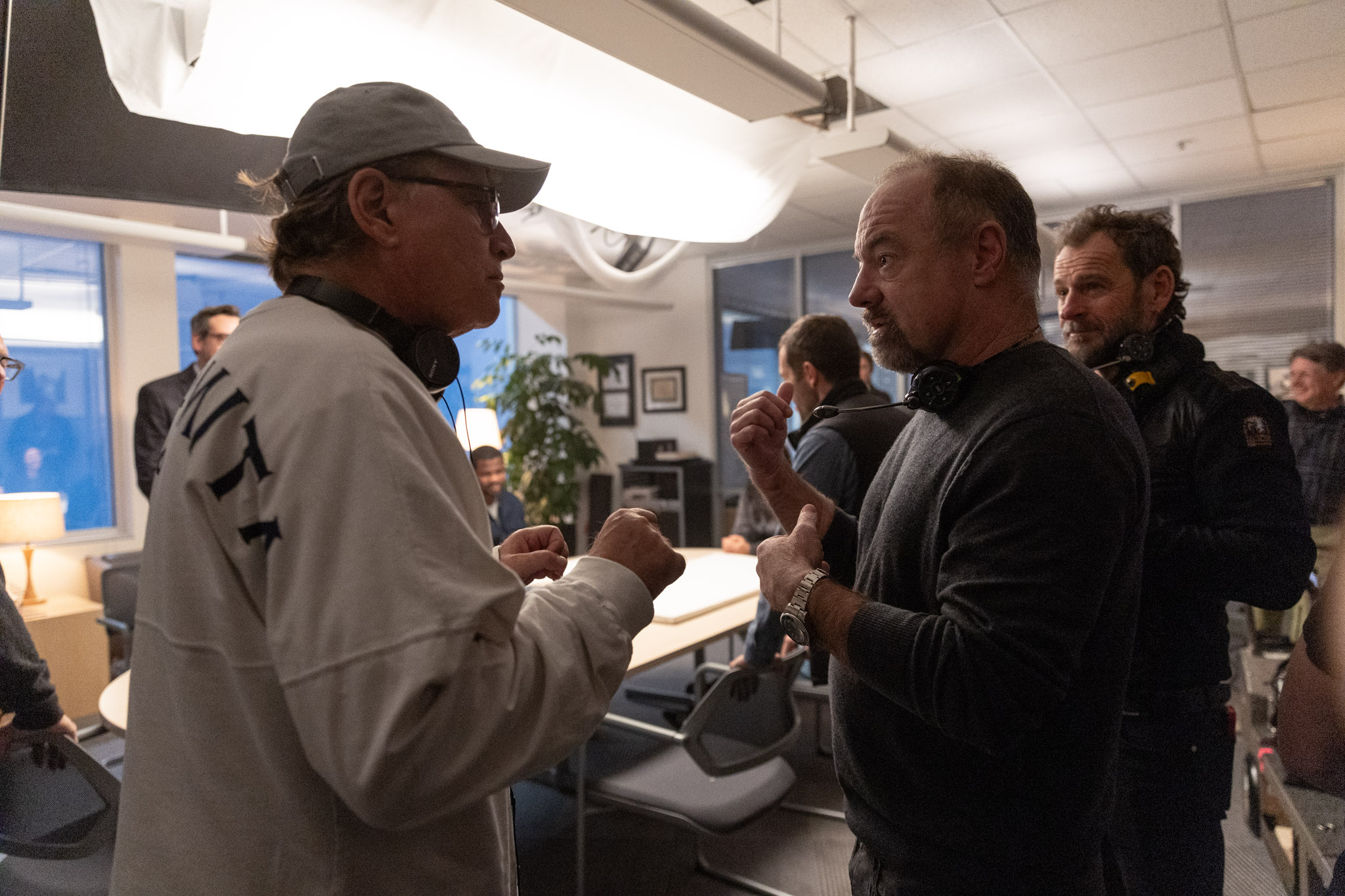
Director/Writer Aaron Sorkin and Jeff Cronenweth, ASC on THE SOCIAL RECKONING. Photo: Leah Gallo – c. 2026 CTMG Inc.