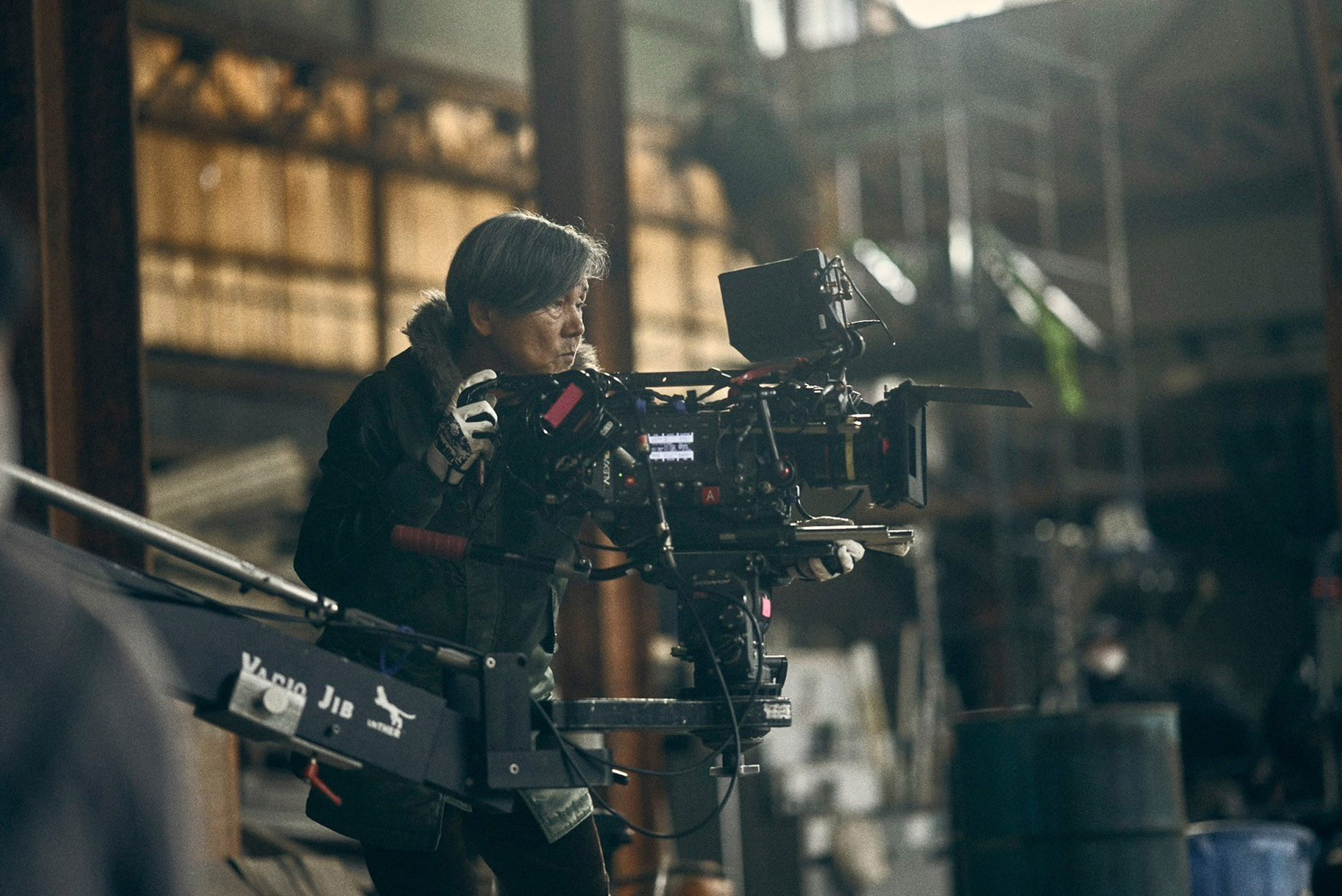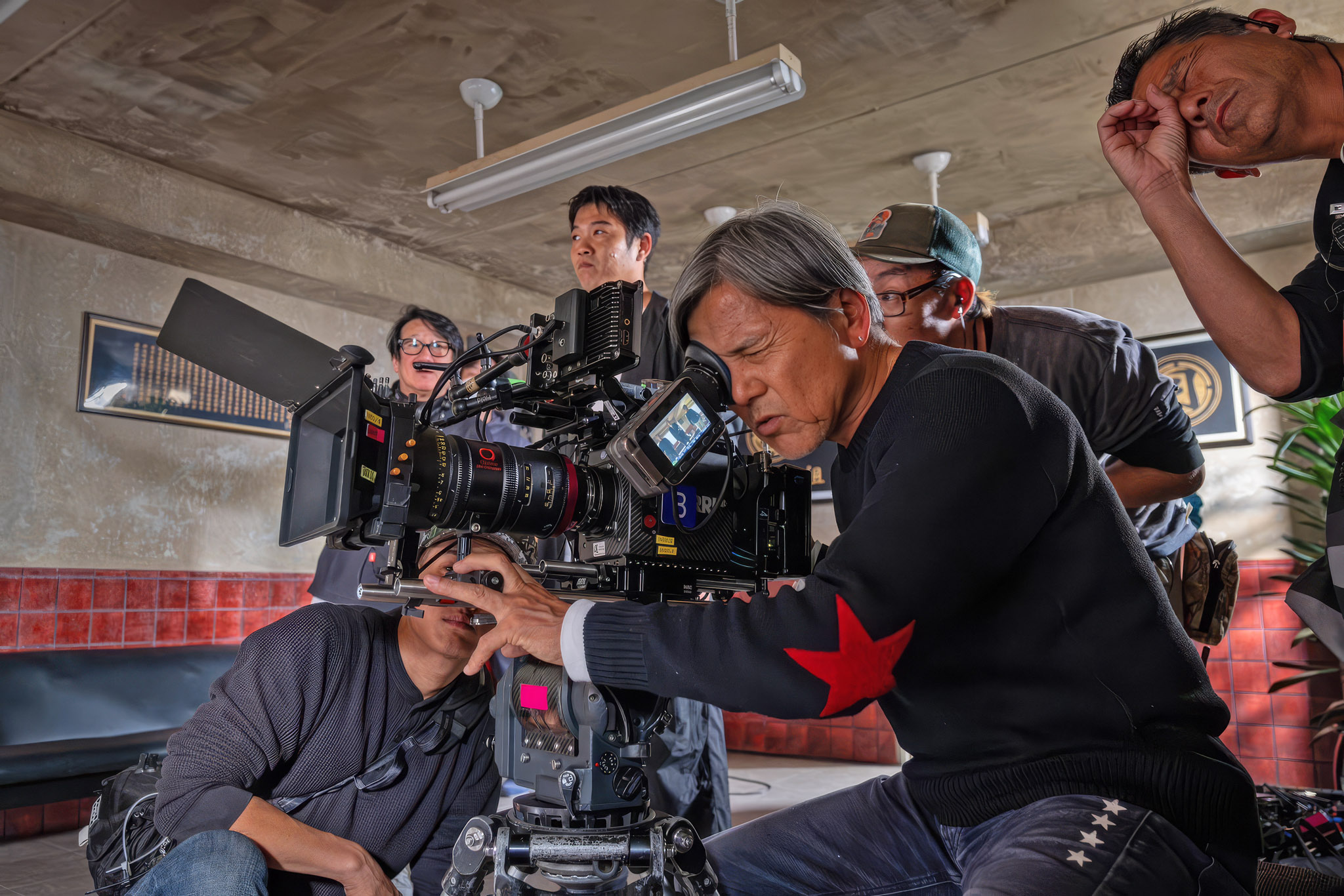
With InterBEE coming up next week (Nov. 18-20) in Japan, let’s focus on a Koichi Nakayama — cinematographer and production company owner.
I met him a few months ago at the offices of NAC Rental in Tokyo. Yasuaki Mitsuwa, NAC Image Technology Head of Global Sales, translated.
Jon Fauer: What projects have you been working on lately?
Koichi Nakayama: There have been many dramatic features and streaming shows. I just finished shooting an action movie. You could even call it a Yakuza movie. It’s a streaming drama on Japan’s DMM TV called Donketsu. For overseas release, I shot MITARAI-KE, ENJŌ SURU (“BURN THE HOUSE DOWN) for Netflix. [8 episodes. Story: Thirteen years after a devastating fire destroyed the wealthy Mitarai family home, Anzu Murata infiltrates the household as a housekeeper to uncover the truth and clear her mother’s name.]
What lenses and camera did you use?
Angénieux Optimo Primes and the camera was Sony VENICE 2. I also have an ALEXA SXT, an ALEXA Mini, an ALEXA 35 Xtreme, VENICE 1 and 2. ZEISS Ultra Primes and Compact Primes.
That’s a lot of equipment. Do you own a rental company?
It’s more of a production company than a rental company. It’s called REN. We are located in Tokyo. (ren-film.co.jp)
That’s interesting. It rare for a cinematographers anywhere to be running a production company as well. In your projects, do you provide all the equipment and the entire camera crew?
Yes. I provide both the equipment and the staff. When I serve as Director of Photography, the Chief (1st AC) is a member of my company and he assembles the freelance crew. He also handles the equipment. We supply the cameras, lenses and accessories. Lighting and grip equipment is rented.
Does your production company select the Director?
That’s right. And then the Director hopefully requests me.
When you’re not using the equipment, do you ever rent it out?
Occasionally. I lend it to people I know and trust.
Nakayama-san, that’s a very interesting business model.
Having equipment helps keep the company running. Payroll alone is not enough.
I heard that you were one of the earliest customers to get Angénieux Optimo Primes. How did you choose them?
The main reason was the IOP (Internal Optical Palette). I was interested in the fact that you can add an element inside the lens, change the iris and attach a filter to the front and the rear. I also like the idea that you can change the irises to achieve various bokeh shapes. Actually, I was the first person in Japan to order them—even before the oval irises were released.
The oval iris is a good idea. Actresses here often tend to dislike anamorphic lenses. Maybe they remember the “mumps” look—where the face appears wider from side to side. Focusing and fine-tuning can be a hassle. When you think about it that way, the Optimo Prime’s concept of using an oval iris to achieve an anamorphic-like bokeh is really great.
Who services your Optimo Primes and installs the IOP elements? Do you have lens technicians on staff?
The camera crew can change the IOP and iris modules easily. NAC and Angénieux provided a toolkit and our staff received training.
Recently, I used an IOP Glimmerglass element on the WOWOW drama SHADOW WORK [2025 5-episode series. Story: women who have risked their lives to escape from domestic violence take refuge in a secret place where they try to reclaim their lives.]
I’m especially happy with the look and colors of the Kamakura café scene in SHADOW WORK.
What kind of lighting fixtures are you using these days?
We use a combination of natural light and LED fixtures. Lately, we’ve been using LED panels from above as base lights. For key lighting from outside, we use large, focusing LEDs in addition to natural light—brands like NANLITE and Aputure. We also use ARRI SkyPanels quite often.
What about zoom lenses?
I hardly ever use zoom lenses. I do have the ARRI ALURA 45-250mm, the 15.5-45mm, and the Fujifilm Premista 19-90mm.
In Japan, are prime lenses the norm for TV drama production?
Yes. I think people in TV production use zoom lenses, but those in film production don’t use them much.
As the DP, do you also operate the camera yourself?
Yes, I do. I usually work with an OConnor 2575. I’ve also been using a DJI gimbal lately. I control it as a remote head using DJI Master Wheels. I also own a DJI Ronin 4D.
When you’re shooting a drama, how many people are typically on the camera crew?
Three people: the Chief, the Second Camera Assistant and the Third AC. When we’re shooting with two cameras—A-cam and B-cam—I’ll assign additional crew members to the camera team.
Do you have a DIT on set?
We bring in a DIT when we have to, but sometimes we don’t have one if the budget is tight.
Who pulls focus? The Chief Camera Assistant?
No, focus is pulled by the Second AC who actually still measures with a tape measure, watches the scene, looks directly at the actors and is not looking at a monitor.
With the shift to digital, many Focus Pullers often adjust focus while watching a monitor these days. But when it comes to subtle movements at wide apertures, there can be a slight lag, a delay. That’s why I prefer to work with Focus Pullers—the “brains” of the operation—who can intuitively gauge distances while watching the action unfold.
I learned that there have been seminars for Focus Pullers in Japan but it seemed that their salaries have been too low for such an important job. Has the situation changed now?
I think pay rates for camera crews in Japan are too low overall. However, Netflix pays relatively well in Japan. Other production companies and TV dramas often pay less.
What is a typical Japanese feature or episodic drama budget?
A low-budget feature may be under ¥100 million (US $ 632,130). A more typical production might be ¥200-300 million (US $ 1,264,258 to 1,896,388).
Productions aimed at international audiences tend to have higher budgets, while those for the domestic market are lower. I heard that KOKUHŌ (NATIONAL TREASURE), the 2025 historical drama directed by Sang-il Lee had a production budget of ¥500 million (US $ 3,150,946). It was a huge hit in Japan, so it must have generated substantial profits.
Budget pressure is happening everywhere. It feels like a global competition of incentives and rebates.
Do you think that been the case since the shift to digital?
It feels like a competition among locations to provide the greatest rebates. Producers can chase the best incentives. I hear that Japan is very busy and film production is booming with a generous 50% incentive.
Yes, for qualifying budgets. Japan’s national film and television production incentive is managed by the Ministry of Economy, Trade and Industry (METI) and operated by the Visual Industry Promotion Organization (VIPO).
What led you to become a cinematographer?
I started out as a studio stills photographer. Later, I joined a video production company, where I became a cameraman and shot documentaries, commercials and music videos. At one point, I was assigned to shoot a film with many live music scenes and that’s when I was selected to become a film cinematographer. That was the start of my career around 1990.
Do you continue to shoot still photos?
I take them as a hobby, but I don’t do it professionally.
Did you study at a film school?
I didn’t go to film school. I really started out as a studio assistant and learned everything on the job.
Where did you grow up?
I’m from the Kansai region. I was born in Kyoto. I watched a lot of films growing up: Yakuza movies were all the rage, as well as Akira Kurosawa films, GODZILLA and comedies starring Hisaya Morishige and The Drifters.
Are you interested in the 65mm format?
Yes. For my hobby doing still photography, I have a Hasselblad. However, I wonder if budget constraints could make 65mm difficult in Japan.
But with more affordable 65mm and 55mm cameras becoming available, I imagine we’ll see more Larger Format work in the future.
Personally, I love Larger Formats, so I’d definitely like to try shooting in 65mm.