This is a shortened version of the April FDTimes cover story — publishing soon on paper, online and at NAB 2026.
Tim Sidell, BSC was the sole cinematographer of all 6 episodes of The Night Manager Season 2, starring Tom Hiddleston, Hugh Laurie and Olivia Colman. Tim’s credits include Flux Gourmet, Romeo & Juliet, I Hate Suzie, etc.
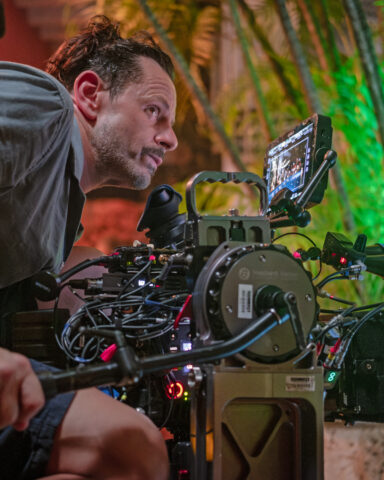
(Photo above: Tim Sidell, BSC with Ronford Atlas 7 fluid head. Photo: Manuel Bermeo, courtesy of The Night Manager S2 2025, The Ink Factory/BBC/Amazon.)
Jon: How did art school lead to a career in film?
Tim: I studied illustration, which is interesting for cinematography because of the similarity in visualizing someone else’s ideas. Then I became obsessed with painting. I did some exhibitions, commissions and gradually painting became video installation, then experimental film. I became interested in cinematography and started working with other artists, shooting films with them. Then I did short films, music videos, commercials, then features, and so on. I still tinker in the studio with painting, experimental film, still photography and printing my own negatives in the color dark room.
The day after we met at BSC Expo London, I went to the Turner Constable Exhibition at the Tate Museum. A prominent ASC DP (name withheld to protect the guilty) once said, “The difference between Turner and Constable was that Turner got up earlier in the morning to catch the light.”
The exhibition was interesting to me because it demonstrated a point where their work was almost indistinguishable. Then they veered apart. I found myself more aligned with Turner and his life of exploration. There’s something more natural and impressionistic; there’s a questioning. I found Constable’s work increasingly cold, methodical and factual rather than emotive.
That is very relevant in our discussion of your work and the current dialog about lenses today. As with Turner, do you lean toward putting your own unique style or signature on your films?
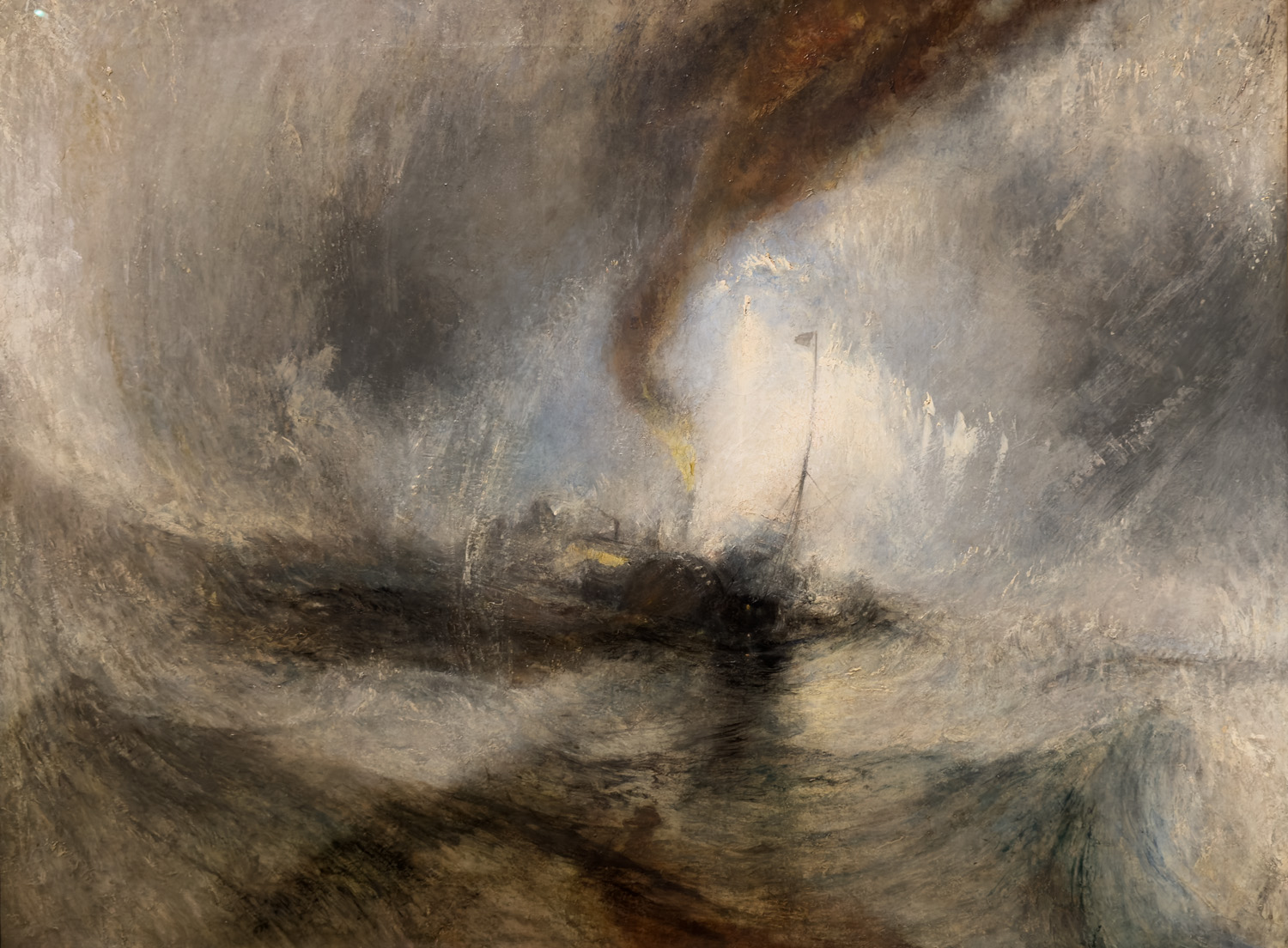
J.M.W. Turner. “Snow Storm: Steam-Boat off a Harbour’s Mouth.” 1842. Oil on canvas. 4′ x 3′. Tate Britain. Photo: FDTimes
Very much. We had a debate at BSC Expo about that. It’s tricky to put more value on one approach or the other. Some cinematographers may be wary of having a style that stands out too prominently because they don’t want to lose work if it is seen as being too specific. Maybe they want more diversity. It’s also a question of diplomacy. Though that’s not quite how I feel.
Doesn’t every cinematographer have a style, conscious or not?
Perhaps. For me it’s about facilitating, encouraging and nurturing the story with the Director and the team. The creative style often is born out of that context and collaboration.
Tell us about how this all worked on The Night Manager.
Collaboration. We enjoyed a great deal of creative freedom, within reason, on The Night Manager, Season 2. It’s still TV drama, episodic, six parts. There are some frameworks you have to follow, but we were never told to do one thing or another.
How did the style evolve?
This is my second main project with Georgi Banks-Davies, the Director. I tried to show Tom Hiddleston, as Jonathan Pine, playing different personalities. He’s Alex Goodwin at the beginning, then Max Robinson as an undercover detective, and then Matthew Ellis, a very showy city banker. For the undercover version, we held back a little bit, always handheld, hiding around corners, longer lenses, a bit more voyeuristic, a bit rougher, a bit more reactive.
We gave a different accent when he’s Matthew Ellis, the role he plays in front of Teddy and Roxy. It was more bombastic. We did bigger camera moves with a Steadicam, crane or whatever.
Did you have different lenses for the Jonathan Pine iterations?
Our main lenses were Leitz HUGO primes. We had two sets, starting at 21mm, one for each VENICE 2 camera. One of our sets had the 50mm T1.0 Noctilux. That was fun to work with.
For the Matthew Ellis banker version, we used my complete set of Mamiya 645 Sekor C Medium Format lenses rehoused by TLS. They have a hint of anamorphic about them. They’re fitted with a speed booster on the back so they become wider and a 2/3 stop faster. You feel the speed booster as the outer edges become diffused in terms of focus and lower contrast, and the image is slightly warped. It’s a little more three-dimensional, like a baby step towards anamorphic. We felt that was appropriate to elevate the Matthew Ellis character who’s larger than life and feels he has to play that part.
[From TLS: “The original Mamiya 645 lenses were designed to cover a film area of 6 x 4.5 cm. With an image diagonal of 75mm, they amply cover 65mm format sensors. Our speed booster is essentially a 0.71x adaptor that sits at the rear of the original lens. It concentrates the light onto a smaller surface area, thereby increasing the speed of the lens by 1 f-stop. So, an original f/2.8 lens becomes T2.3 (f/2.2). Furthermore, the speed booster reduces the focal length of the lens. So, a 35mm base lens becomes a 25mm once rehoused with the speed booster. This affects optical performance. The speed booster renders a beautiful cinematic characteristic not seen in the original lens. Although most popular in LPL mount, TLS also offers a PL mount.]
How did you come to choose HUGO lenses?
Going back to where we started, we talked about Turner and Constable. Turner’s painting has an emotional quality. I prefer “emotional” lenses (as my partner calls them) as opposed to very technical lenses, which might be sharper but don’t have the same feeling. I default to older glass because I don’t need all of the extra sharpness. I like some softening. It’s more forgiving on skin. I like lenses to be very small because they have better balance for handheld. Also, smaller lenses are less intimidating to the actors. Having a great whopping lump poked in front of an actor’s face is not pleasant.
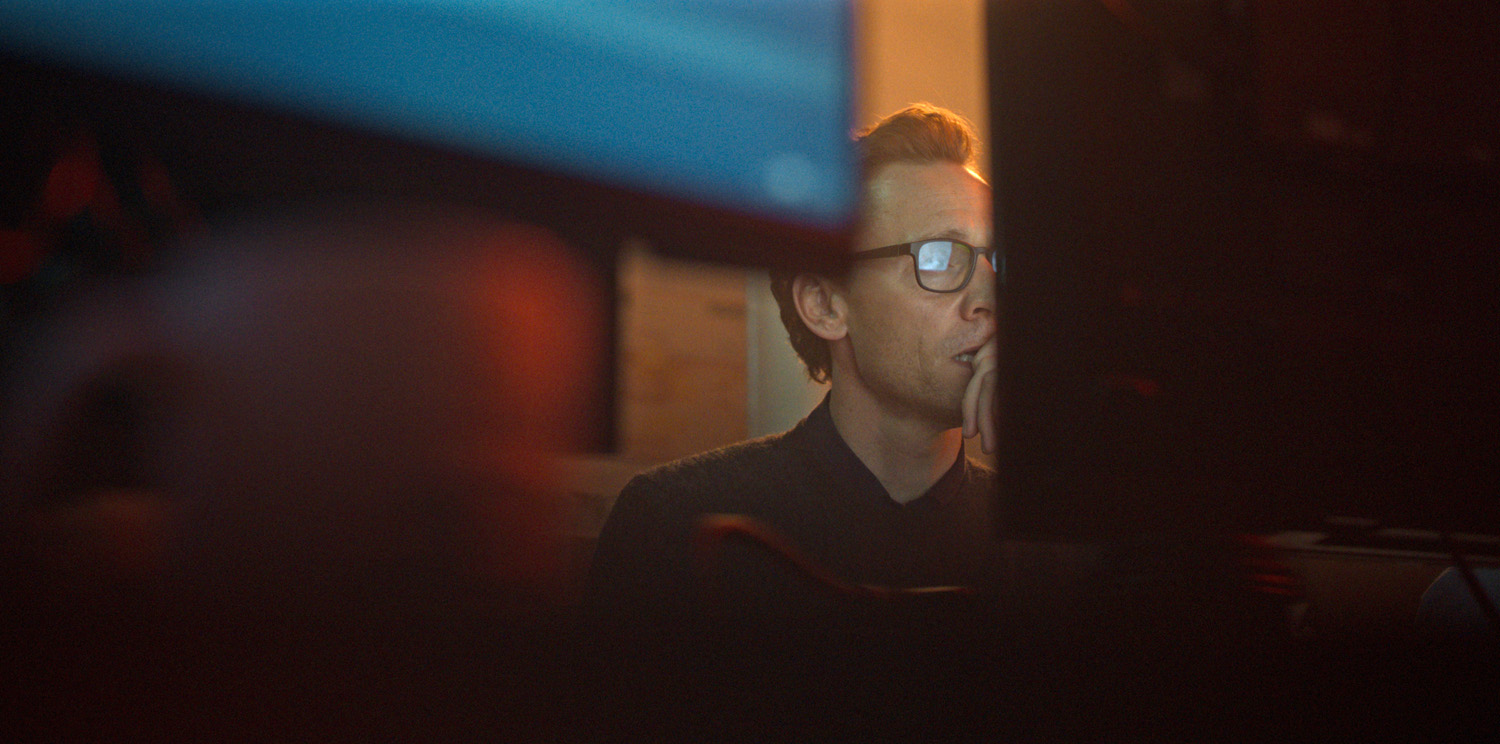
Framegrab: NIGHT OWLS HQ – LONDON MEWS HOUSE. Courtesy of The Ink Factory/BBC/Amazon.
Our references for Night Manager included thriller, espionage, long lens scenes in The Conversation as well as wide shots in The Conformist and Parallax View. But Night Manager is also a thriller, so we considered Hurt Locker and Sicario which looked sharper and had more snap than the older lenses I’d normally go for. Our mandate was to find lenses that were small, light, fast, had a good range of focal lengths, not as forgiving as something like K35, but not as hard as something like Master Primes. We found those qualities with the Leitz HUGO. They’re still slightly sharp, but I eased that with diffusion and low con filtration. It’s an excellent set and what they do for such small size is incredible and it’s a great range of focal lengths. They’re very fast and worked very well.
Did you use diffusion filters?
Yes, I usually do. I always have a set of Tiffen Lo-Cons and Black Diffusion FX or Digital Diffusion FX. I like those because they don’t halate too much. I like the reduction in resolution, but without the blooming. There are some scenarios where I will use Black Pearlescents or Black Satins, which have weak halation.
You also had zooms?
We had zoom lenses, particularly for some of the espionage scenes. Our workhorse zoom was the lightweight Angénieux Optimo Ultra Compact 37-102 T2.9 FF, though we also carried two Angénieux EZ’s. Sometimes we used Ultra Compacts on the Steadicam rather than a fixed prime so I could manipulate the focal length during a move. We also had 2x extenders for the zooms.
The long lens overhead sequences were inspired by Francis Ford Coppola’s The Conversation and we used the Angénieux Optimo Ultra 12x Full Frame Zoom. The reason I love the Optimo zoom series is because it is classy glass. And, with a little bit of filtration, they just nail the look.
Does the Optimo Ultra 12x match the Ultra Compact Zooms as well as the HUGO Primes?
Yes it does. We used the Ultra 12x at La Alpujarra Administrative Center, when Alejandro’s character appears and goes into the Ministry of Justice and Sally meets him. There are three massive buildings around the square. We scouted all the high camera positions and the teams made it happen. It was not easy getting three camera crews each in separate buildings.
How did you decide when to go handheld, on Steadicam, sticks, crane or something else?
It was quite a mix. We didn’t have a hard and fast rule, but we’d lean towards much more handheld with the “Max Robinson” scenes. We’d never be handheld with the “Matthew Ellis” character. But of course, all of these personalities converge as the series progresses, so the rules kind of dissipate. A lot was Steadicam and a good bit was handheld. I love operating handheld.
You mentioned that the cameras were Sony VENICE 2?
Yes—not so lightweight, but for me it’s all about balance. If you can put it on your shoulder, let go and it stays there, then that’s a well-balanced camera. Front-heavy cameras are no good for natural operating. I have a little cushion between my shoulder and the bottom of the camera. I’m not so keen on shoulder rigs as they offset the balance too much. And I like the SHAPE telescopic handgrips. I can push the release buttons to adjust their configuration, even during a take. I try and keep the underside of the camera very slim for handheld, because the way that you move to keep the camera stable and smooth has to come from your core, not bouncing on top of your shoulder. I used to do a Brazilian martial art called Capoeira that taught me a way of moving. A bit of stretching at the beginning of the day helps to warm up.
Did you operate a camera?
I’ve always enjoyed operating. There’s the immediacy, relationship with the cast, intricacies of framing and height relative to the subject, the eye line, all of that. We often needed two cameras running at the same time. Dan Nightingale was our main camera and Steadicam Operator. He did an amazing job. We often tag-teamed the handheld scenes, sometimes bouncing between characters.
Rather than A and B Camera, we called them red and blue. There would be times when I’d operate with a single camera, and other times where Dan would operate. There were occasions where we had three cameras and times when I would be at the monitors.
I do like to move the camera. I also had a Chapman Cobra—a little pedestal dolly with a pneumatic riser—with a Ronford Slider and Ronford Atlas 7 Mini Fluid Head. I can operate and go where I want without having to choreograph out the movement in advance. I often have the camera underslung with the Atlas 7 on a small jib arm with the Cobra dolly so I can float, find and hover the camera over a shoulder or wherever, without restriction and without the edginess of handheld. I’ve also done the same with a telescopic crane, with the arm’s control in my left hand and the Atlas 7 handle in my right hand so I can go anywhere.
Where were the locations?
It was quite a puzzle figuring out the equipment across all the territories. We shot a month in London from June to July in 2024, then Wales for the big beach at the beginning of Episode 2, then Colombia—Bogotá, Medellín, Cartagena—for six very hot weeks from July to August; back to London and then to Spain, doubling for Colombia, for three and a half months. We were in Barcelona for almost eight weeks. All the jungle scenes, the port, airport and the little village were in Tenerife. The time in prep to find those locations and get everything matching was tricky.
How did you manage the logistics of equipment rental?
The camera and lens package for London and Wales came from Sunbelt. For all the other locations, we kept the glass from Sunbelt and rented cameras from EPC in Spain. They sent the equipment to Columbia. We had four VENICE 2 camera bodies. Because we were quite remote, we wanted backups. Lighting and grip in Colombia came from Congo Films. They had a lot of flashy new equipment. Also, they run a film school that’s very cool.
Why did Spain double as Colombia? It worked well.
Budget funding. That’s the way it was structured.
Back to cameras. Did you have VENICE Rialto?
We used the Rialto occasionally. It’s super handy and sometimes the only way to get into certain places, for example the car shots when they’re driving through the jungle and we’re scrunched inside the car, shooting French overs, or frontally from the dash. The Rialto comes in handy for that. In fact, it’s the only way.
What were your ISO and LUT settings for the VENICE 2?
All over the place. I use the ISO settings freely. In the past, I was very considered in my ratings. But with the time taken to manage and keep the ISO ratings consistent, I found it quicker and easier to adjust things in the grade. Normally I ended up tweaking the ISO to protect highlights.
The LUTs were quite important. I don’t go too strong with LUTs because I don’t want to push the image too far or to light to much against the LUT. So, the LUTs are quite subtle. I was very keen to temper the greens in Columbia—there is so much green. The LUT for those scenes had the same slightly steeper gamma curve as all the LUTs (for more punch in the middle and slightly reduced contrast) but a reduction in the saturation of those more yellowy greens. I think I had four LUTs and mostly used one or two of them.
This was also the first project I did in ACES, which was really good. Initially, I was unsure because everything seemed even more digital and a bit magenta—the color I hate the most. It reminds me of video cameras from the nineties. But once we figured that out and dialed the magenta out, the color separation you get with ACEs is on another level. You can look into the shadows and find more information there. Obviously it’s already there in the camera either way, but the ACES color space and HDR was an interesting journey.
Wait, you’re handheld, it’s 47 degrees Celsius, and you had a DIT with a cart rolling around in the jungle?
Yes. But if it was an extreme setup in the middle of nowhere, then we’d scale down. Usually, Matt Hutchings or Nick Randall from Rebel Colour just got there. In his tent with a Flanders monitor, he also tirelessly ensured I had my own Flanders nearby alongside my little Odyssey monitor, which was set to Log and false color so I could see, with full accuracy, if and where the image might clip.
You recorded Sony X-OCN?
Yes. We went with X-OCN ST because there’s a fair amount of VFX work. I’ve shot a lot with X-OCN LT and never had any issues. It’s superb. But they were happy to provide the hard drives, so it was fine with us.
What was the VENICE sensor mode?
We were Full Frame, full width, 17:9 sensor mode, framing for 2:1 aspect ratio and cropped in post to 2:1. We recorded 8.6K.
I guess the VENICE internal NDs helped with the changing weather conditions and locations.
It is a game changer what Sony and the VENICE have done there.
Your crew did not have it easy: cameras moving, tough locations.
Red Cam was focused by Joseph Mastrangelo. I’ve been working with him for years. Blue Cam was David Agha-Rafei. At the beginning, production said that the A Camera team would be from the UK for the whole show. B Camera team would always be local. I said, “No, that’s not going to work. If I’m going to operate, I’m going to need to bounce between cameras and know that whoever is there with the focus control knows the way I work. It’s an instinctive collaboration that grows over years. Even if it means I have to have a local Second AC on my camera team, I’ve got to have my two focus pullers.” That worked out well. Raquel Rodriguez was our second AC for Red Cam in Colombia as well as Spain. Lara Blanco took over Blue Cam focus in Spain to maintain the local quota, and she was incredible, along with Flora Novarro as Second AC.
You had some beautiful drone shots as they were driving on the narrow road through the jungle.
That’s an interesting story. We had the DJI Inspire 3. In the past I’ve insisted it had to be VENICE or ALEXA on a heavy-lifter drone. But I must admit, the Inspire 3 is so nimble and it can go so far and for so long compared to a heavy lifter, you just get better material. Andrés Sotomayor was the Drone Op. He won’t stop until he’s got what you want.
What do you use for lenses on the Inspire 3?
I used the native DJI lenses. I found that we’ve been able to match material perfectly well in grading, given that the drone language is completely different anyway. I think we used the 35mm and 50mm. I don’t like the feeling of drones on very wide lenses.
Let’s talk about grading.
Simone Grattarola is the colorist working with DaVinci Resolve. The company is Time Based Arts in Shoreditch, London. We mastered in HDR and then did a tweak pass for SDR. I think I was in the final grade for nearly 40 days.
You’re viewing in HDR or SDR on set?
SDR on set. I always make sure that we shoot tests. They are as much a confirmation of what we’re doing as they are a representation for the entire team of where we’re going. The Director, Heads of Departments, Crew, Producers and Network Teams get to see what we’re going to do. It becomes a bit of a contract. This is our promise as to how we’ll make the imagery look.
Having Simone involved at the very early stage was so important as we were shooting those tests, taking them into the grade, creating LUTs based on those tests and then loading those LUTs into the cameras. The execs came to that test grade as well so that we could all sign off and say, yes, we are doing this. We had their support.
Meanwhile, back at Turner, Constable and style. This show is for screens at home. If it were projected theatrically, would you have used the same lenses?
I think so. The choice was largely visual, but it was also a process of wanting lenses that are physically light, small and fast, regardless of the screen size. I might have been a little more lenient on the focus pullers in terms of the aperture if it was for large screen, but it would’ve been a subtle difference. I don’t think it would’ve changed much.
It’s interesting how Turner went to larger and larger canvases to attract attention and compete with Constable.
The competitiveness between them was amazing. Turner’s work became fields of color. Some were almost like Rothko—you get lost in it. And at that point, Constable was becoming more mechanical.
Turner’s work was pre-Impressionism. His backgrounds became swirly, almost like Petzval lenses. This was some 30 years before Claude Monet’s Impression, Sunrise (1872) invited the scorn of the French art establishment.
The critics said Turner was senile at the time. So was Cezanne for his constructive take on Impressionism. He was building a block of fruit as a very physical thing, but the establishment thought that he just couldn’t paint. He was pioneering a whole new movement called Modernism. I love that cutting edge when you are potentially being shouted down and challenged for doing something that is creative and you are breaking new ground.
And yet, were vintage lenses refused or scorned? Maybe in the analog film days when lens manufacturers tried to overcome gate weave, poor projection, multiple generations of printing that degraded the image?
It is less the case now. I remember writing my dissertation for an MA in photography about vintage as a marketable aesthetic. The fact that you could shoot on your phone and then pop a couple of filters on it in Instagram and make it look like it was shot on film in the seventies somehow had this signifier of authenticity simply because it looked old. I found that interesting: you’re degrading an image and somehow that makes it more authentic.
That’s a critical take on the concept. But at the same time, I’ve always preferred an organic feeling lens because of my background in painting, and I don’t want anything to look digital. I’m trying to get to a place where you don’t feel it’s digital. That doesn’t mean it has to feel like film; it just needs to feel that everything is bound together within its own world.
But devil’s advocate, the digital sensor is essentially analog because it’s just shades of black, white and gray, and then it gets converted to a digital signal. But it starts out analog. We could argue that a lot of this dialog came from the low resolution of early digital cameras. And now that we’re getting cameras like the VENICE 2, which has higher resolution and smaller pixels. It’s almost like the dots in printing or pointillism, with smaller points of paint. You don’t see moiré or artifacts or notice the digital qualities as much.
I must admit, I went to a Sony screening at Golden Square in London a number of years ago. It was 4K material on a 4K projector. And I just thought, really? Do we need 4K? At that point we’d just gone from HD to 2K but it was a revelation because I just thought, oh, now I’m not seeing the corners of the pixels. It’s more organic.
And the skin tones are smoother.
Yes. So I thought, okay, bring on the resolution. I’m game. Film doesn’t have hard gates, by which I mean brights at one end and darks at the other end don’t suddenly stop. It just sort of fades and carries on and just bleeds away into this ethereal loveliness. Admittedly, you see that less these days because almost everything goes through a DI. Whereas digital is absolutely hard. This is the bottom, this is the top. You’ve got white, you’ve got black. As Ernst Gombrich asks in The Story of Art, what is white, what is black? It depends on the context. To me, nothing in the visual representation should be zero or a hundred.
Talking about Turner and getting the attention of the audience, isn’t it the same for us cinematographers searching for a signature or style that separates ones work from everyone else and hopefully attracts the attention of a Director or Producer?
Maybe. My own signature starts with subjectivity. A key thing that we wanted to do on Night Manager was to articulate what is in the script, which is an exploration of identity. In Season One, Jonathan Pine is more of an action hero. Here, in Season Two, he has questions—he’s less sure of himself. There’s also an investigation of gender and sexuality in this season.
So we explore Pine’s identity, but also those of Teddy and Roxy. There’s a very interesting triangle between them where they’re all trying to figure out who they are in the life they find themselves in. Even bigger than that is the way Roper and Sandy Langbourne play up to the stereotypes of British imperialism, suggesting a question about the identity of Britain post-Brexit.
To articulate the subjectivity, I love to move the camera, anchor on a person and not only share their experience, but also witness it. I think maybe that’s part of my signature along with color and texture, which comes from lenses, filtration, location and light. As I said earlier, it’s about not having zero and not having a hundred within the frame, but having everything in between.
Your compositions were very interesting and different. Framing was unusual. It was sometimes nicely off balance.
Thanks. I don’t like cropped heads. I want to see some space above. It’s informed by my love of portraiture. I remember when I was painting how I’d buy all the different colors in tubes and I’d buy extra big tubes of white and yellow ochre because every color I mixed had white and yellow ochre. They were like the binding agent visually. I think it’s the same in what I try to do with lighting and in the grade where there’s a slight earthiness that holds it in the same world.
How did you prepare for The Night Manager? Did you go to art galleries, museums?
If only there were time. Georgi put a mood board together before I was involved, then we started anew on assembling a fresh one together with Víctor Molero, the Production Designer. Georgi also mentioned a couple of films that she wanted me to watch and I’d sent her a few as well.
It seems that you were both in sync visually.
Definitely. In addition to that, she pushes me to avoid being precious. Her drive is authenticity. We never do a camera rehearsal or crew show. Georgi blocks with the artists and wants me in there from the beginning. I’m watching the blocking and influencing it if I think something’s essential, easier or quicker to shoot, and I’ll also be plotting a shooting plan during the process. And there are no marks on the floor.
Your focus pullers probably were not loving that. Full Frame and it looked like you were wide open quite often.
They’re used to it. They knew what they signed up for. I normally settle at T2½ or T2.8. Joseph would run in with his tape measure sometimes, but I think he knew that it was fairly pointless. It’s all about being reactive. That’s the authenticity that Georgi is after. And she doesn’t want a camera rehearsal because she doesn’t want to miss something that might happen. And it’s quick.
Almost every shot is a master, unless it’s a closeup or specific detail. That is the way I learned to work long before I met Georgi. You get as much as you can in one direction so that you’ve got a chance to light something with shape, turn it around, shoot back the other way. It’s fluid. And the actors love it because they are free. They don’t have to land on a position.
Every take is a discovery. Every take is different.