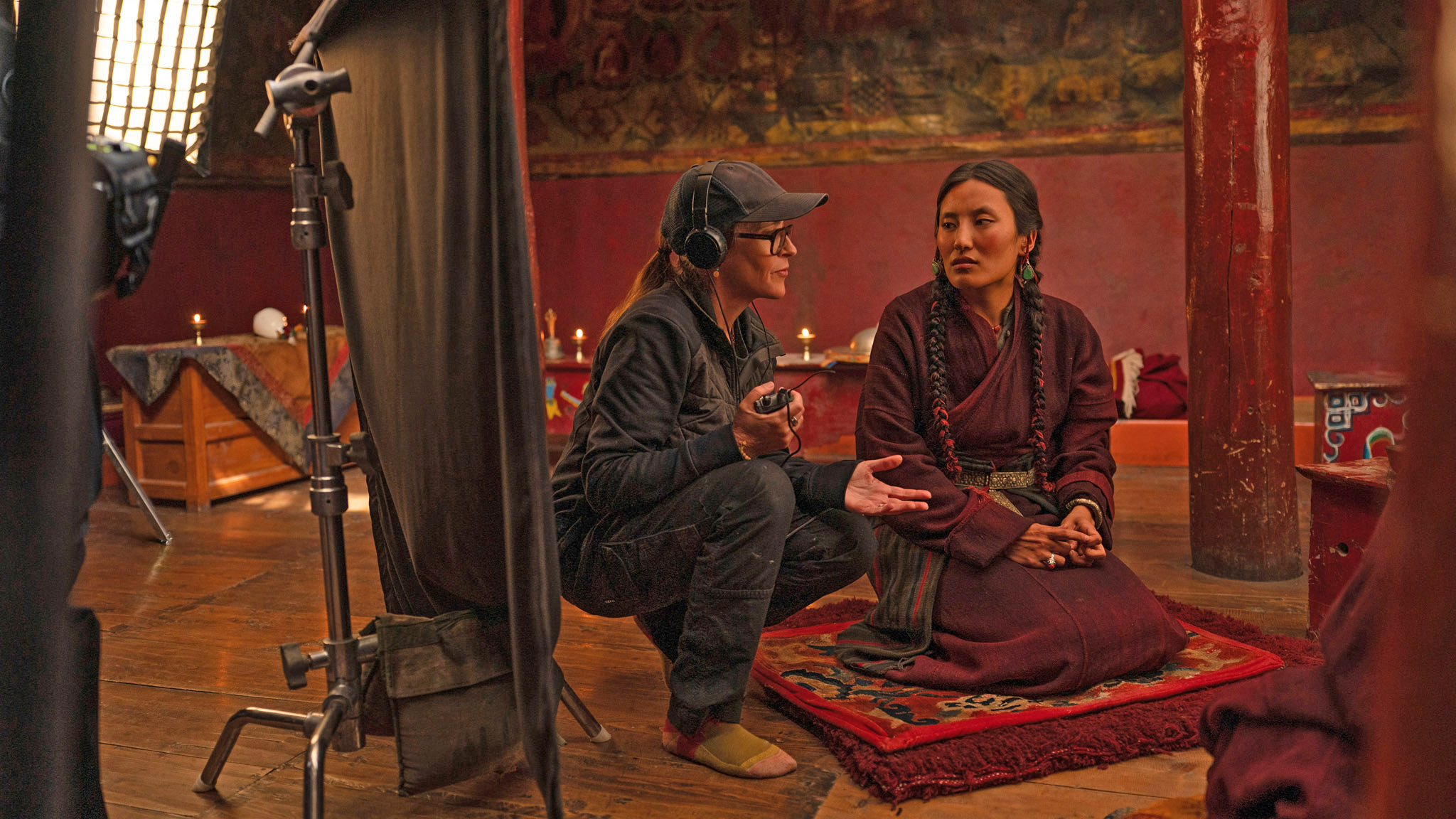
Jennifer Peedom with Thinley Lhamo as Dawa. Photo: Kirsty Griffin / Courtesy of Apple.
Jennifer Peedom directed TENZING, in theaters and streaming on Apple TV. It is a beautifully crafted film—the true story of Tenzing Norgay (Genden Phuntsok) who, together with Edmund Hillary (Tom Hiddleston) was the first climber to reach the summit of Mount Everest, Chomolungma, sacred mother goddess of the earth.
Jon: How did you get into film?
Jennifer Peedom: I came to filmmaking by a slightly unconventional route. I studied business at RMIT University in Melbourne and worked briefly in the corporate world, but I always had a passion for photography, travel and storytelling. I’d also lived and studied in Latin America and travelled extensively in Asia, and I think the desire for a more adventurous and creative life eventually won out.
In 2000, I was selected to participate in an Australian Broadcasting Corporation television series called Race Around Oz, which was essentially a crash course in documentary filmmaking. We were taught the basics of shooting, sound and editing, then sent out to make short documentaries on our own. That was really my film school.
Around the same time, I began working at Inside Film magazine in Australia, eventually becoming its publisher. It was a wonderful way to learn about the industry and meet filmmakers, while I continued making my own films. I started by shooting and editing almost everything myself, which was an invaluable education. When you’re the person editing your own material, you quickly learn what you should have shot differently!
Were you a climber before you worked as a camera operator?
No, quite the opposite. Filmmaking led me to mountaineering. I had always loved the outdoors and hiking, but I wasn’t a technical climber. My first trip to the Himalayas was in 2003, when I went as a young documentary filmmaker and became completely captivated by the mountains and the people who lived and worked there.
I also discovered, somewhat accidentally, that my body seemed to function quite well at altitude. After that first experience, I went to New Zealand and completed a series of technical mountaineering courses. I knew enough to understand that I couldn’t be working on serious mountains without the skills to look after myself and, importantly, not become a liability to other people. I’ve since done a fair amount of climbing, including on Everest and Cho Oyu, but I’ve never really considered myself a mountaineer. It’s always been the filmmaking that took me there.
How did you wind up as a camera operator on Everest?
On one of my early trips to Everest, I made a short documentary called THE SHERPA’S BURDEN, looking at the role of Sherpa climbers in the Everest industry. This was in 2004, on the North side of the mountain. That experience led to further opportunities as a high-altitude camera operator. In 2005, I climbed Cho Oyu, an 8,188-meter peak, with Phurba Tashi Sherpa and a team I’d come to know well. Then, in 2006, with that same Sherpa team, I worked as a high-altitude director on the Discovery Channel series EVEREST: BEYOND THE LIMIT, reaching Camp IV on the north side of Everest at approximately 8,400 meters.
It was an extraordinary education in both filmmaking and human behavior under extreme pressure. I also developed enduring friendships within the Sherpa community, and began to understand the enormous disparity between the recognition given to Western climbers and the contribution of the people who made those expeditions possible. That became a recurring theme in my work, eventually leading to my documentary SHERPA and, much later, TENZING.
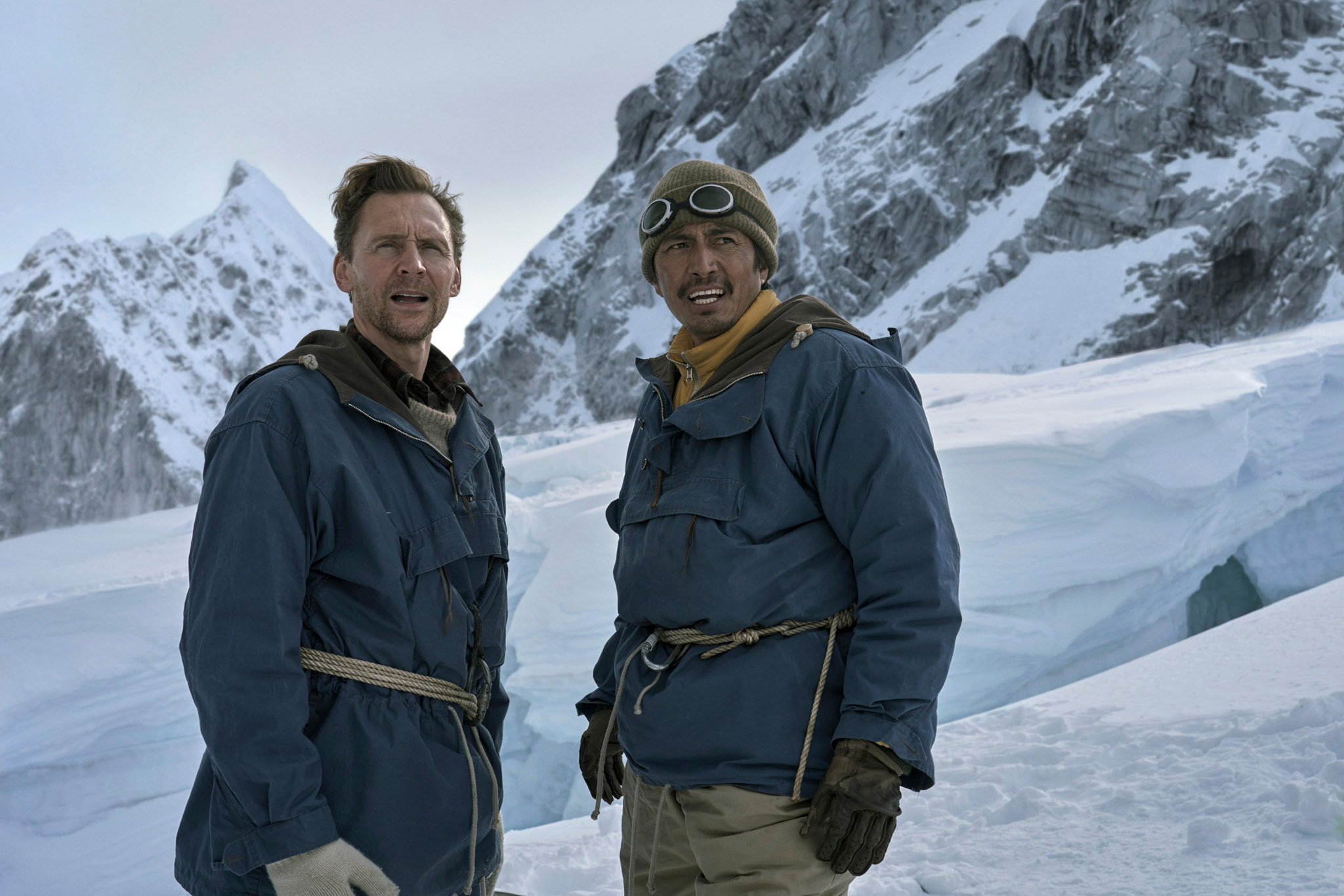
Tom Hiddleston as Edmund Hillary and Genden Phuntsok as Tenzing Norgay. Photo: Courtesy of Apple.
When did you first get the idea to do this film?
The idea really crystallized around the time I made SHERPA, my documentary about the 2014 Everest climbing season. Over those years, I’d come to know several members of Tenzing’s family, some of whom also appeared in SHERPA. Through their stories, I began to get a much more personal sense of the man behind the legend.
When SHERPA screened at the Sydney Film Festival in 2015, Tenzing’s eldest son, Norbu, travelled there to support the film. When I invited him on stage, he received a standing ovation. It was a very moving moment, and I think we both recognized that there was an enormous appetite for his father’s story.
What fascinated me wasn’t simply the first ascent of Everest, which is already one of the most famous achievements of the twentieth century. It was the extraordinary life Tenzing had lived before he ever reached that summit. I knew it couldn’t really be told as a documentary. So much of his formative life had never been filmed or photographed. It needed to be a dramatic feature.
How did the film TENZING evolve from idea to script to prep and from shooting and screen.
It’s been a journey of more than ten years, although in some ways I’ve been preparing for this film for much longer. The first important step was securing the trust and support of Tenzing’s family. Norbu came on board as an executive producer before we even had a screenplay, and the family’s support and trust have been essential to the project ever since.
I approached Luke Davies, the wonderful Australian screenwriter who wrote LION, and we began developing the story together. We shared a conviction that this shouldn’t be another Western conquest narrative. We wanted to tell the story through Tenzing’s eyes, including his spiritual relationship with Chomolungma, the mountain he regarded as a living goddess.
The challenge was finding a way to weave the extraordinary adventure of the 1953 expedition together with Tenzing’s childhood, his relationship with his wife Dawa, and the difficult journey that brought him to Everest. Eventually we partnered with See-Saw Films, and Apple came on board to support what was always a very ambitious production.
From the outset, I was determined to shoot the film in real landscapes. I didn’t want actors standing in front of green screens pretending to be on Everest. I wanted them to feel the cold, the wind, the altitude and the physical scale of the mountains. We spent much of 2024 scouting in Nepal and New Zealand, working out how we could recreate the 1953 expedition in places that were both visually convincing and safe enough for a large film production.
We shot Tenzing’s early life in Nepal, including locations in Lower Mustang, Kathmandu and Bandipur. For the 1953 climbing sequences, we went to the Southern Alps of New Zealand, where the landscape is remarkably similar to the Himalayas, but at much more manageable altitudes.
After principal photography, Stefan Duscio (DP) and Renan Ozturk (Second Unit Director/DP) returned to Everest with a small camera unit to capture the real Himalayan landscapes and VFX plates that would allow us to bring those two worlds together. It was an enormous logistical undertaking, but I think the authenticity of the result is what makes the film special. The actors are genuinely in those landscapes, and the mountain becomes another character in the story.
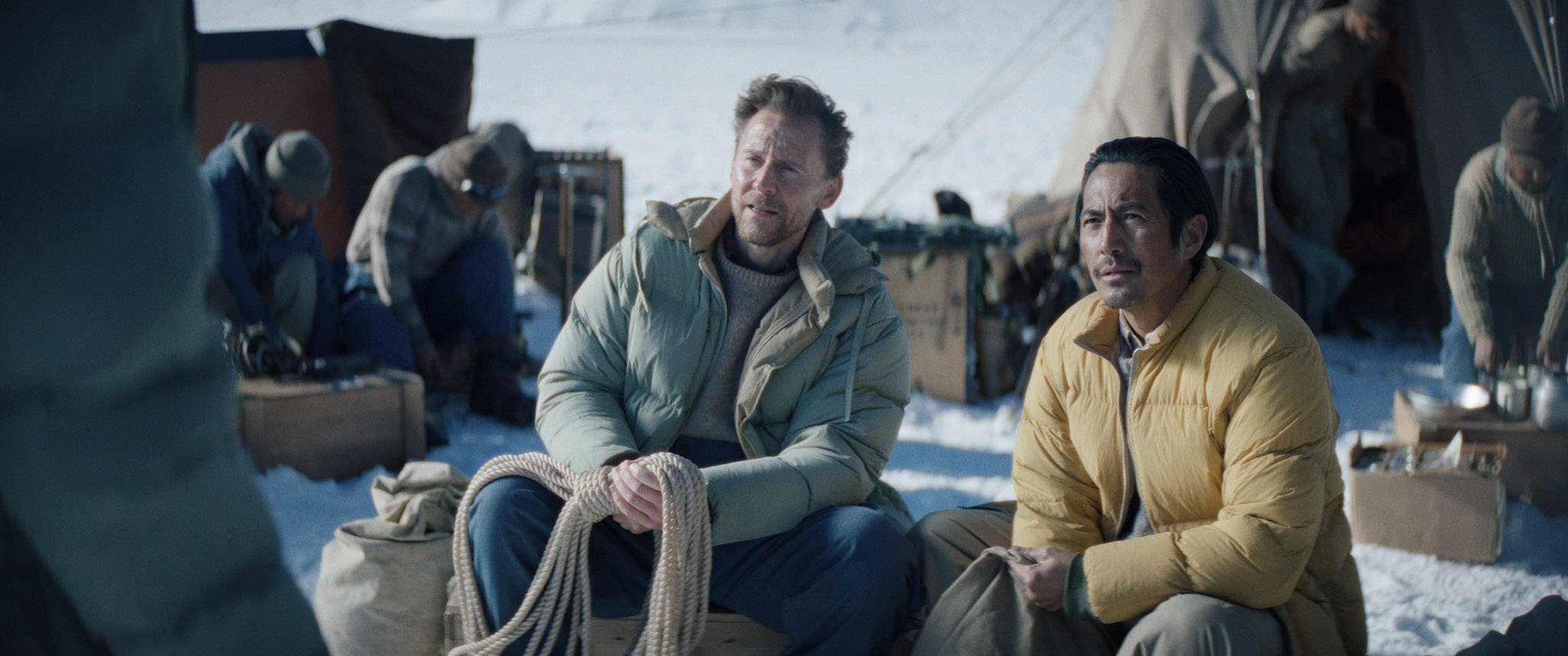
Tom Hiddleston as Edmund Hillary and Genden Phuntsok as Tenzing Norgay. Frame courtesy of Apple.
How did you convince the studio and insurance company to allow real actors, who hadn’t climbed, climb on real mountains?
The key was demonstrating that we could manage the risks properly. I’ve spent enough time in the mountains to have a very healthy respect for what can go wrong, and safety was absolutely paramount. We were fortunate to have Guy Cotter as our alpine production supervisor. Guy has summited Everest five times and has been running commercial expeditions in the Himalayas for decades. He knows the mountains of New Zealand intimately and was instrumental in identifying locations that gave us the visual scale we needed while allowing us to work safely.
We also assembled an extraordinary team of mountain guides, safety specialists, climbing Sherpas and stunt professionals. Between our cast and crew, there were more than 60 ascents of Everest. Tom Hiddleston and Genden Phuntsok undertook extensive climbing training, including technical rope work, rock climbing and ice climbing. By the time we reached the more demanding sequences, they had developed considerable confidence and technical skills.
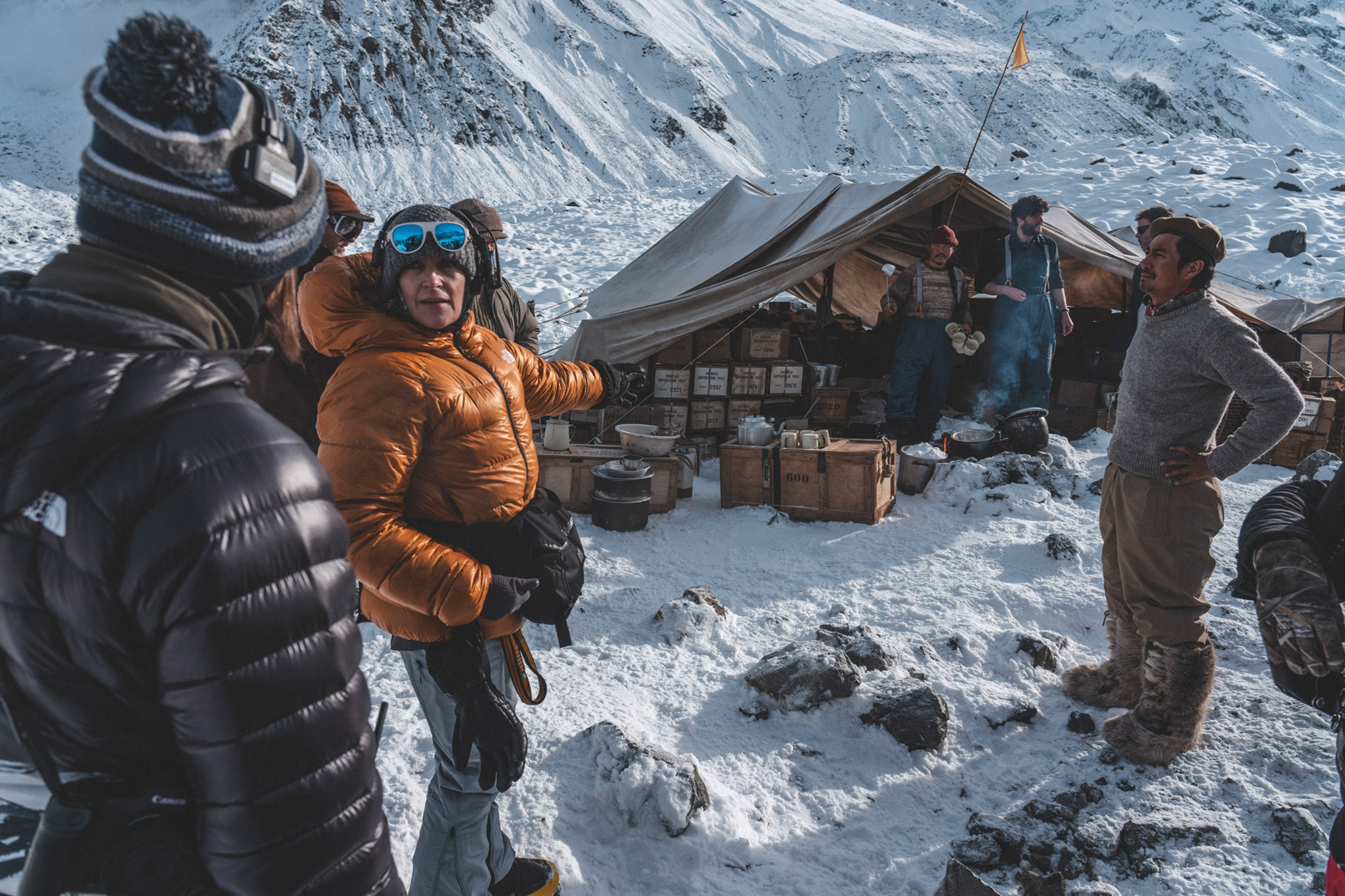
Jen Peedom (in orange jacket) at Base Camp location. Photo: Renan Ozturk.
One of the things that really helped was the detailed planning of the mountain sequences. We storyboarded extensively and used Unreal Engine to create previsualizations of the more complex stunts. This allowed the producers, actors, stunt and safety teams, and all the other departments to see exactly what we were proposing and to plan meticulously around it. I think that was an essential tool in demonstrating that we could achieve these sequences safely.
The actors were then able to rehearse in the actual crevasses and climbing locations we’d be using, so they weren’t encountering those challenges for the first time on the day of filming. We used fixed ropes and carefully planned safety systems, and had stunt doubles available for the more dangerous work. But ultimately, Tom and Genden performed far more of their own climbing than we’d anticipated. When you see them negotiating crevasses or recreating the Hillary Step, they’re genuinely climbing on real mountain terrain, rather than performing in front of a green screen.
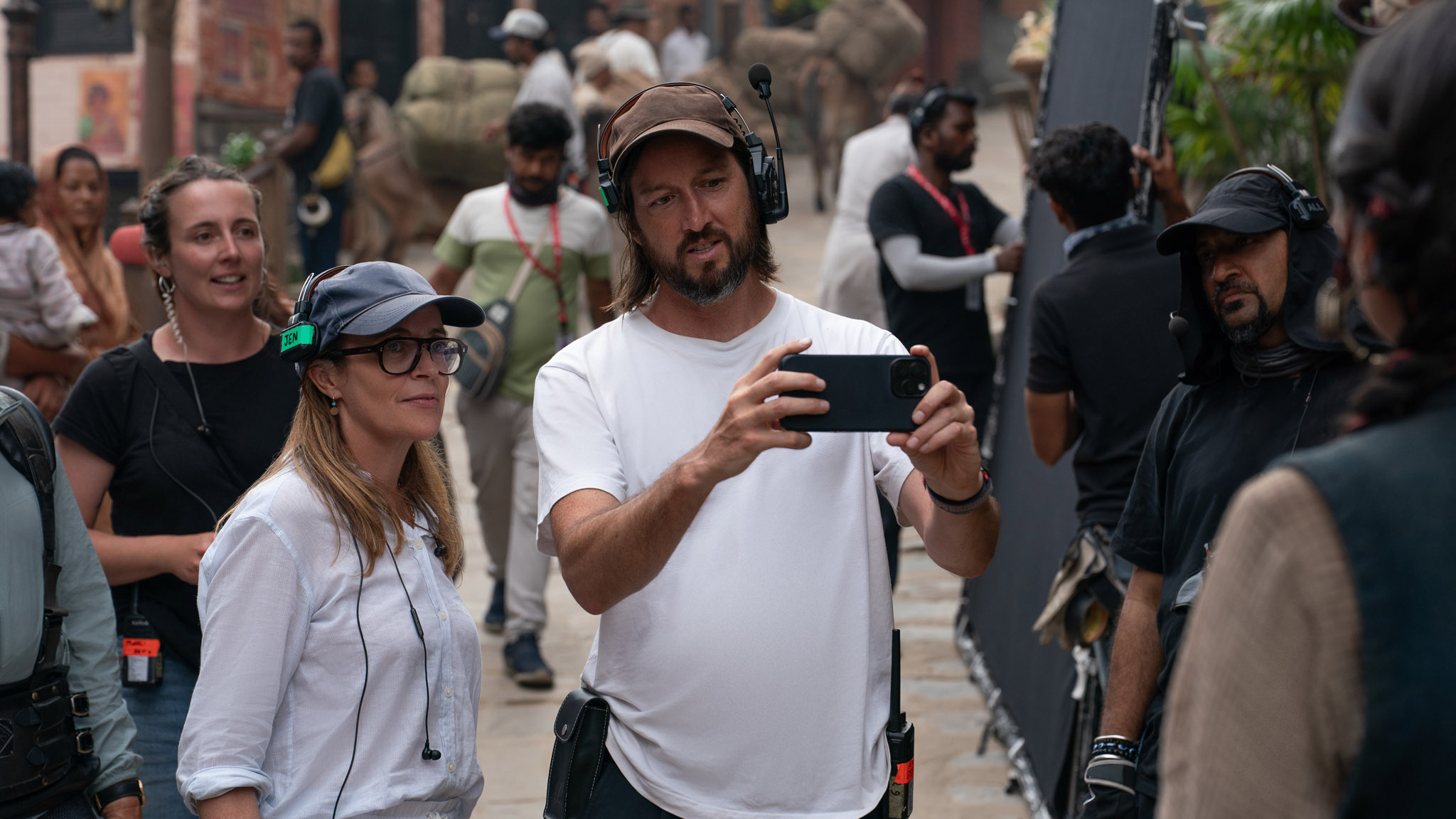
Director Jennifer Peedom with Stefan Duscio, ACS. Photo: Kirsty Griffin / Courtesy of Apple.
Stefan Duscio, Director of Photography says in his interview, “I’d been on some pretty casual hikes.”
Stefan is being very modest. He’s a natural in the mountains, incredibly fit and strong, and pretty fearless. He also had complete trust in our alpine safety team, which meant he could throw himself into the creative challenges and problem-solving without being preoccupied with the environment.
From our earliest conversations, he understood that this shoot was going to be an adventure, and I suspect that was part of the appeal. That was important to me, because not everyone thrives in such unpredictable conditions. Some people would understandably prefer to work in a more controlled environment, but for this particular film, shooting in real landscapes was an essential part of the vision.
One of the things I appreciated most about Stefan was that he never wanted the technical challenges to become an excuse for compromising the cinematography. He was determined that we could bring the visual sophistication of a major feature film into these environments, however difficult that might be. And he was right.
He worked incredibly hard to prepare, both physically and technically, and by the end of the shoot he was operating with real confidence in some extraordinarily demanding conditions. I think we learned a lot from each other. I knew the mountains and what was possible in those environments, and Stefan brought a depth of experience in dramatic cinematography that was invaluable to the film, and to me as a director coming from documentary.
How did you choose Stefan as DP?
I was looking for a cinematographer who could bring a beautiful, cinematic quality to a film that needed to feel both epic and intimate. I’d admired Stefan’s work on SHANTARAM and THE DRY, which demonstrated not only the breadth of his skills, but also his ability to create worlds that felt genuinely inhabited, rather than overly polished or artificial. THE DRY also demonstrated a real sensitivity to landscape and atmosphere.
But equally important was choosing the right person to go on this particular adventure. Working in the Himalayas and the mountains of New Zealand requires sensitivity, curiosity and openness. Stefan wouldn’t always have his usual crew or equipment, so he needed to be comfortable adapting to different teams and ways of working.
What struck me about Stefan was his quiet, collaborative approach. He wasn’t someone who needed to impose a particular way of doing things. He seemed genuinely curious about what other people, including the local crews and mountain specialists, could bring to the process. When we met, we connected very quickly over the kind of film we wanted to make. We both loved classical, immersive cinema and wanted the audience to feel as though they were experiencing the events alongside the characters.
And when you began filming?
What became particularly clear once we started working together was just how exceptional Stefan is as a leader. This was my first scripted feature, and an unusually ambitious one, so having someone with his experience, confidence and creative instincts was invaluable. But what really impressed me was how he brought people together. His crew, the Sherpa team and the actors all adored him. His collaboration with Renan Ozturk and the second unit team was also extraordinary, particularly given the complexity of integrating their work across such different environments.
Stefan never lets ego get in the way. He’s always interested in the best idea, regardless of where it comes from. He has that wonderful balance of technical precision and creative instinct, but also the generosity and confidence to bring out the best in everyone around him.
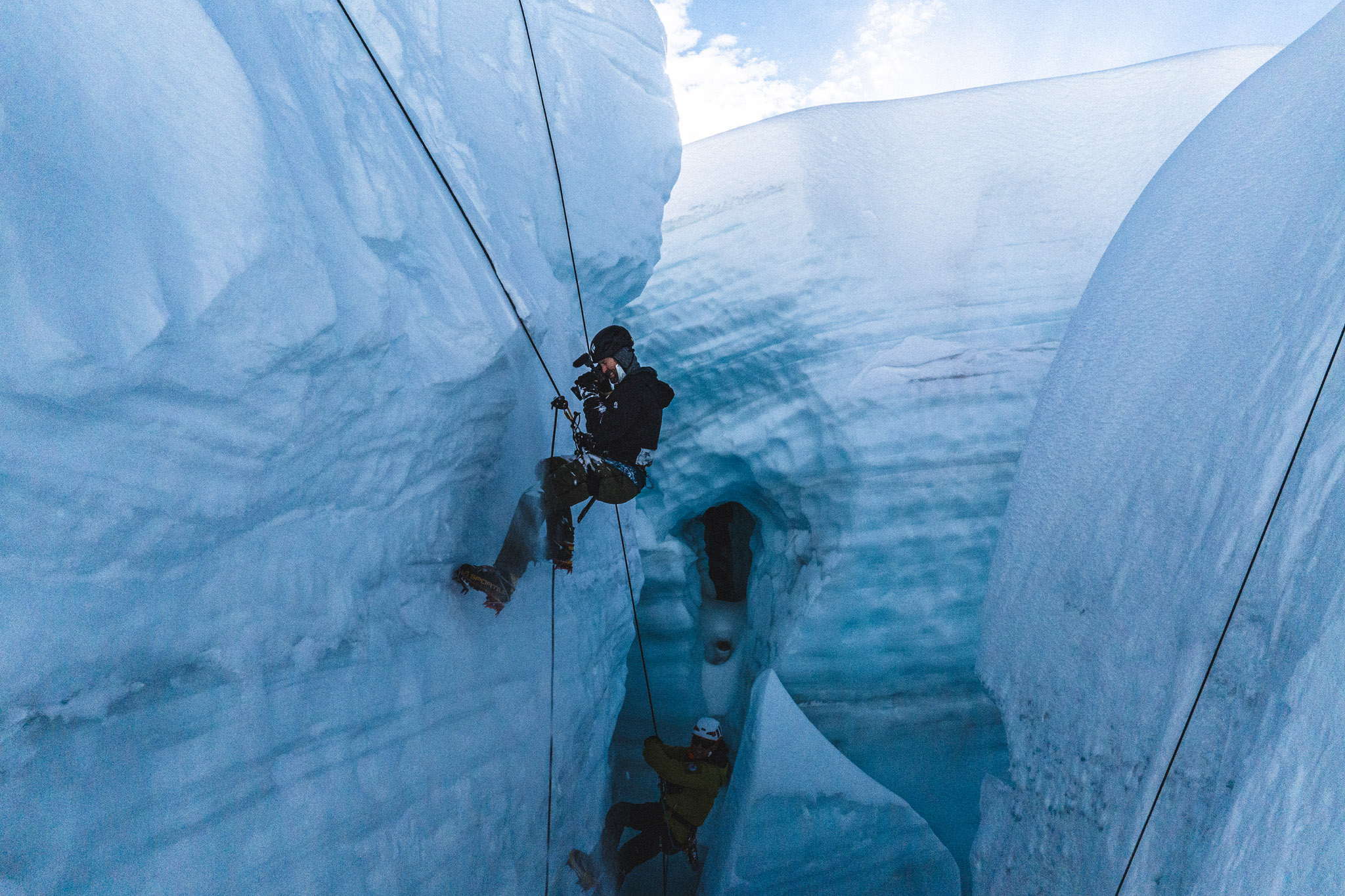
Second Unit Director / DP Renan Ozturk in crevasse. Photo courtesy of Renan Ozturk.
I know you worked with Renan before. Please tell us more about Second Unit.
Renan and I go back a long way. He was one of the principal cinematographers on my documentary SHERPA, and his extraordinary imagery has also featured extensively in MOUNTAIN and RIVER. He’s a rare combination of world-class climber, visual artist and deeply instinctive filmmaker. I knew from the beginning that I wanted Renan involved in TENZING, because there are certain things he can do in the mountains that very few cinematographers in the world are capable of. But equally importantly, we have a shared understanding of how to tell stories in these environments, and I trust his instincts completely. He directed our second unit, which was a substantial part of the production and involved much more than simply capturing beautiful mountain imagery.
In Nepal, his team filmed parts of Tenzing’s journey across the Himalayas, including the family’s exile from Tibet, as well as the British expedition’s long approach towards Everest. In New Zealand, he was responsible for many of the spectacular climbing sequences and details, often working in places that were extremely difficult to access. Renan has a remarkable instinct for where to put a camera in the mountains. He understands movement, exposure, scale and the physical experience of climbing in a way that very few people do.
He also worked closely with Stefan, including on the later Everest expedition to capture the real mountain landscapes and VFX plates. Bringing all that material together into a consistent visual language was an important part of the process, and their different skills complemented each other beautifully.
I also loved that Renan’s team included a highly skilled Sherpa camera crew, including some of the people we’d worked with ten years earlier on SHERPA. For me, having people from the Himalayan community involved in telling this story, both in front of and behind the camera, was especially meaningful.
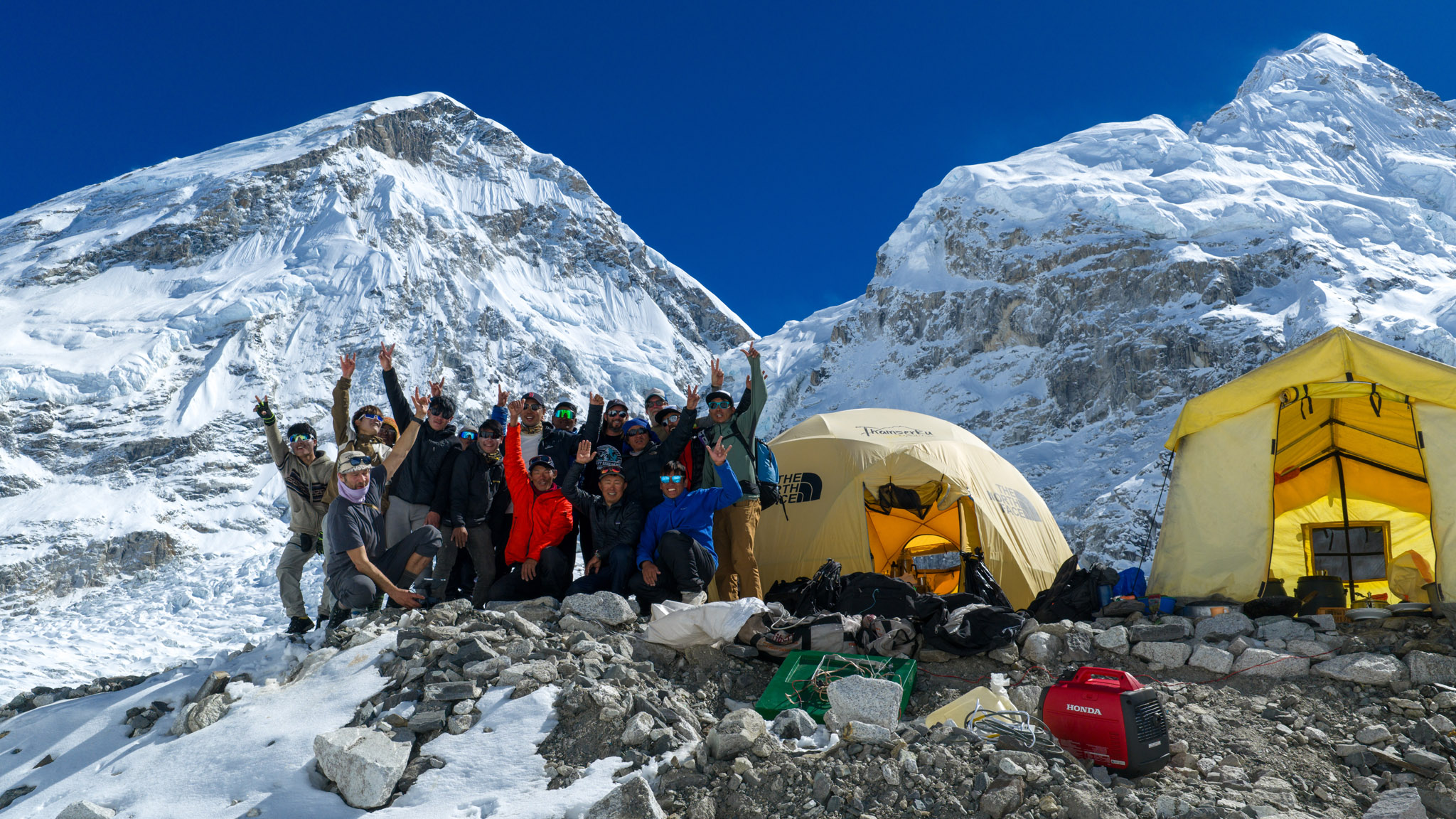
Crew at South Base Camp below the Khumbu Icefall. Photo: Renan Ozturk.
Did your documentary experience influence the approach to TENZING? In what ways?
Enormously. In fact, I don’t think I could have made TENZING without that background. I needed all the experience I’d gained over more than twenty years of working in these environments and building relationships with the Sherpa community. Documentary filmmaking taught me to observe people closely, to respond to what’s happening around me, and to recognize moments of emotional truth that I might not have anticipated.
I tried to bring that sensibility to the performances. I wanted the characters to feel like real people rather than figures from history. I wanted the landscape to affect them in a genuine way. Shooting in real environments helps enormously with that. When actors stand on a narrow ridge with a thousand meters of exposure beneath them, you don’t have to ask them to imagine what that feels like.
Documentary filmmaking also teaches you to be resourceful and adaptable. In the mountains, the weather dictates so much of what you can do. You might have a carefully planned scene, but suddenly the clouds move in, the light changes, or the wind picks up.
Rather than fighting those conditions, you often have to find ways of using them. That was something Stefan and I worked on together. We planned meticulously, but we also needed to remain open to what the mountains gave us. And perhaps most importantly, my documentary background taught me the value of trust. I’ve spent more than twenty years building relationships in the Himalayan community, and those relationships were absolutely foundational to this film.
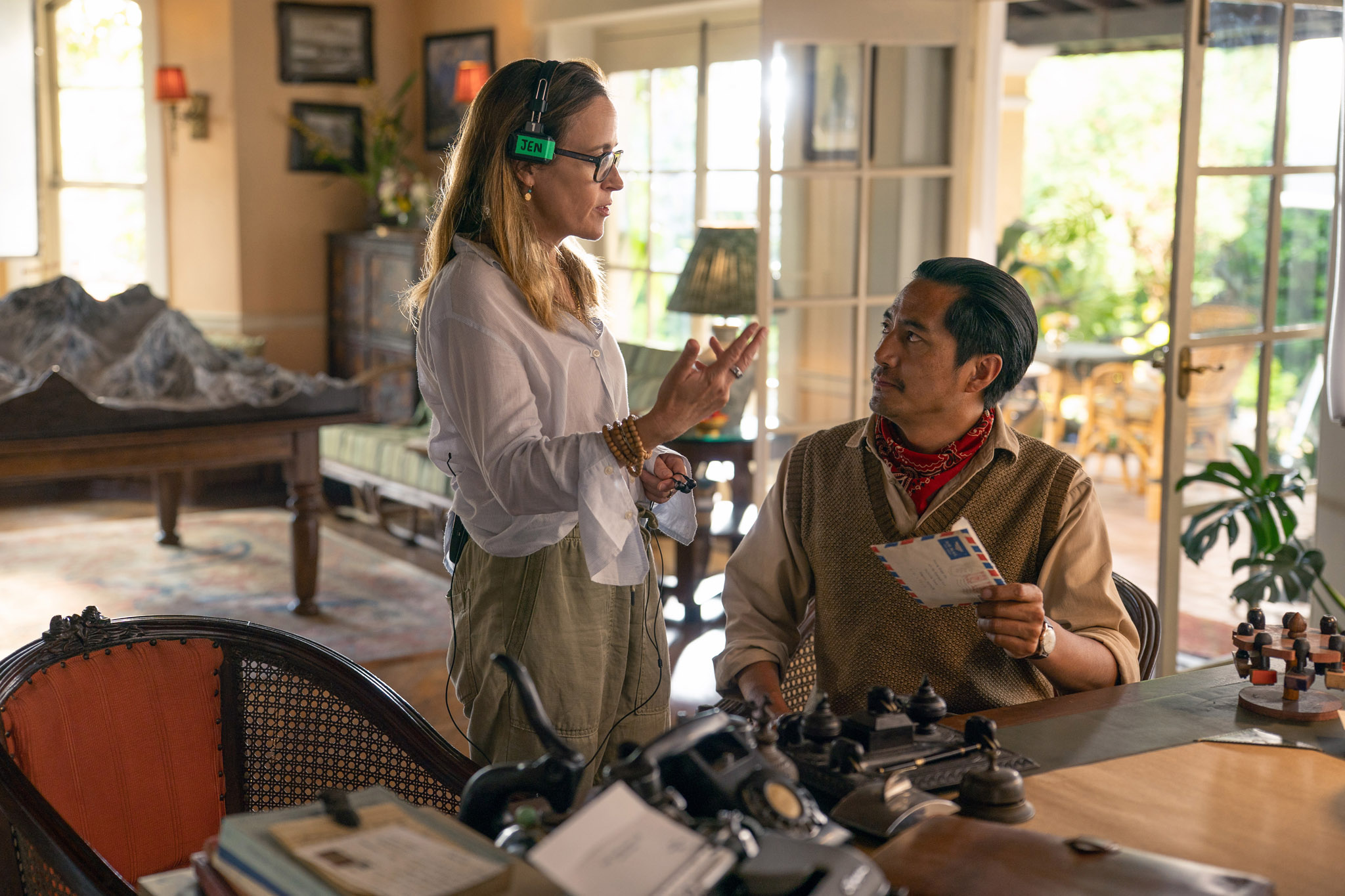
Director Jennifer Peedom with Genden Phuntsok as Tenzing. Courtesy of Apple.
Your editing and structure of TENZING was terrific: a period piece with flashbacks upon flashbacks.
Thank you. The structure was one of the great challenges of the film, and something we worked on for a very long time. We knew we wanted the 1953 expedition to provide the dramatic spine, but we also needed the audience to understand the extraordinary life Tenzing had lived before he ever joined that expedition.
In many ways, the physical climb is only the final chapter of a much longer emotional and spiritual journey. We experimented with how to move between the different periods of his life. Rather than following a strictly chronological structure, we wanted the flashbacks to emerge organically from Tenzing’s emotional experience in the present. The past needed to illuminate what he was feeling at particular moments on the mountain.
I worked with Simon Njoo, an editor I’ve collaborated with on several documentaries, and he was involved very closely throughout the shoot. One of our particular challenges was creating an emotional continuity between the three actors who portray Tenzing at different ages. Ultimately, we wanted the audience to feel that they were following one man’s inner journey, rather than moving between separate stories.
My experience in documentary editing was invaluable here. I’m very comfortable pulling a story apart and putting it back together in different ways until you find the structure that carries the greatest emotional truth. It’s one of my favorite parts of filmmaking.
Anything I didn’t ask that I should have?
Perhaps one thing worth mentioning is just how important the cultural collaboration was to the making of this film. We had a wonderful team of Sherpa and Tibetan actors, cultural advisers, language coaches and mountain professionals, many of whom had personal or family connections to the Everest story. Tenzing’s family was involved throughout the development and production, and we worked very hard to make the cultural details, languages and spiritual traditions feel authentic.
For me, the film was never simply about recreating the first ascent of Everest. It was about trying to understand the man behind one of the most famous images of the twentieth century, and telling that story from his perspective. There’s something quite beautiful about the fact that the film itself became a collaboration between people from so many different cultures and backgrounds, working together in some extraordinarily difficult circumstances.
In that sense, the process of making Tenzing reflected something of the story we were trying to tell.
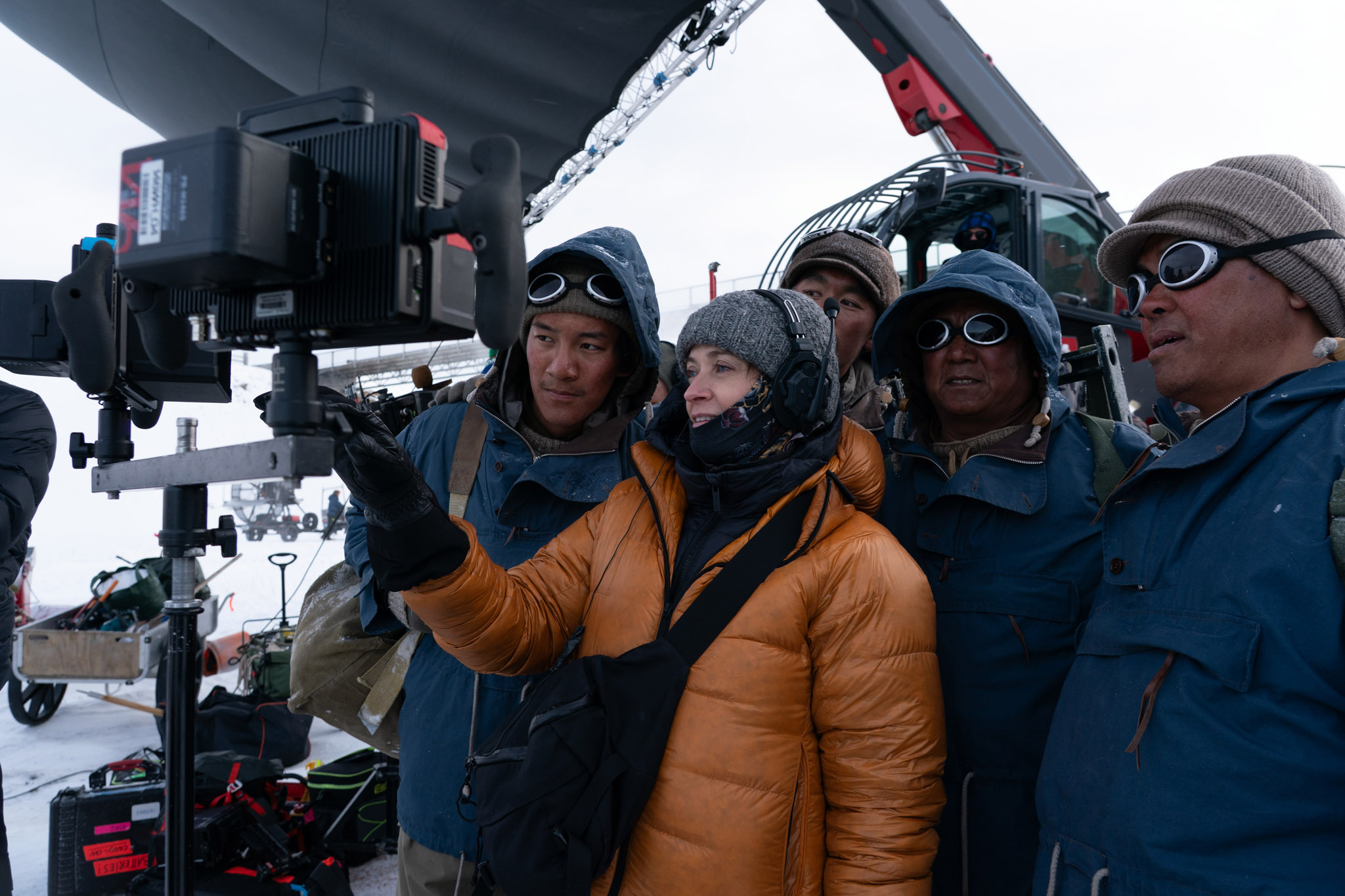
Director Jen Peedom. Photo: Kirsty Griffin / Courtesy of Apple.