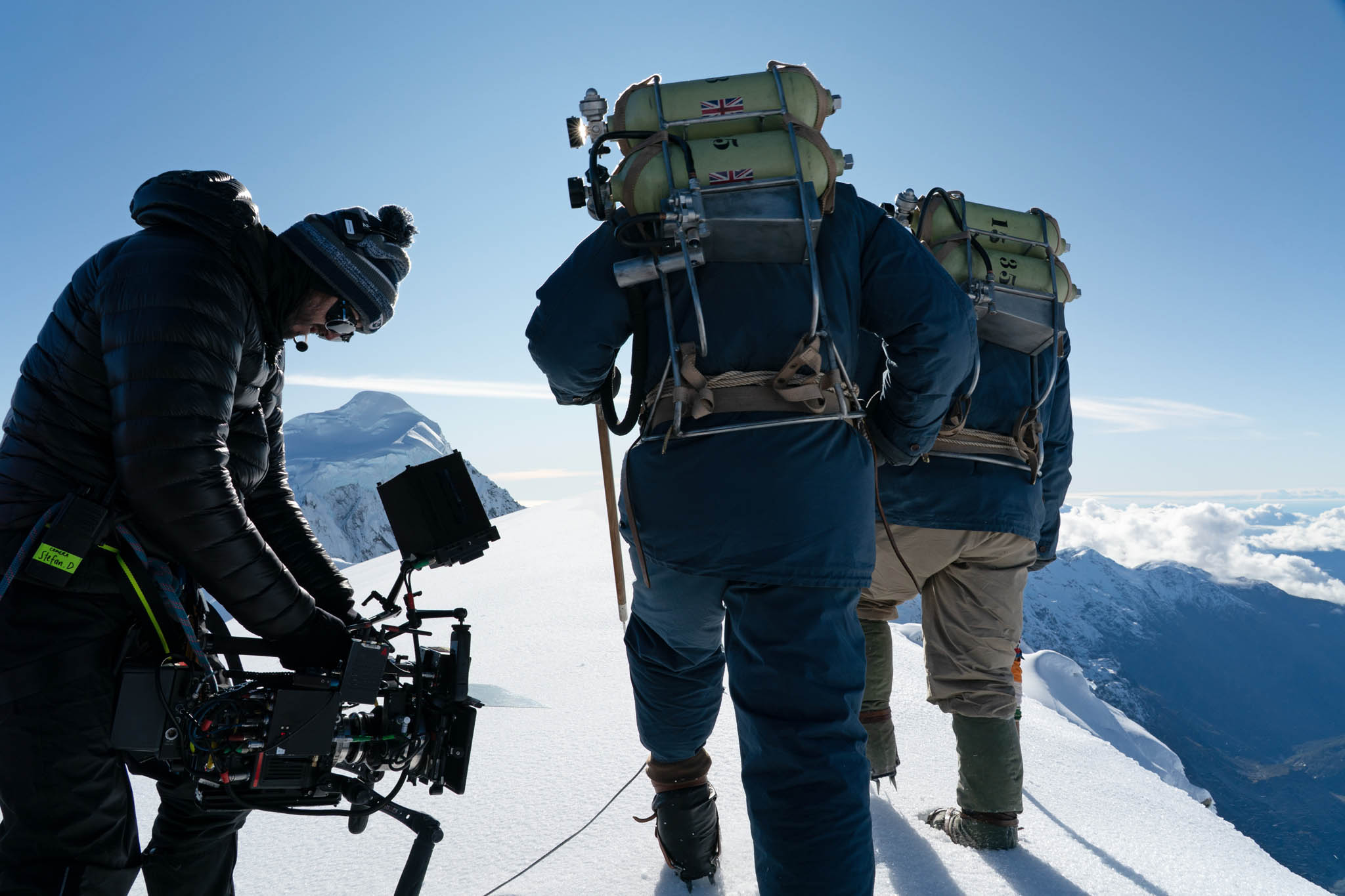
Stefan Duscio, ACS on TENZING. Photo: Kirsty Griffin / Apple TV.
TENZING is in theaters and streaming on Apple TV. It is the true story of Tenzing Norgay (Genden Phuntsok) who, together with Edmund Hillary (Tom Hiddleston) was the first climber to reach the summit of Mount Everest, Chomolungma, sacred mother goddess of the earth. Jennifer Peedom directed. Stefan Duscio, ACS was the cinematographer. We met at the New York premiere and spoke again a few days later.
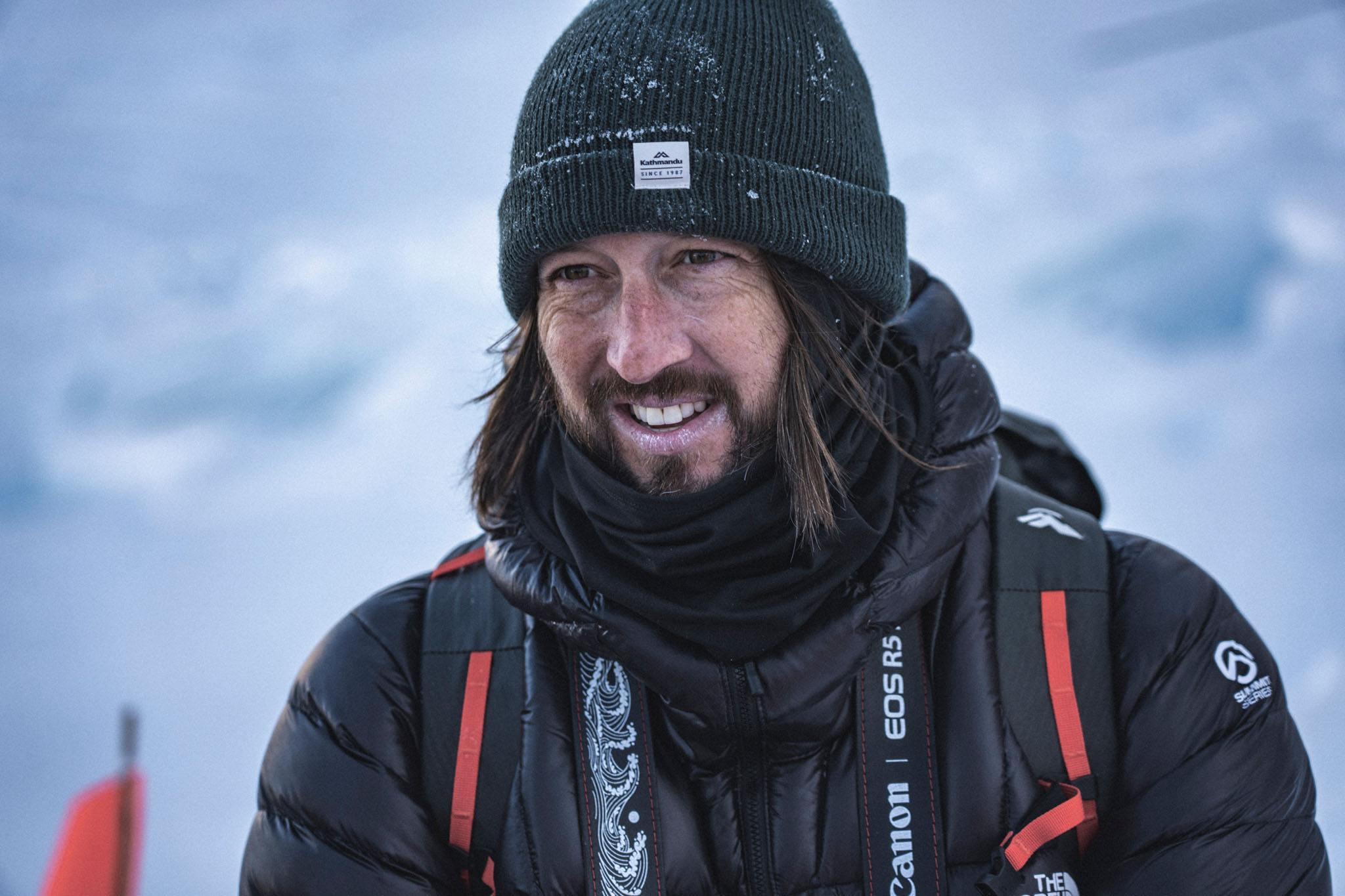
Stefan Duscio, ACS. Photo: Renan Ozturk / Apple TV.
Jon: TENZING is getting great reviews.
Stefan Duscio, ASCS: It’s been amazing. The reception has been really warm, and I think it’s surprising people because they’re expecting a mountain climbing film, which it is, but it’s also quite emotional.
The film is emotional, spiritual and uplifting. The modesty of Tenzing and Hillary is a refreshing theme. Hillary doesn’t want his picture taken on the summit, and it’s “after you, after you.” Not the usual “because it’s there” film.
It’s the antithesis of that. It’s beautiful. I’m glad you think that. Nepal especially needs a good news story right now. They continue to have ecological disasters and I hope this is an uplifting great story for Nepal. So many people of Nepal worked on it and are proud of Tenzing.
It was beautiful that we were filming in the homelands of both Tenzing and Hillary. The mountains of New Zealand, the Mount Cook region, were the mountains where Hillary cut his teeth, and there’s an Ed Hillary Museum there. Tenzing himself went and visited Ed over there. There’s a Tibetan and Nepali community in New Zealand and they love climbing in the Mount Cook area.
It felt like we had this wonderful blessing and connection from both communities and both countries that honored these two men. Norbu Tenzing, Tenzing’s son, came to the set in New Zealand and joined us for dinner one night, on the same day that the Māori indigenous leaders of the area welcomed us to the region. They knew Norbu Tenzing because he’d been to New Zealand several times before and has close ties with the Māori community. There were so many moments of synchronicity and blessing on the shoot. So many people thought we weren’t going to get it done in those New Zealand mountains, because many productions have tried and just didn’t finish their days. They get two days done every two weeks because of the weather and climate. That was always hanging over us, but something blessed us all, and it’s a miracle we got it done.
What was the shooting schedule?
It was a 45-day shoot. I think we began in March or April last year in Nepal, and we finished around August 2 in New Zealand.
That’s pretty quick.
It was spread out a bit because of weather and country moves, and there was a lot of moving.
Did you have everything you needed in the camera department?
I was happy. I never felt wanting, but I also never over-ordered. I didn’t want to overthink it, because I knew we had to carry everything I ordered to all these places. So it was, “Let’s not overdo it.” Jen was very pragmatic in the way she works too. Given that a lot of her work has been documentary, she was able to work with what we had in a very simple, pragmatic way. A lot of the effort was just being in these locations. I didn’t need to add to the complications.
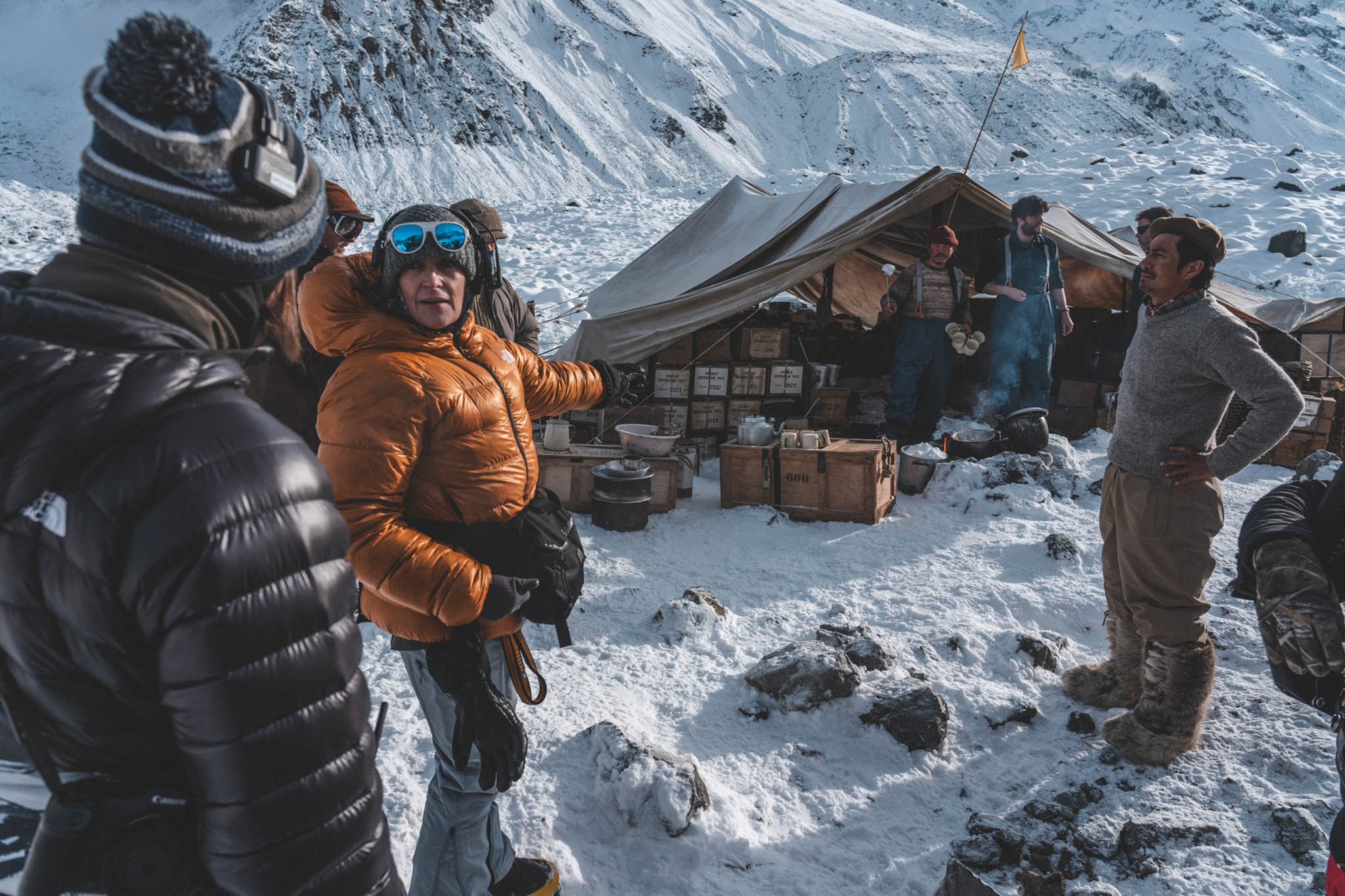
Jen Peedom (in orange jacket) at Base Camp. Photo: Renan Ozturk / Apple TV.
The style of the film was natural; directed with great sensitivity.
Jen Peedom handled it super well. You could tell there was a rapport with the actors. It’s an unbelievable achievement. Most people would do something easier for their first dramatic feature film. But she knows the material so well. She knows Nepal, she knows the Sherpa community, and she knows the Tenzing family really well, having helped them develop the film. We all fell in behind her, trusted her and wanted to do right by her and by TENZING. She had everybody’s full support.
Your cinematography on TENZING is terrific. How did that start?
Jen reached out to me in 2024 to discuss the film. I was familiar with her amazing documentary work and excited to hear that she was planning a film about Tenzing Norgay’s ascent of Mt. Everest, one of the great untold stories of the 20th century. The world was watching this expedition and most people already know about Edmund Hillary. I was eager to work on a classic biopic like this. She wanted to make it in an old-school fashioned way, nothing fancy: take a real crew with real actors to real locations and tell the story. That attracted me a lot.
What do you think resonated with her to ask you on as a DP?
I think she’d seen my work on THE INVISIBLE MAN and SHANTARAM.
I remember SHANTARAM. Another great journey.
That was for Apple TV as well. I think Jen reacted to the texture and color of my work on SHANTARAM, another classic adventure tale about wanderlust and exploration. We hit it off in our meetings and got along well.
Had you done mountain climbing before?
Nothing like this. I’ve been on some pretty casual hikes.
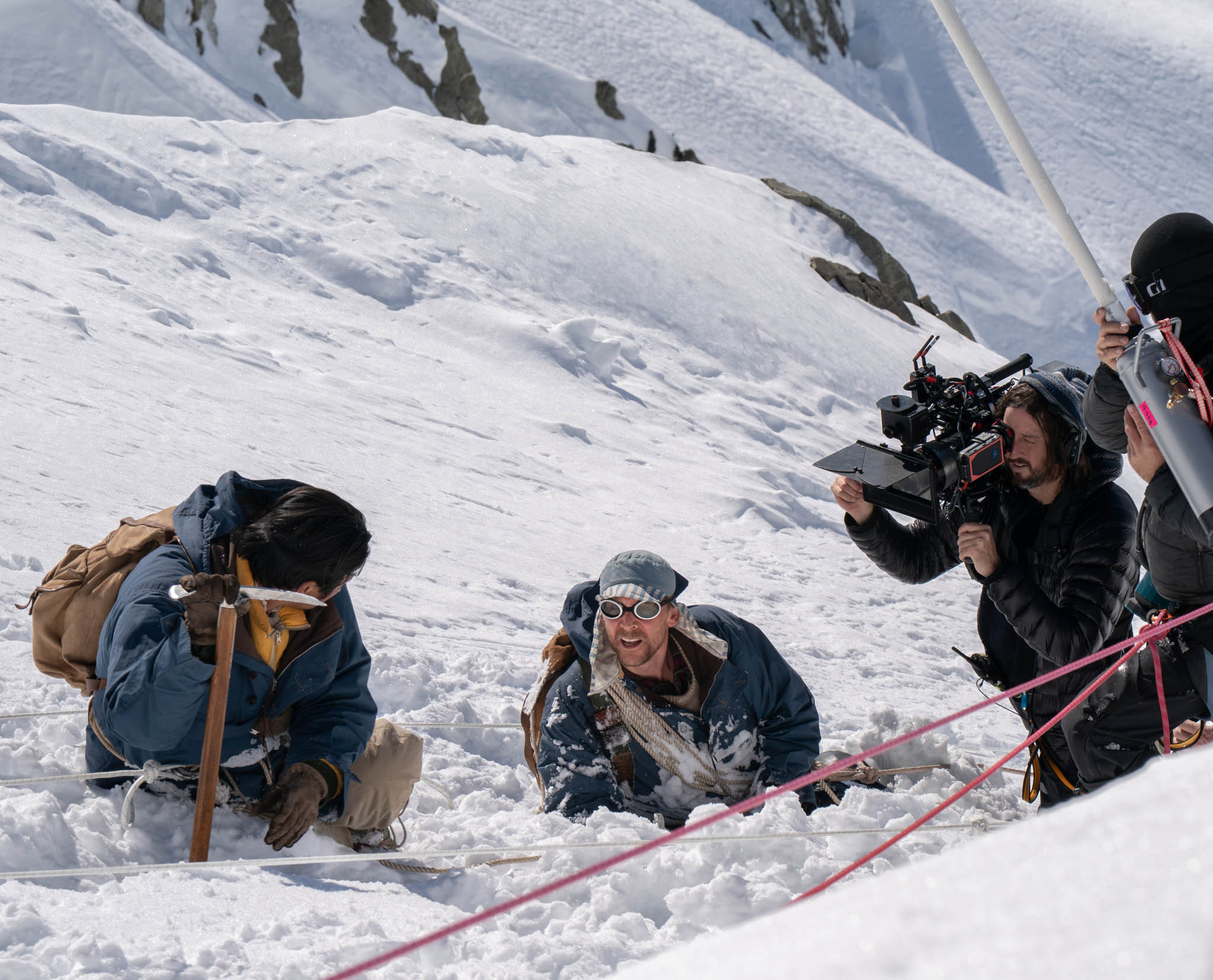
Hardly a hike—Stefan Duscio at right. Photo: Kirsty Griffin / Apple TV.
Everest is hardly a hike.
That world was very foreign to me. I’m a sea-level person. But I have deep admiration for the climbing community. Jen is an Australian filmmaker who has been climbing for many years. A lot of her documentary work was in the Himalaya mountains. The stories took her there, she had a camera, and she became very good at both.
I learned a lot about working in these environments from Jen and the team she brought on. Many had worked on her documentaries in the past. But I was also trying to show her that you could take cinematic-level equipment to these environments without compromising on quality or storytelling. There’s a lot of pressure at times to take smaller packages, smaller cameras and smaller lenses to these high-altitude, perilous environments. But I’m pretty stubborn and I thought the story deserved the best possible cameras and lenses. I didn’t want to compromise on that.
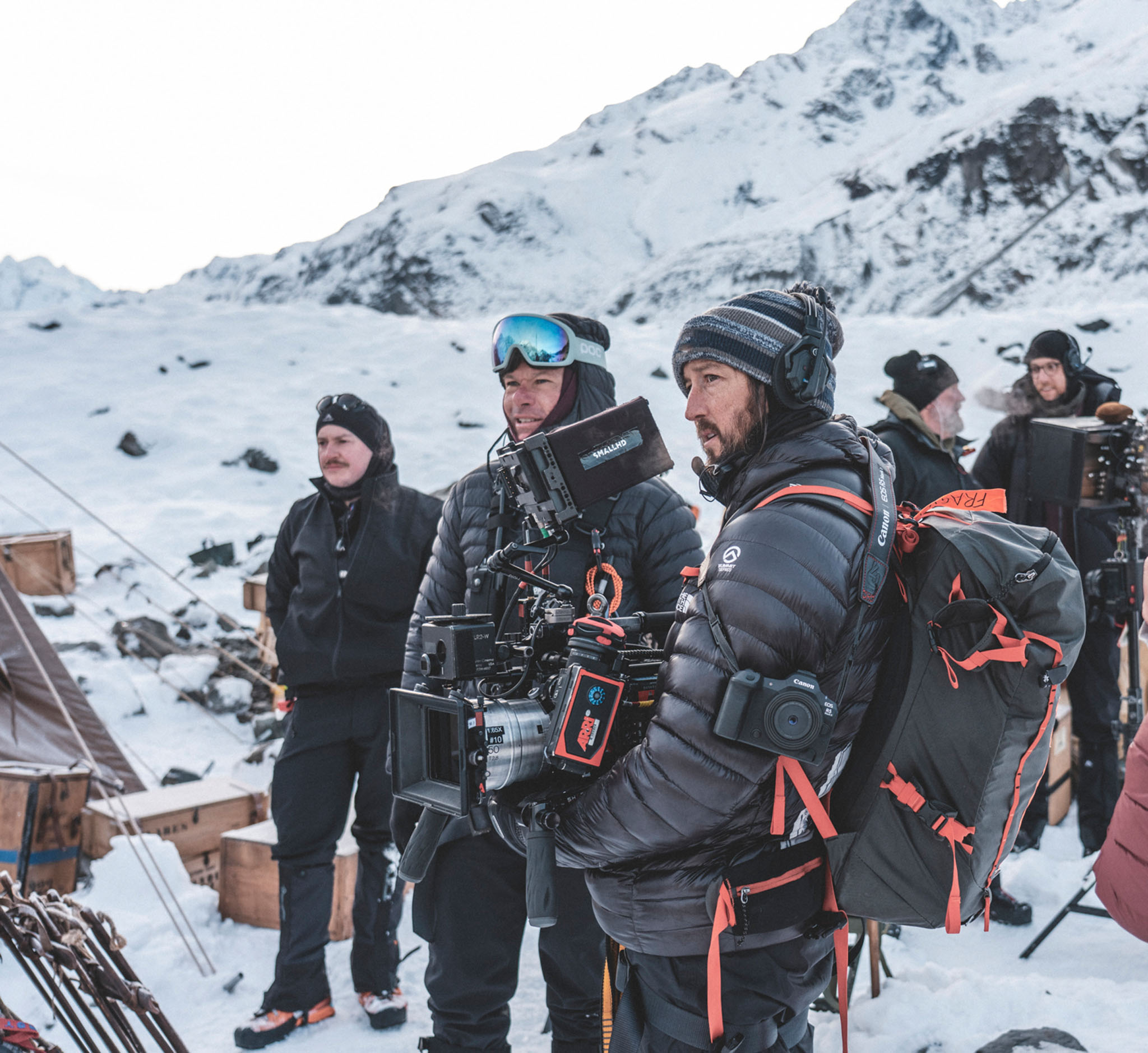
Stefan Duscio, ACS with camera. Photo: Renan Ozturk / Apple TV.
That’s a good transition to talk about the equipment.
I shot primarily on the ALEXA Mini LF. We had several of those bodies on the main and second units. I used Panavision Ultra Vista 1.6x anamorphic lenses, which take up every photosite on the Mini LF sensor. You wind up with a widescreen 2.39:1 frame with about zero cropping by the time you’re done. I love that you use every part of the sensor. The lenses have a wonderful vintage anamorphic quality and such a beautiful, idiosyncratic texture. I’m endlessly inspired by how they render the world. I get so many happy surprises with them. I adore the 65mm focal length. I almost shot the whole movie on that 65mm because it was so versatile. I could shoot portraiture on it, but I could also shoot landscapes. I could put the camera on my shoulder or on a Steadicam and know that it would handle anything from a mid-shot to a close-up. It became our favorite lens.
Where did you rent from?
We prepped initially at Panavision Sydney with my camera assistant, Luke Thomas, whom I’d worked with many times before. He’s very familiar with these anamorphic lenses, which are incredible but can be very challenging to pull focus with that size sensor. It’s very unforgiving. After prepping at Panavision Sydney, we went to Kathmandu, Nepal, picked up whatever other local equipment we could get there—monitors, additional camera crew—and filmed in Nepal. Once we’d finished the work there, we moved to New Zealand and re-prepped out of Panavision Auckland to complete the filming in the mountains of New Zealand.
There’s a rental house in Kathmandu?
Sadly, there’s not, but we got a lot of equipment from Mumbai. We got most of our technical crew for Nepal from India and additional crew in Nepal. Our grip, gaffer, B-camera focus puller and all the second ACs were from India, as was our VTR operator. When we went to New Zealand, we hired a whole new crew. The only crew on both locations were first AC Luke Thomas and B-camera operator Dana Little, who was also our Steadicam operator.
Were the scenes at base camp shot at the Khumbu Glacier?
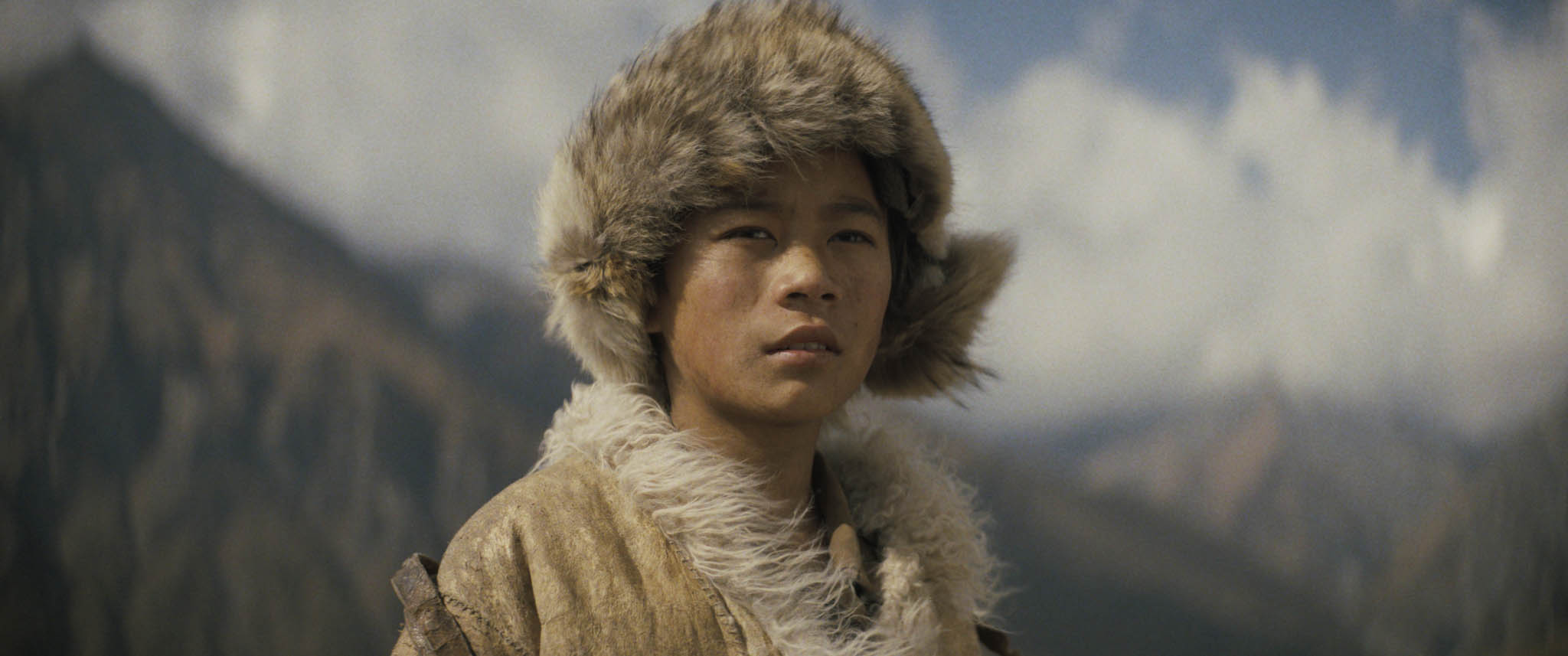
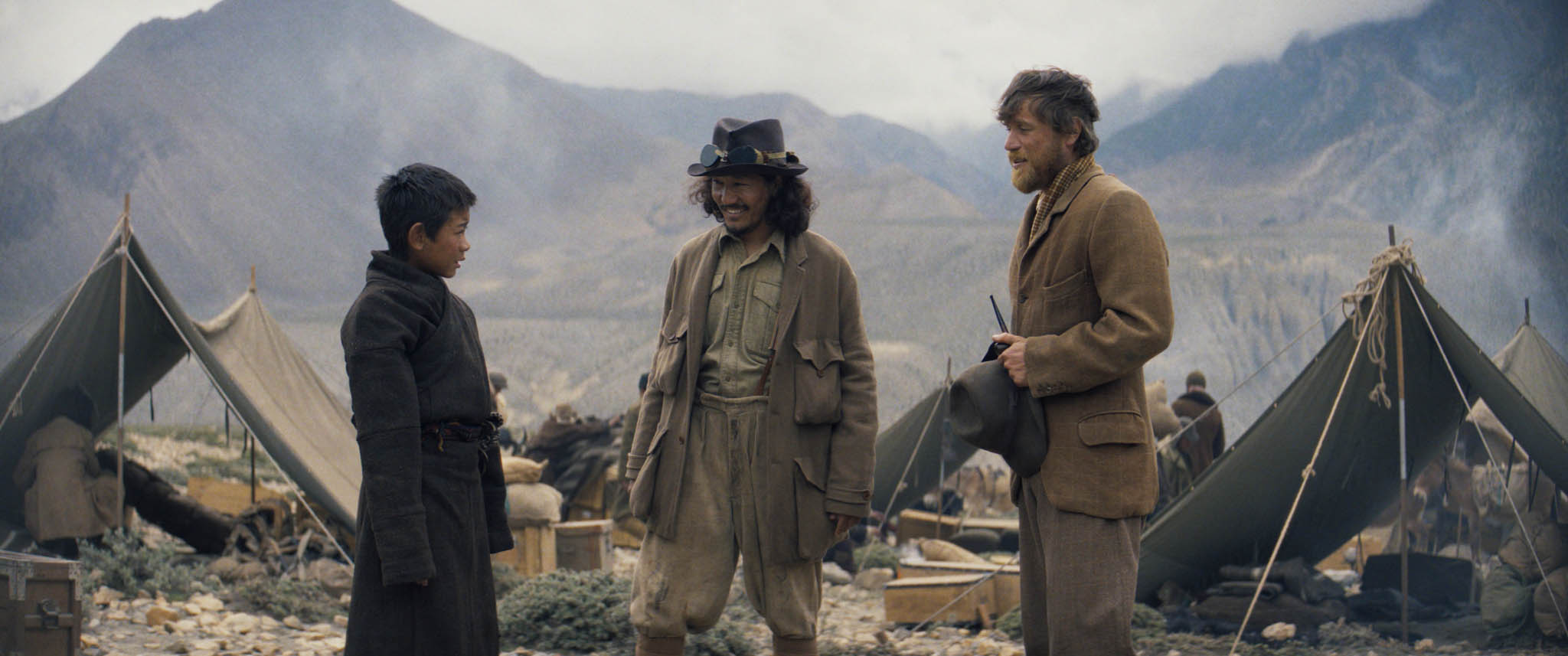
That was actually the beginning of our New Zealand work. This was a Nepal and New Zealand production. Think of Nepal as doubling for three countries: the Tibetan Plateau, India and Nepal itself. All the flashbacks of Tenzing’s early life were shot in the Lower Mustang region of Nepal, in Kathmandu and west of Kathmandu.
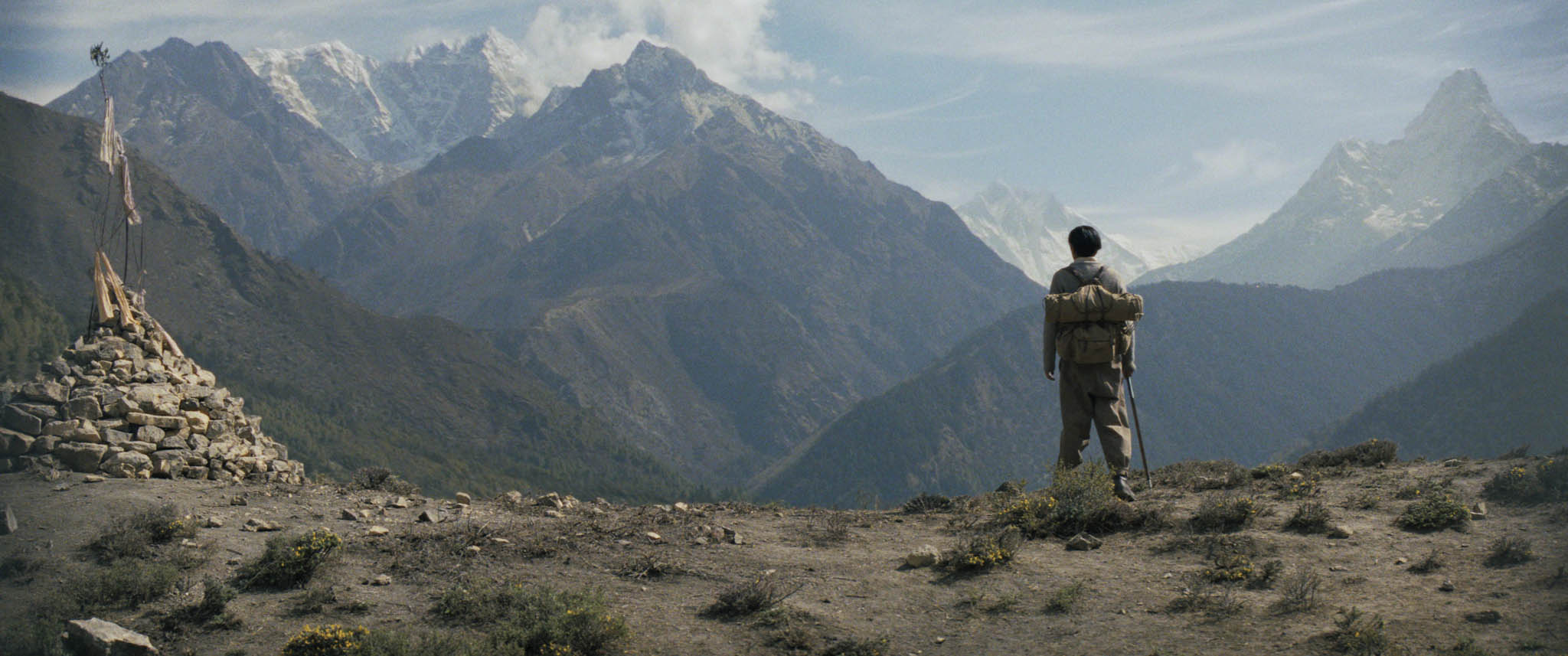
Where was the scene with that great rise-up reveal, where Tenzing is looking at the mountain and then you see Mt. Everest-Chomolungma?
That was in Lower Mustang as well, in the far northwest of Nepal, up near the border with Tibet. You are surrounded by 8,000-meter peaks there as well. The actual mountain in that shot was Dhaulagiri. We replaced it with Everest. We were inspired by that mountain and thought, “This is a great way to introduce Everest as a character in the movie and connect it with Tenzing spiritually.” I could have made that shot go twice as long. I loved it. I wanted to do it really slowly and just reveal it.
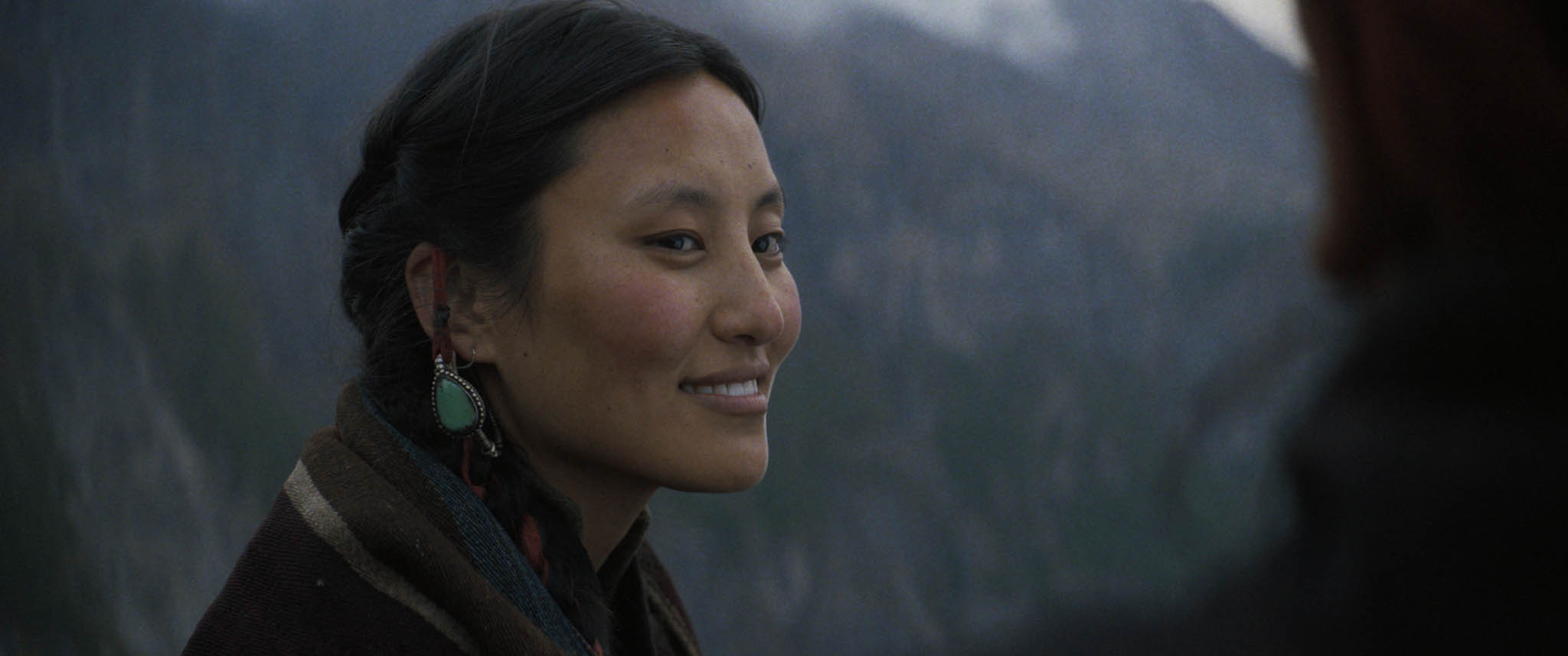
When Tenzing and his wife Dawa (Thinley Lhamo) moved to India, where was that filmed?
That was in Bandipur, a village a few hours west of Kathmandu. Our amazing art department transformed it into 1940s Darjeeling. We were there for about a week filming a lot of the flashbacks.
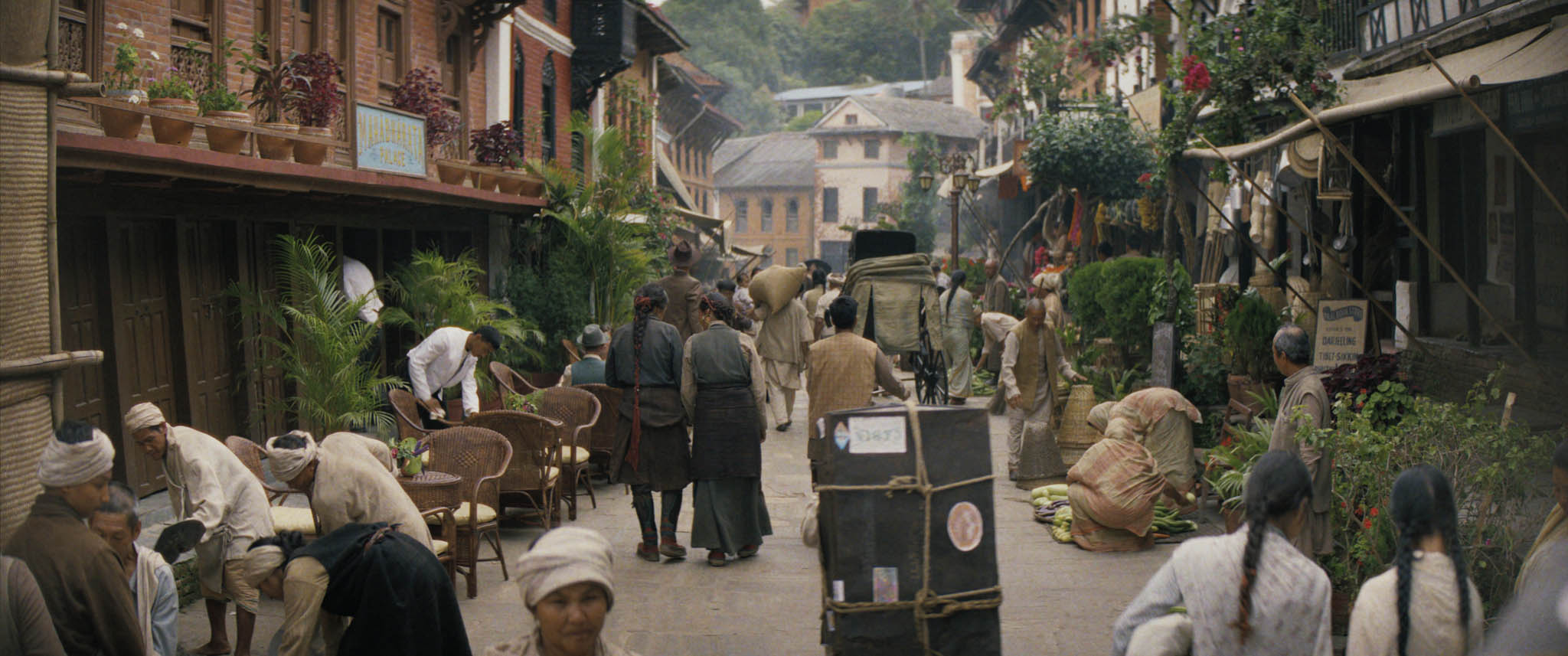
Frame courtesy of Apple TV / Apple Original Films.
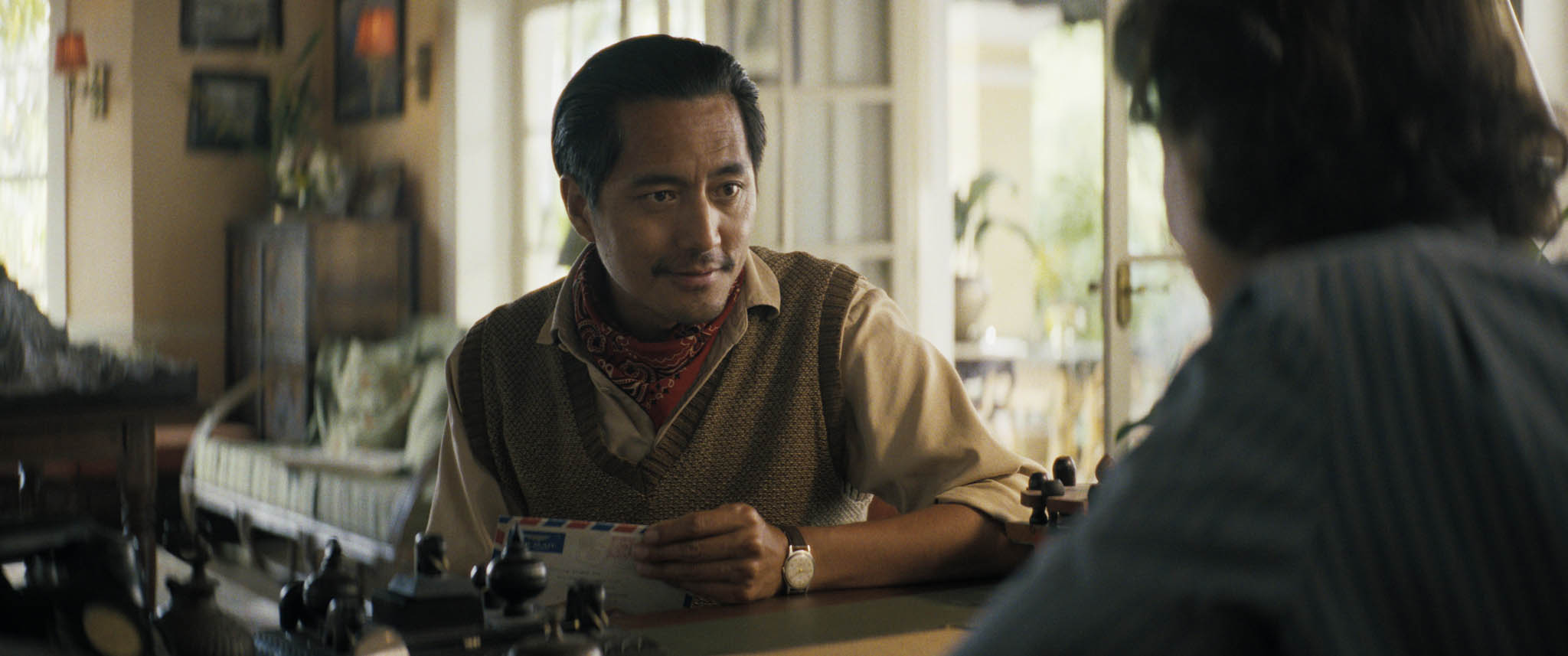
When Tenzing goes in for the first interview with Jill Henderson, how did you light that office?
Frame: Apple TV.
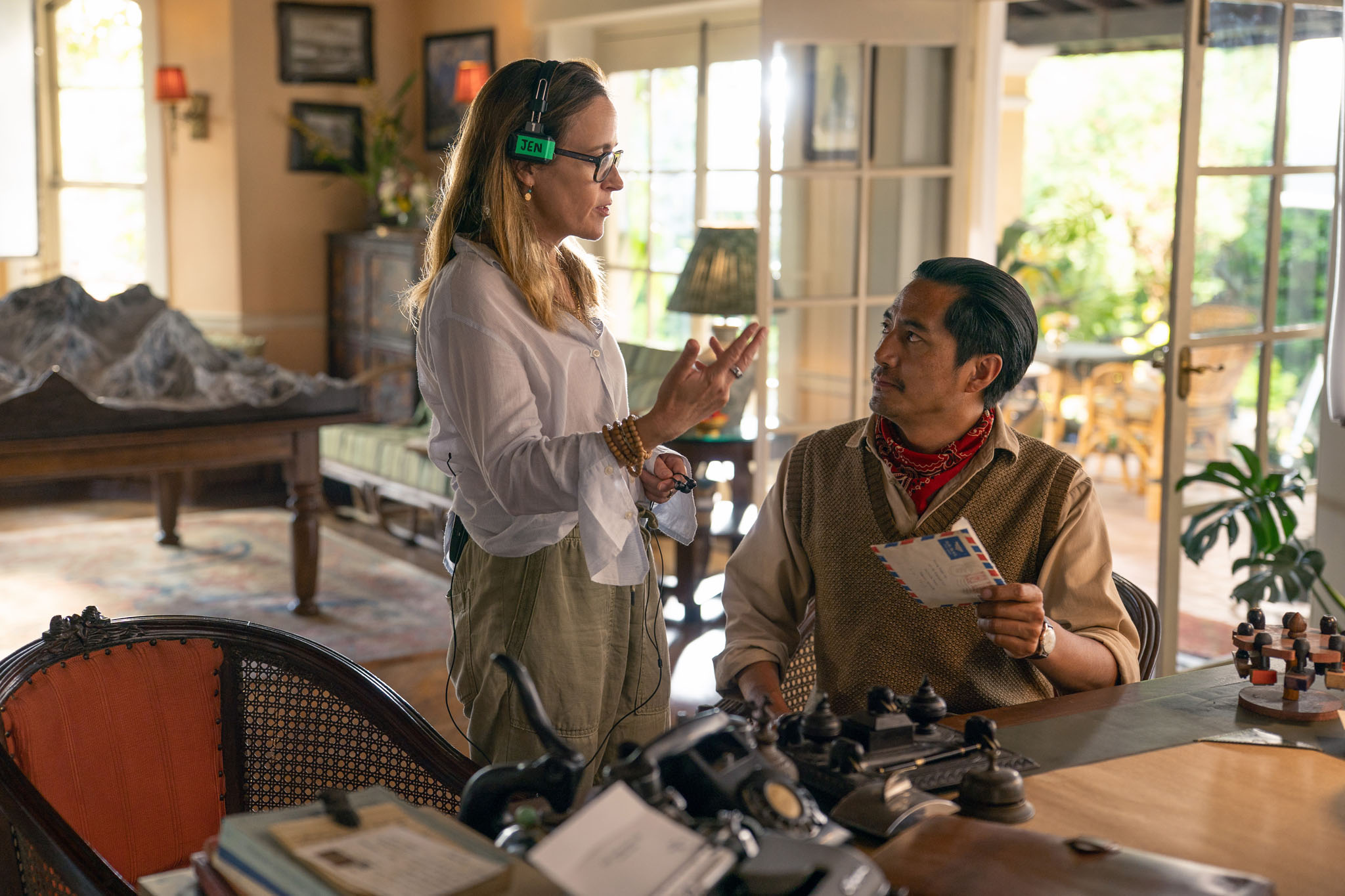
Director Jennifer Peedom with Genden Phuntsok as Tenzing. Photo: Kirsty Griffin / Apple TV.
That was shot in Kathmandu doubling for the Himalayan Club of Darjeeling, where all the expeditions originated.
Famously, that’s where Mallory started in the 1920s, and that’s where Tenzing heard from Mallory in the beginning: “Come to Darjeeling when you’re older.”
Frame: Apple TV
I lit primarily with LEDs: a lot of Creamsource Vortexes and Litegear LiteMats. We had some HMIs. I also had 18K ARRI HMIs for backlighting. That was probably one of our most well-resourced, accessible locations. We were able to light and shoot it comfortably. That was one of the rare exceptions.
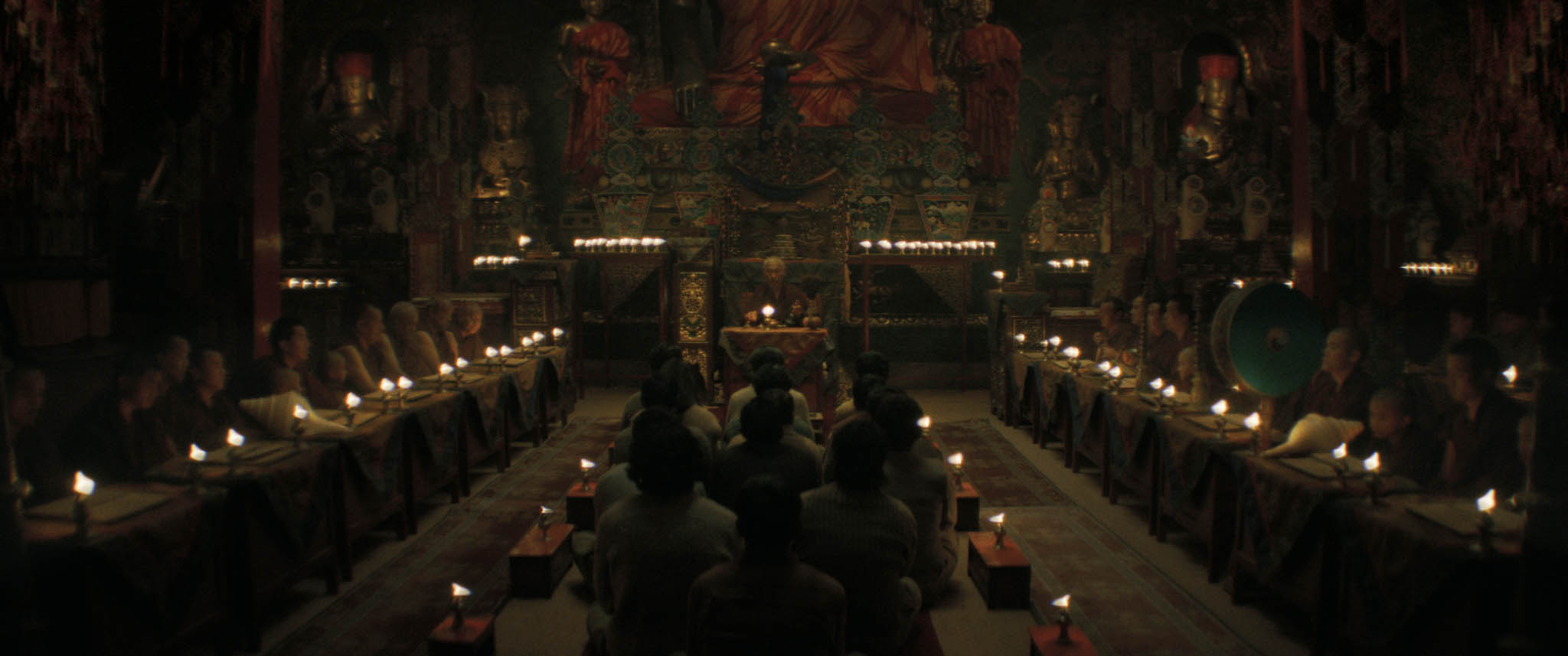
Monastery. Frame courtesy of Apple TV / Apple Original Films.
How did you light the Tengboche monastery?
The monastery was also in Kathmandu, but in the story it’s one of their final stops on their trek to basecamp. We blacked out the windows because I wanted it lit mainly by candlelight, very moody, spiritual and solemn. LED soft boxes were rigged throughout with egg crates. There were a lot of them up above, very gently secured with scaffolding in the ancient monastery. We had to be incredibly careful. There were hundreds of candles, but they weren’t bright enough, so we had a lot of Astera tubes that provided a gentle up-lit glow on the monks. Our gaffer, Rubb Bhungdawala, did a fantastic job. His team was great.
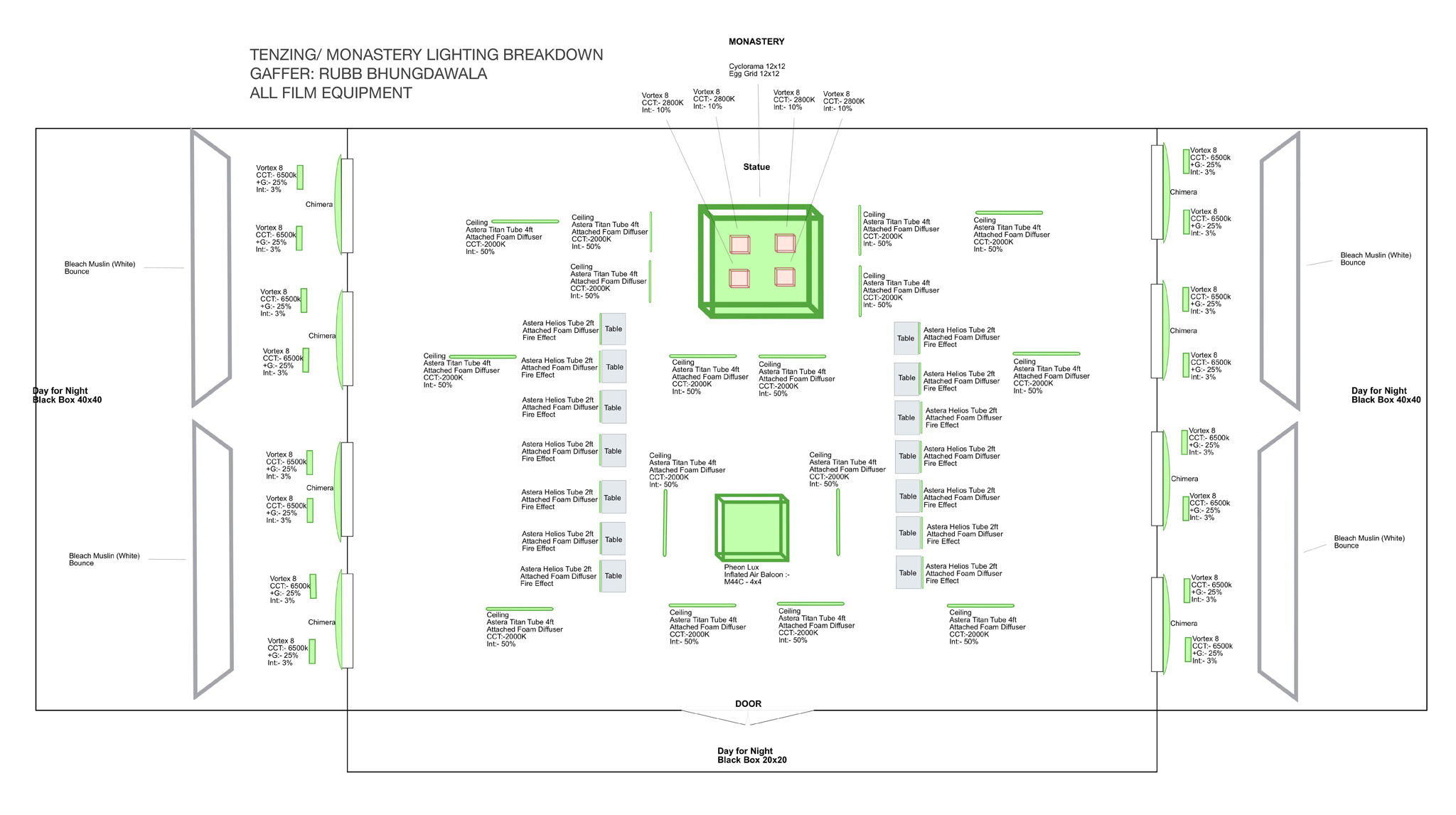
At what ISO did you rate the ALEXA Mini LF for those interiors?
For low light scenes, it was usually at 1280 ISO. I try to stick to that when possible, and I’ll only go to 1600 if necessary. The lenses were set at around T2.8½. I tried not to open those lenses up further unless I absolutely needed to.
And what about exteriors?
800 ISO whenever possible to protect the highlights. Occasionally I went to 400 ISO for a bit more shadow detail. It was very high-contrast work, with bright glaciers and dark clothing.
Lots of ND?
A lot of ND on the mountains. We had minimal lighting equipment and no generator high up on the mountain. I tried to use negative fill more often than not to shape faces in close-ups and mid-shots. We worked with a great New Zealand gaffer, Jo Bollinger. He was like a mountain goat and would offer up some gentle bounce or a highlight if we needed it.
What doubled for the Mt. Everest base camp?
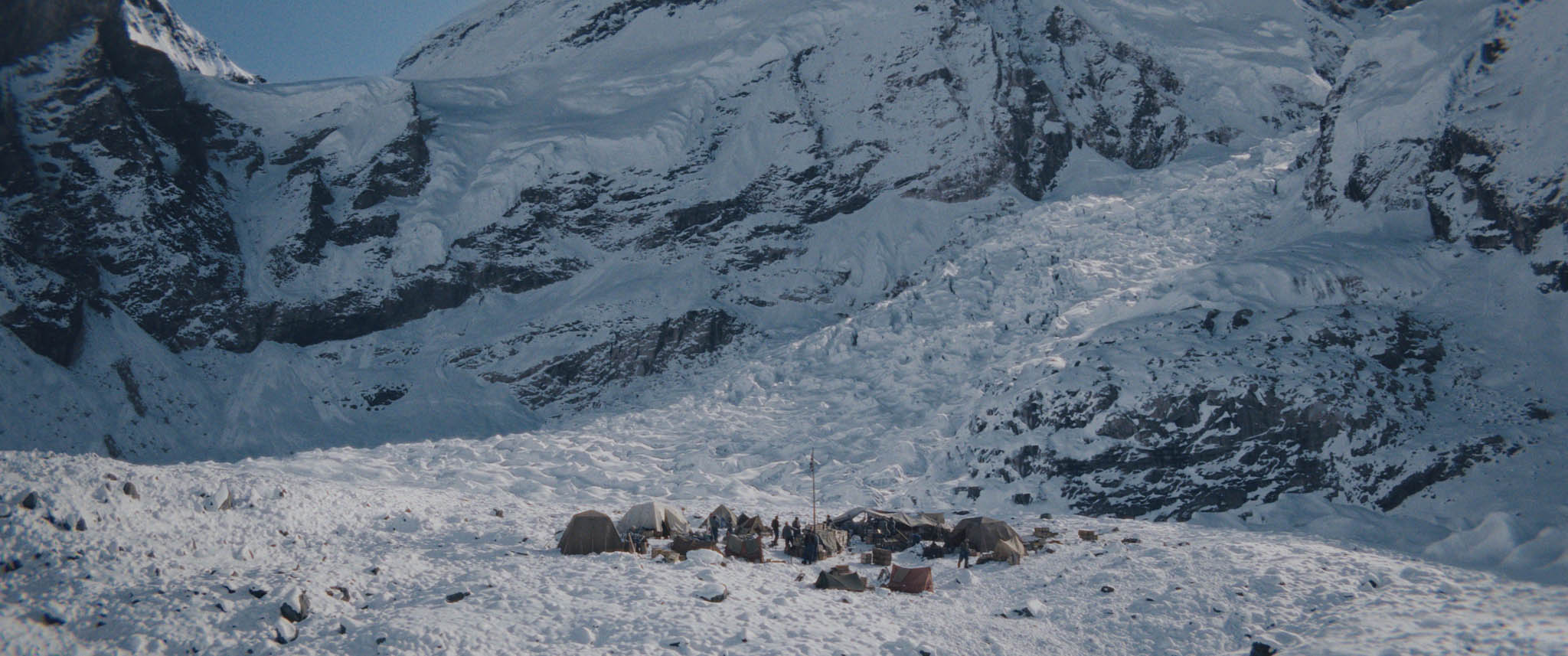
Everest Base Camp. Frame courtesy of Apple TV.
Aoraki/Mount Cook [3,724 m / 12,218 ft], on the South Island of New Zealand, doubled for base camp. Anything from base camp up, anything in snow, is New Zealand. We scouted thoroughly across the Southern Alps of New Zealand to find locations as close as possible to our Everest locations. Jen had obviously been to Everest many times before. We had an amazing mountain safety supervisor, Guy Cotter, who lives in that region of New Zealand and has also been running expeditions to Everest for the last 30 years.
He was an integral part of the crew, because he was part location manager, part supervisor, part advisor and safety supervisor. I could be scouting with Guy and ask, “Does this icefall look like the Khumbu Icefall? Does this look like the Western Cwm? Does this look like base camp or advanced base camp?” He was a great advisor on all that work.
Did you have VFX work?
A lot. I don’t want to undersell that side of it, because our VFX supervisor Jay Hawkins was integral in this jigsaw puzzle with Jen, Guy and me. Essentially, the plan was that once we finished main unit shooting, Jen and I wanted a lot of shots of the real Everest throughout the movie, and we didn’t want to rely on stock footage. We wanted to custom-shoot it for this movie with the same camera and lens package. We also knew we were going to need a lot of VFX plates to supplement our New Zealand work, because as fantastic as it looked, it wasn’t the real Himalaya in the background, and it wasn’t the real altitude. We were still very high up, but not at 8,000 meters. So, late last year, in October and November, I did a month-long production to get to Everest. We took a small unit to hike up the Khumbu Valley.
This time we prepped out of Melbourne, where I’m from. My assistant Luke and I flew to Kathmandu, did some further prep and flew to Lukla Airport. Then, our small team and many porters hiked to Everest Base Camp over 11 days, filming on the way.
We did ground-based and drone-based filming. When we got to base camp, we camped there for four days alone, without another soul there besides ourselves, because we were there outside of the climbing season. The Government of Nepal gave us special permission to be there.
Monsoon season?
It was November. Just before the monsoon season, I think. We did have some very heavy snowfall. It was actually a good match to our New Zealand base camp, which also had unseasonal snow across it, so they blended together well when matching plates. We were filming plates with the ALEXA Mini LF on the ground and drone-based work. I had a very strict shopping list from Jay Hawkins that I’d discussed with him: What do we need for every scene? What time of day? What lenses, ideally?
Once wed completed all that work, I took a helicopter up and down the Khumbu Icefall, the Western Cwm and up the Lhotse Face, as high as the South Col—very high. I filmed the additional plate work, as well as the full-screen shots of Everest that you see throughout the movie from an AS350 B3 helicopter.
What did you use for these aerials?
I worked with Brad Hurndell from Immortal Camera Systems and a new head called the Phoenix. He came over from New Zealand, assembled and fixed the head onto the helicopter in Lukla. For three days, I flew from Lukla to Everest and shot with the ALEXA Mini LF. This time, the lenses were ARRI Signature Zooms. I didn’t shoot anamorphic; I went spherical because I needed a lighter weight zoom in spherical Open Gate. The lighter the camera package, the higher we could fly.
Which zoom was it?
It was the 24-75mm T2.8 Signature Zoom, which was amazing.
Your Signature Zoom had an LPL mount, not a Panavision mount?
Exactly. We had to change the mount, because we were still shooting a lot of the ground-based work anamorphic. When we started doing the aerials, we changed the Mini LF camera’s lens mount to LPL.
Why did you trek into base camp rather than just take the helicopter?
Acclimatization was important to avoid altitude sickness. That was part of it. But we also knew we had to get a variety of shots through the Khumbu Valley on the way, and it felt like there was no other way except to walk.
It must have been difficult, even acclimatizing, shooting with all this heavy equipment on the way up over these narrow paths and bridges.
It was. I think my body was a little more prepared for it, having been to Nepal a lot that year and at high altitude in New Zealand. But it’s a whole other level of fitness you need to walk the Khumbu Valley and get to Everest Base Camp. When we got there, it was exhausting just lifting the tripod and being able to work. You just had to take it easy, slow and steady. The days were quite warm, but the nights were freezing. I had to get fitter than I’d ever been for this movie, just to stay healthy, keep going and be able to think creativity. I didn’t want my health ever to be the thing that held us back.
Please talk about the Second Unit Director/DP work of Renan Ozturk on TENZING.
Renan had worked often with Jen before. He shot SHERPA with her and much of her other documentary work. A lot of the footage in MOUNTAIN and RIVER is his.
Renan’s second unit work includes the sequences of young Tenzing and his family when they are exiled from the Tibetan Plateau and endure the changing landscapes into Nepal. He also shot a lot of the British expedition walking across the country from Kathmandu to Everest. A lot of the footage of Sherpas carrying heavy loads, walking past waterfalls and through valleys is Renan’s.
When we got to New Zealand, Renan did montage sequences to show the climbers on the Khumbu Icefall and the Lhotse Face. Renan was wonderful at getting climbing details because he’s a renowned climber himself. He was also involved in a lot of our scouting. For example, when we were looking for the crevasse that Hillary falls into and Tenzing saves him, Renan would rappel down these crevasses without a second thought, and then I would very slowly follow. He was fearless and a great collaborator. He also came to Everest with me.
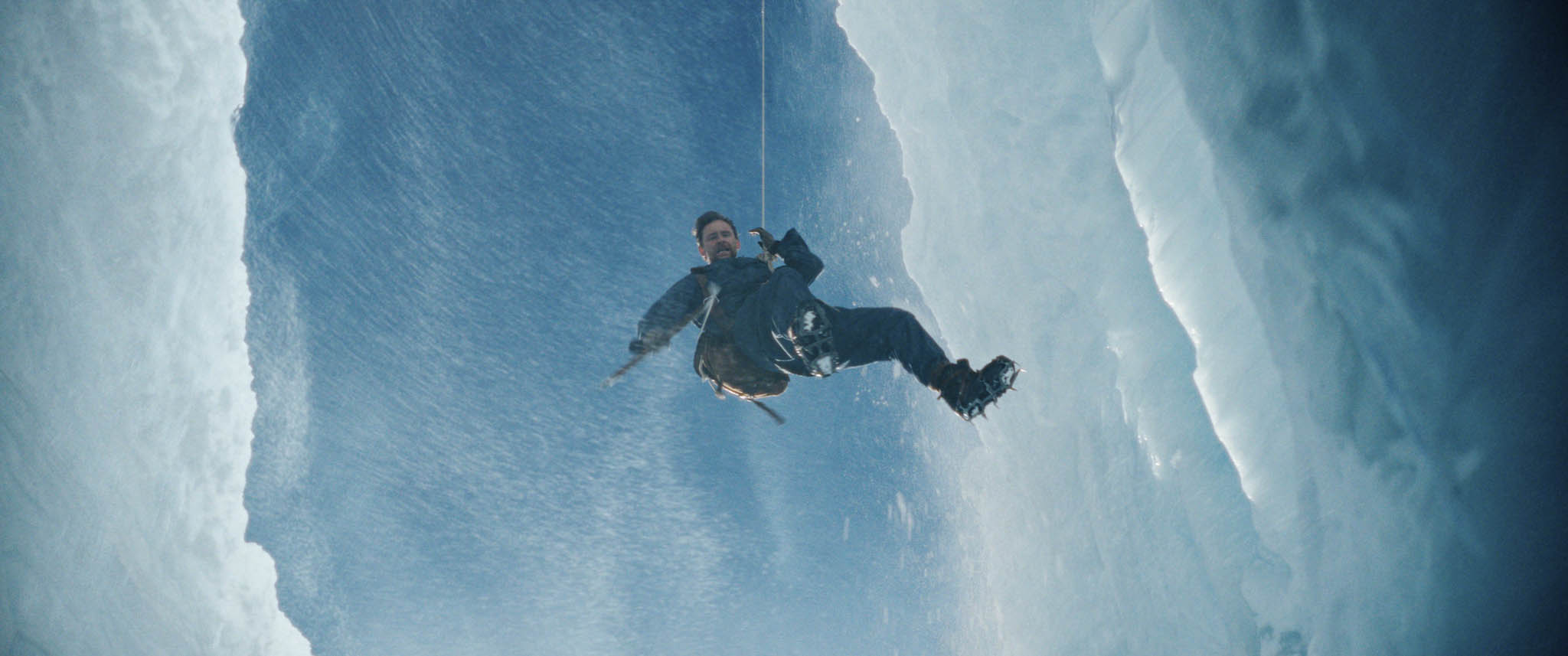
Frame: Tom Hiddleston in crevasse. Frame: Apple TV.
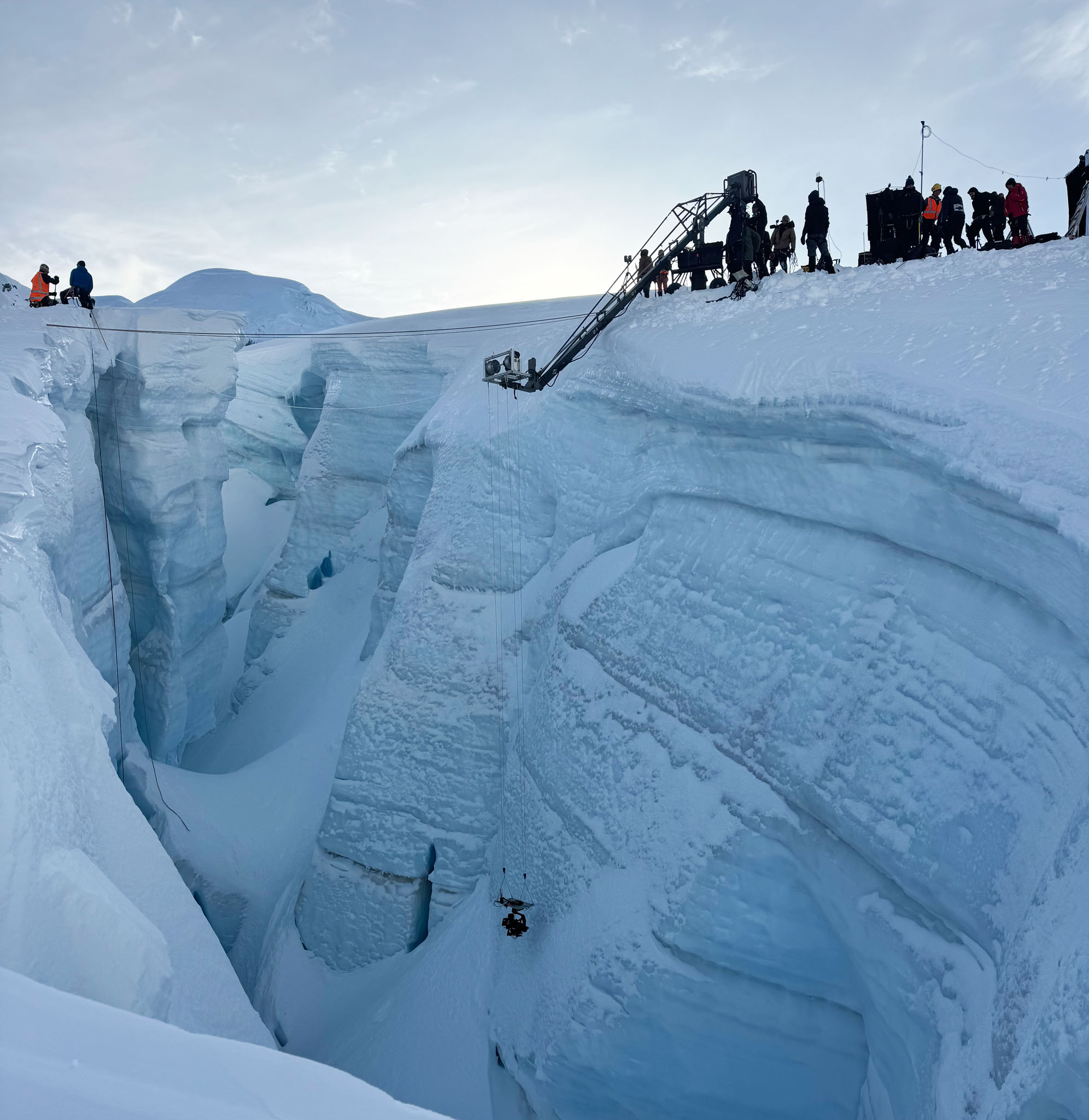
Camera is suspended from GF8 crane on a Ronin 2 in crevasse.
He was part of our team of six: Renan, myself AC Luke Thomas and two camera assistants from Nepal—Pemba Sharwa and Ngawang Tenjing, who grew up in that area and did the whole film with us. Pemba had just come back from working with Jimmy Chin on Everest: The Other Side. He came down from Everest, met us in Lukla and walked back up.
These guys are incredible. We also had a high altitude doctor who doubled as our unofficial production manager. He was a bit of a lifesaver, making sure we were doing things safely and acclimatizing well. We were all juggling many jobs.
What camera did Renan use for second unit?
He also had an ALEXA Mini LF. For some of the more extreme work, he also used his own Sony VENICE 2 in Rialto mode when they needed to get a camera into some really difficult climbing positions—for example, when they needed to rappel down a crevasse. Either Renan or his camera operator, Matthew Irving, would do that. Matt is also an incredible climber and works with Renan a lot on their documentary productions.
Rialto mode let them hold just the lightweight camera head [sensor block and lens], tethered to the camera body that was in a haul bag. We had some spherical lenses, thinking Renan would want something lighter. We had some Panavision H Series spherical glass that are smaller and lighter. But to Renan and his team’s credit, they loved the anamorphics and used them for almost everything. The sphericals very rarely came out.
Where did you stay for the Mount Cook filming?
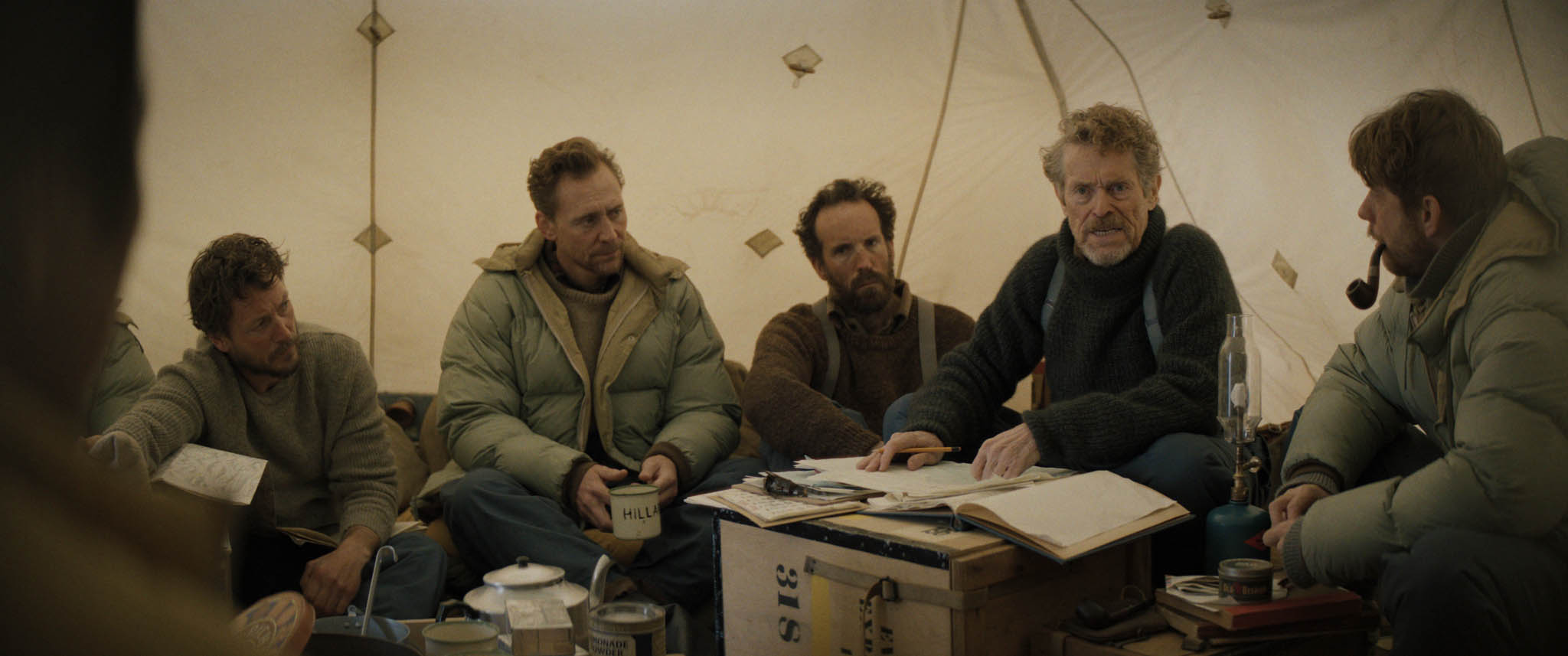
The Mount Cook Village. It’s next to an airport which became our unit’s base. There was endless talk about weather. Could we fly the next day or not? We were completely at the whim of the weather. It was very volatile and our schedule was forever changing. We didn’t have many weather-cover days. We had only a handful of tent interiors to do.
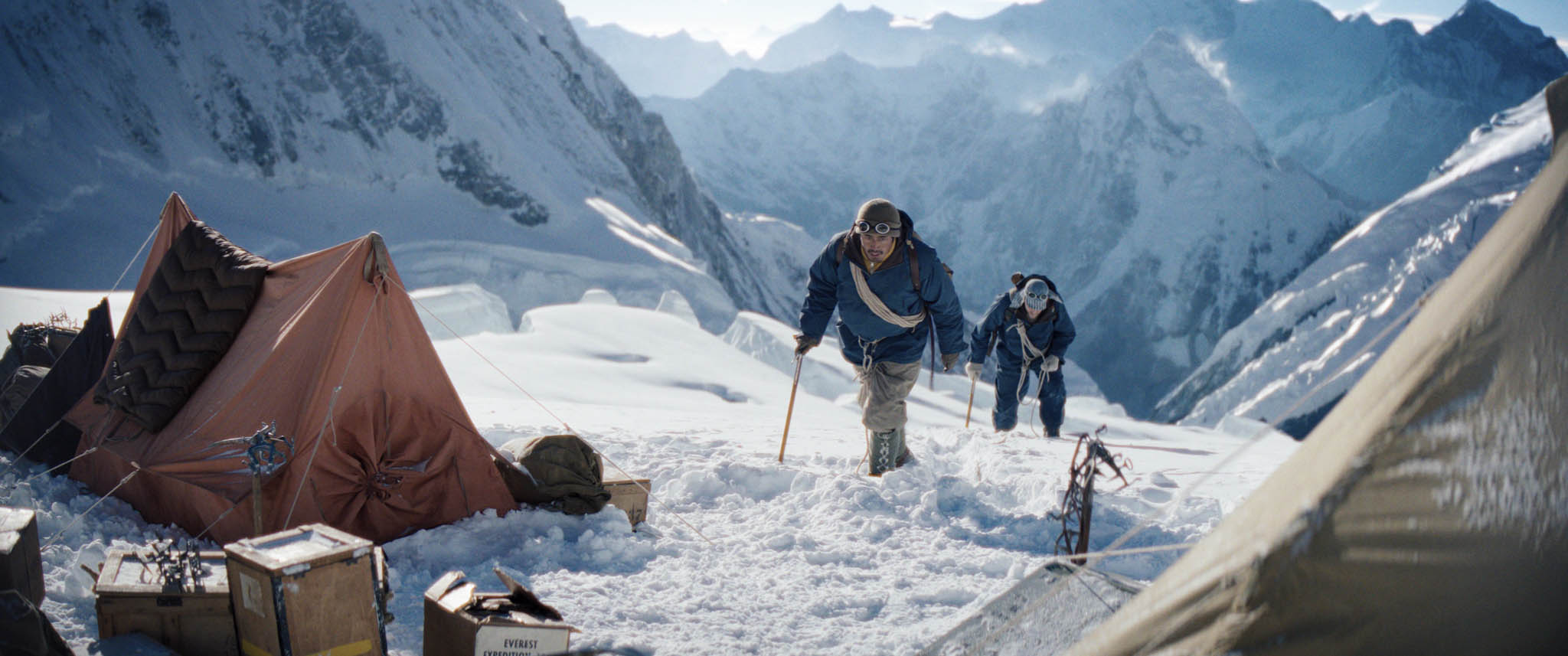
Frame courtesy of Apple TV.
Where did you film the high-altitude camp for the final push?
The very final one is actually in a different mountain range, the Remarkables near Queenstown. We shot the final camp there, where John Hunt, Willem Dafoe’s character, reads the note and wishes them all the best. And we shot the Hillary Step sequence there.
We shot distant Himalayan plates for the background, but the foreground location was still unbelievably precipitous, high and very difficult to film on. To Tom Hiddleston’s and Genden’s credit, they actually climbed that thing.
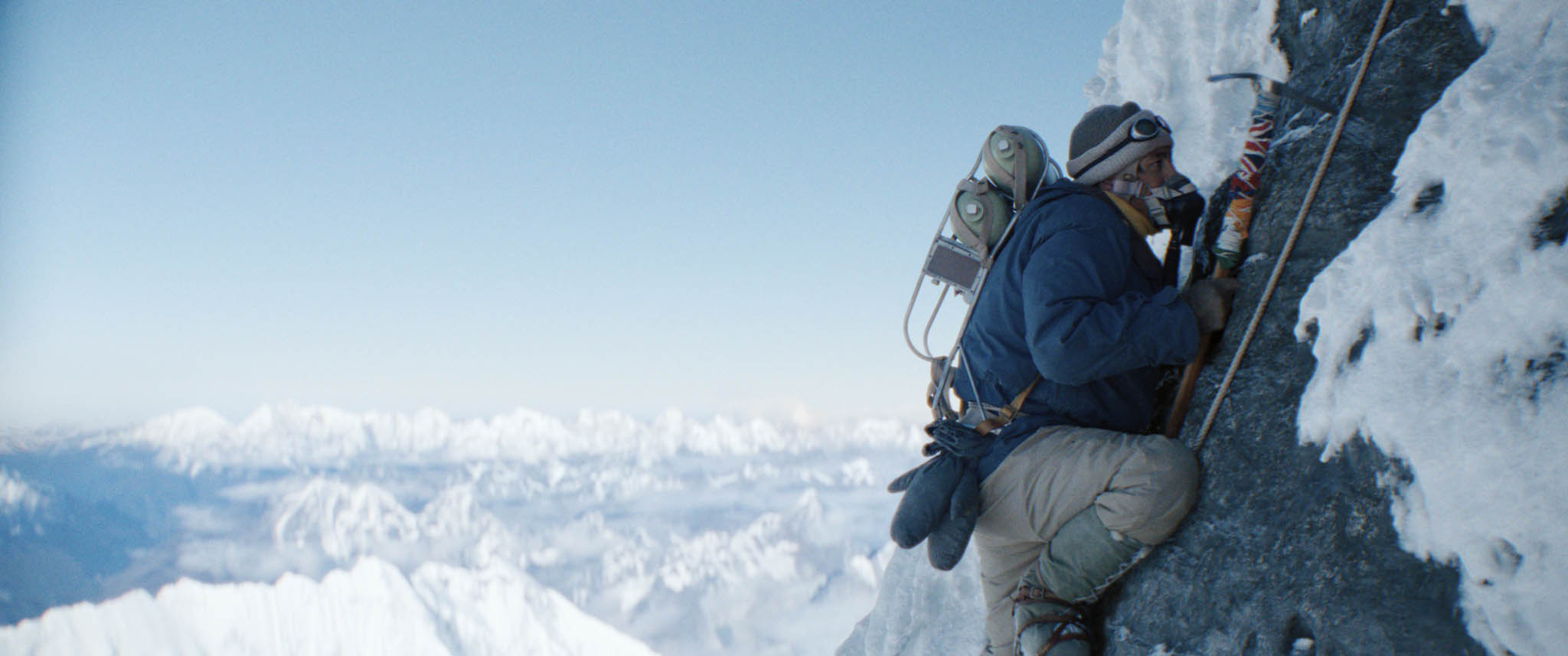
On the Hillary step. Frame courtesy of Apple TV.
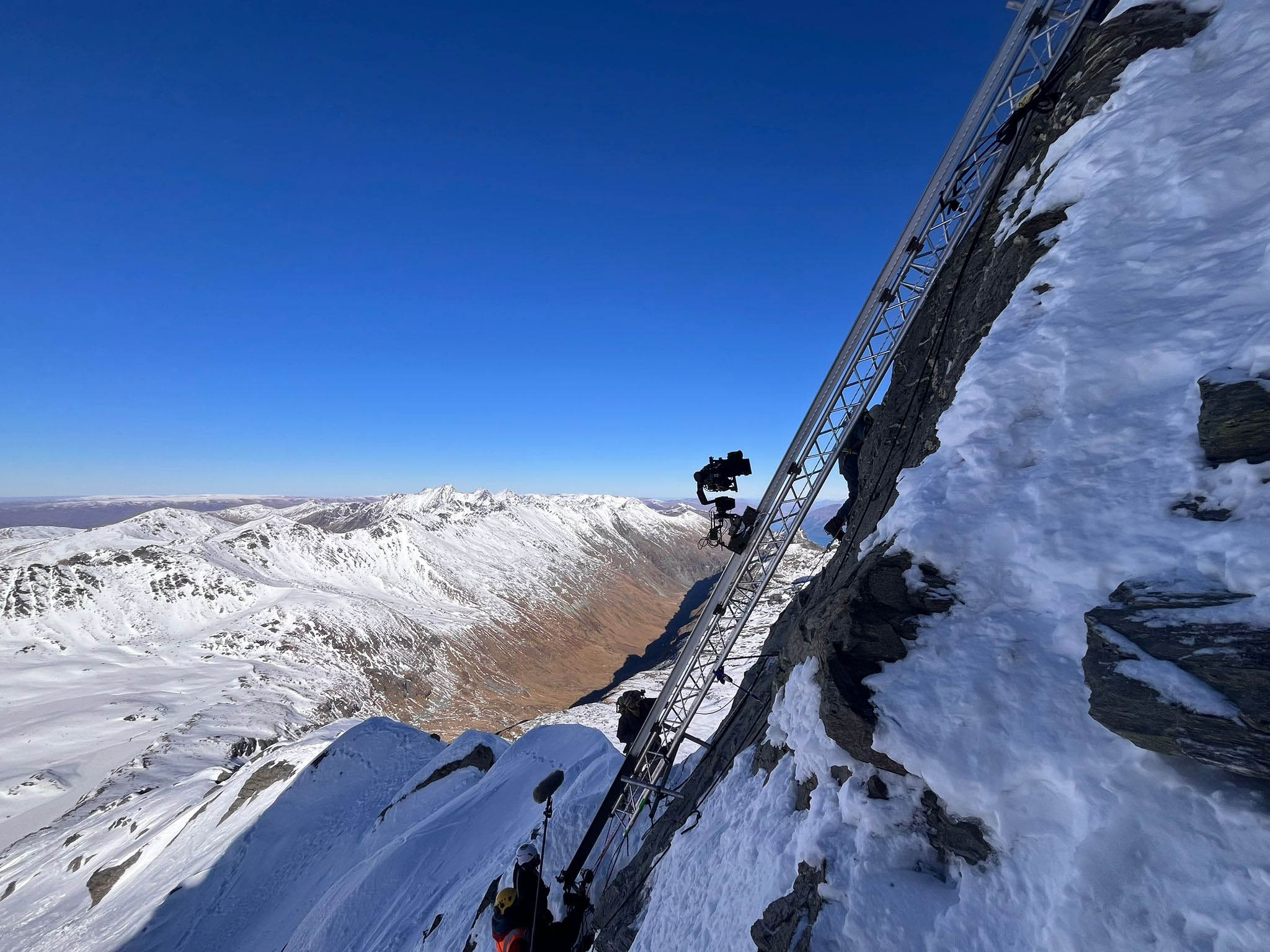
Truss Winch Rig with ALEXA 35 and DJI Ronin 2 gimbal as a remote head on the Hillary Step, operated with DJI Master Wheels.
The actors did those climbing scenes for real?
They did. Of course, they were on safety ropes and all that, but it’s really hard work. It was still a lot of physical effort, especially carrying heavy oxygen tanks and packs.
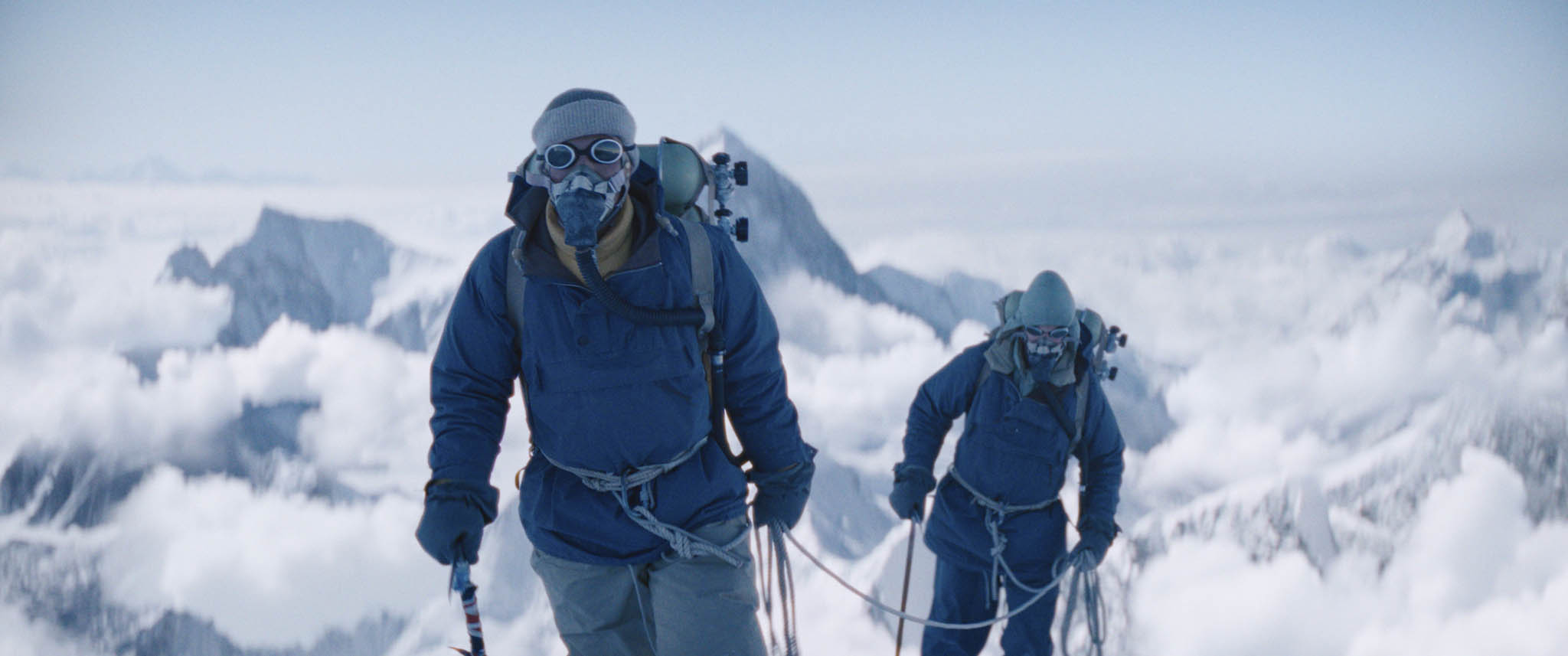
Frame courtesy of Apple TV.
Good for them. Where did you shoot the summit?
The summit was Hochstetter, a mountain near Mount Cook. Getting it right was one of the highest priorities of our shoot. As soon as we had good, clear weather, we went there with a very minimal unit because there was barely anywhere to stand at the summit. There were about 10 of us that day, cast and myself included. It was very emotional. The looks on their faces when they looked down, with the clouds below, were all real. They were in awe of that environment.
There are some wonderful shots when they’re climbing up the icefall, small figures in a vast landscape. Where and how did you do it?
That is the real Everest, filmed by me from a helicopter, and those are digital doubles that we put into the real Everest footage. Anytime they’re a significant size in frame, that’s all New Zealand, and it’s all in camera. Whenever we went really big, though, I said, “That’s got to be the real Everest. It’s got to be unmistakably the real Khumbu Icefall.”
But there were plenty of icefalls in New Zealand that looked just as dangerous. It was interesting: when I finally got to Everest at the end of the shoot, it made me appreciate our New Zealand locations even more. I thought, “Wow, we got really close.”
Did you provide the VFX team with metadata and notes?
We had a VFX data wrangler whenever possible to take notes and stills to document the location. That was all fed to Jay, our VFX supervisor. Jay and I had many meetings about how to get the right plates for this work. It was an ongoing conversation because every scene needed a different strategy. Sometimes he needed plates from somewhere I couldn’t be, so I tried to get a drone there or do it by helicopter. Some of it I could do from the right perspective at ground level. For example, for all the base camp work, I could get traditional ALEXA plates from a tripod.
Some of the plates were done with a DJI Inspire 3 for video and stills, or even on a Mavic 4 Pro, which came out during the production. It was actually a really great tool for us because it has much greater range. We could fly it kilometers away from us. It had a setting that enabled me to shoot spherical panoramas. It would shoot a 42-image stitch that I could supply to VFX and say, “Look, I’ve parked the camera halfway up the Khumbu Icefall in the morning, and I’ve given you a stitch of that. Now I’ve done it again in the afternoon.” So I was able to give them a variety of panoramas at almost every altitude and every time of day. That was an amazing tool.
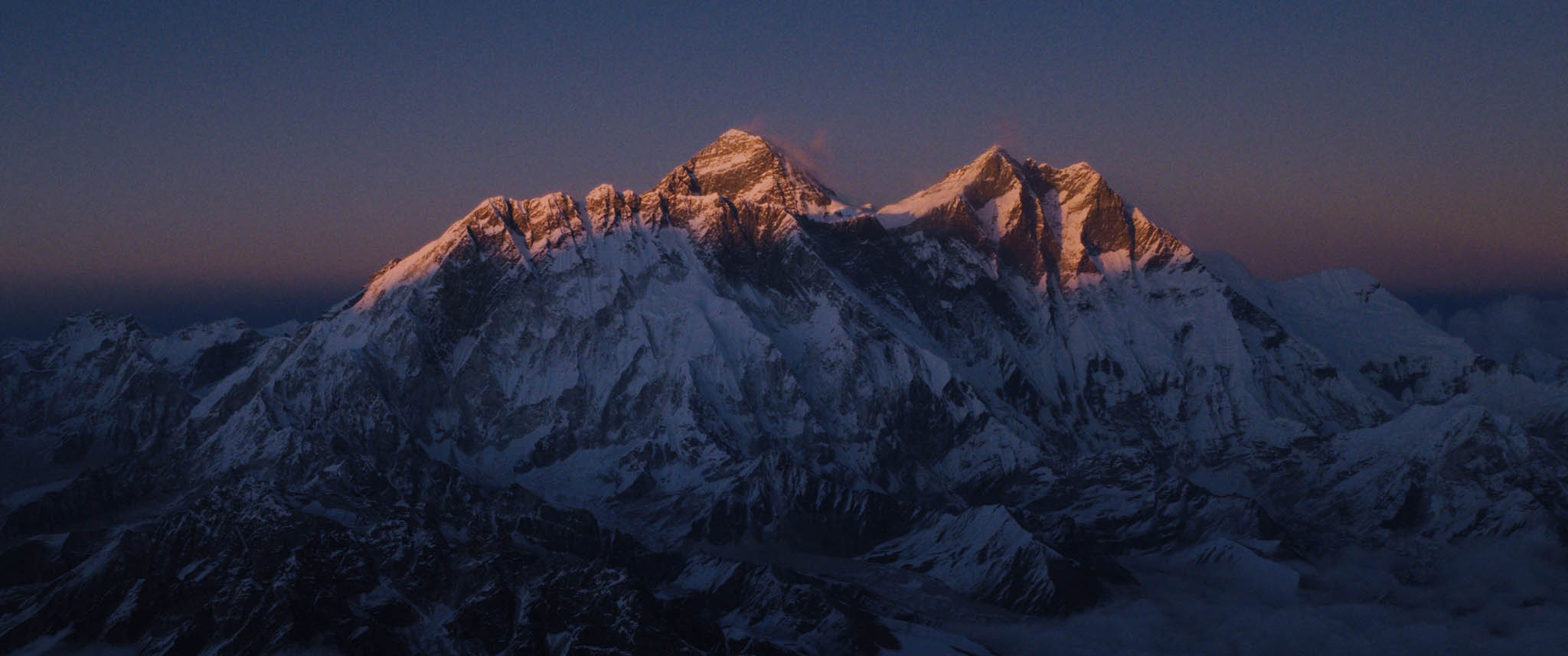
High altitude drone shot of Mt. Everest. Taken with DJI Mavic 4. Frame courtesy of Apple TV.
How did you decide when to use the Inspire 3 and when to use the Mavic 4 pro?
Distance, basically. The Inspire was always preferred. In pre-production, I gave up the dream of having a heavy-lift drone with an ALEXA at any of these locations. Renan was key in convincing me. He had done it before in locations like the ones we were considering, but he said you’ll get far less done, and you’ll get far less distance and altitude.
I reluctantly agreed, but as we got into production, I realized how right he was. With the Inspire 3, we could film for 25 minutes at a time at high altitude. If we needed to go much longer or further, we would fly the Mavic 4 Pro. On cruise control at full speed straight up, it would blast through the clouds, and we’d be basically level with the summit of Everest, shooting time-lapses through the clouds. Renan was fearless with those. He’s an amazing drone pilot. He encouraged me to get my drone license, because we weren’t always going to be together during the production. Sometimes he was on a different mountain from me, and logistically I could never get him over to the main unit to fly those shots. I ended up studying and doing all the exams, practical and online, and I got my full drone license so I could fly and shoot the main unit drone work, while Renan and Rudy Lehfeldt-Ehlinger did all the second unit drone work.
Good. Were you the operator, the pilot or both?
Both. But there were occasions when we had dual operating. For example, the shot you mentioned of young Tenzing at the start of the film, where we rise up and reveal the mountain, was a dual-operator shot with Rudy.
That’s a drone shot? I thought it was a crane.
It’s on the Inspire 3 drone. Rudy piloted it and I operated. I slowly tilted and kept little Tenzing center frame as Rudy ascended.
Good job. With a joystick, not with wheels, right?
Exactly, with a joystick. It was very delicate. We did treat a lot of the DJI Inspire work in post to give it more of an ALEXA + Panavision lens look. Our colorist gave it some of the same chromatic aberration, halation and film treatment we were doing throughout the film. Some of the edges of the frame were made a little softer and we took away some of the sharpness.
What lenses did you use on the Inspire 3?
We used the DJI stock lenses. I did investigate getting other lenses, but Renan and his team suggested they would be too unreliable at these altitudes compared to the DJI lenses, and they didn’t want to risk it.
You had the DJI DL full frame lenses: 18, 24, 35, 50 T2.8and 75 mm T1.8?
Yes. It was such a great tool, because it was the difference between getting the shot or not. There were many times we were on the mountain shooting a scene with the ALEXA, all ground-based work, and I would say, “I really want to do a wide shot on the Inspire 3.” If I couldn’t get that shot in 10 minutes, we had to move on to the next location. My team had the drone with the lens and filtration ready. I would grab the controller, fly and get the shot. We’d be radioing the cast, giving them directions. For example, with Tenzing and Hillary on the summit, once we’d shot all the close-up work, I said, “Please let me get the aerials.”
When you’re circling around them.
Exactly. I thought it was essential. There was huge pressure to get off the mountain, and I said, “We have to get this shot.” So in five or 10 minutes, we were up in the air, flying and recording the scene. If I hadn’t been able to do that comfortably and quickly, it just wouldn’t be in the movie.
You mentioned filtration. Did you use filters other than NDs on the drones and cameras?
Just NDs. That goes for the whole film. Even on the ALEXA Mini LF, I just used NDs and polarizers. I used a few crystals and prisms to shoot through for the hallucination sequence where Tenzing sees Dawa on the mountain. I had triangular prisms and crystals on the edges of frame, but that’s about the extent of it.
Did you operate the camera yourself?
Yes, and that’s why I needed to be fit throughout the whole film. As we discussed, Dana Little did all the Steadicam work whenever we could use a Steadicam, which was more often in Nepal; the Nepal work has a lot more Steadicam. He also operated a lot of great B-camera shots throughout the film. When we shot with simultaneous cameras, he was right there.
What did you do for focus? You had a good focus puller.
Our focus puller was Luke Thomas. He’s rock solid, mind-blowing. He uses a Preston Light Ranger system mounted on the camera. His strike rate on unpredictable scenes is always really high.
Luke has done a lot of large-format work on the ALEXA 65 as well, so he’s very used to how tricky these large sensors and large anamorphics are. He had actually worked on Vertical Limit which was shot in the same mountains of New Zealand around 2000. He brought a lot of lessons from that onto this film in terms of facilitation and logistics: how to work with gear up there and how to pack it for helicopter travel. I can’t thank him enough, because it’s not something I ever had to worry about. He’d corner me and make me specify the gear every night and every morning, very clearly, but it meant that during the day I didn’t have to think about camera gear. It was very smooth.
He was there every step of the way with me. We prepped in Australia, we prepped in Kathmandu, and we did all the Nepali work. Then, preparing for the New Zealand work was almost a different shoot. That was an expedition in itself. And then he prepared and shot Everest with me as well. Everything was taken out of the hard cases and went into soft bags and backpacks.
What did you do for LUTs?
We made two LUTs with our dailies colorist, Christopher Rudkin. The flashbacks and locations in Nepal were generally warmer and more open. I’ve worked many times before with Chris. He’s wonderful for continuity on a production, especially when filming in two different countries without an on-set DIT. Chris becomes my visual continuity, especially with multiple units. He helps balance the second unit work. We can analyze the second unit work together and give them feedback.
How did you handle dailies? What were you watching on?
Grading was done by Chris with DaVinci Resolve. In Kathmandu, he was working out of a hotel suite. When we moved to Mustang, Chris set up next to the editor and data wrangler. They had a bit of a mini post facility there: the editor, data wrangler and Chris all working together. When we went to New Zealand, Chris went back home to Belgium, where he lives. We sent the rushes to him there, he graded them, and I checked in and watched remotely.
How did you deal with data wrangling when you went to the Everest base camp?
Luke, our focus puller, handled all the data wrangling there. He was in a small tent with his MacBook and whatever drives we had. I was sending some selects back to the editor and director when we could via Starlink. I loaded the footage into Resolve, did a little cut, and send them what I could, with a note, “This is what we did today.”
Were these proxies or the camera-original ARRIRAW files?
I ingested the ARRIRAW files into Resolve and then export an H.264 proxy that was easy to send.
Being from Melbourne, home of DaVinci Resolve, obviously you know how to use it?
I do. I tried to learn it early on because the more camera tests I did in pre-production, the more I felt I needed to learn the software to better understand the footage and what I was doing. In my early days, I became frustrated when I had to make decisions about the camera and format with very little time at a post-production facility. They might give you half an hour or an hour in a suite with an operator, and then you had to walk away having decided what to shoot the whole movie on. So I thought, “I really need to take this power back to the cinematographer and director, so we can have the footage, play with it and study it. Then, sure, we can go to a post facility and project it big once we’re closer to agreeing on a decision.” I love the ability to take the footage, color it, play it and cut it.
I do all my own camera tests. I equate it to a photographer knowing how to use Photoshop. Most photographers know how to use Photoshop to analyze, study and color their work, and I think cinematographers should be doing the same. We need to understand color science and the tools of a colorist. This is not to take anything away from the colorist, but to help us understand how to communicate with them. The things that colorists do are light years beyond anything I can do, but I know how to bring footage in, edit, assemble and do some basic color.
Did you prepare with storyboards and previs?
Yes, we used previs for the Hillary Step and crevasse sequence, using Unreal Engine simulating our same camera and lens package. We would shoot a version of the scene using 3D stand-ins, and then an animator would animate the scene. I also did a lot of photo-boarding throughout Nepal with my Canon R5 Mk2. And we spent a lot of time making regular storyboards as well.
What did you and Jen discuss in advance about how the film should look?
A lot of our pre-production time was spent doing that. I don’t go into productions with a very strict idea of how I think something should look. For me, pre-production is an intense period of being open and listening—to the director, the art department, visual effects, everybody—taking all of it in, and then, once I’ve absorbed everything, gently pushing a goal back at everybody. On a movie like this, I was trying to listen to what the locations and the script said, until eventually we developed a language through my Lightroom library of 20,000 stills. We shot so much to develop the language of this movie, from the basics of where we’re shooting to what the color and texture should be. How should the flashbacks feel different from the contemporary story? Do we need to do anything different with lenses or aspect ratio, or do we trust that the locations and the period itself will differentiate them enough?
Ultimately, I think they did. I didn’t do anything fancy to tell the audience we were in a different time and place. We did use film emulation techniques throughout the whole film during the DI, and we were a little more intense with the grain structure, halation and aberration for the past compared to the present, but it was quite subtle. Beyond that, I think the locations did enough for us. The flashbacks were inherently much warmer. Darjeeling and the Tibetan Plateau were very warm, but we pushed that a little further as well. When you cut from the mountains to that, there was no doubt where you were.
Did you add the film grain with DaVinci Resolve or some plugin?
It was through Resolve, but our colorist, Dave Cole from FotoKem is a bit of a wizard. He coded his own custom grain plugin for Resolve. His knowledge of working with film is fantastic, being a full-time employee at FotoKem. Dave does more than just simulate grain, there is also chromatic aberration, halation and many other subtleties. There’s so much detail in what he does. Dave actually came out from FotoKem to Australia where he graded at Spectrum in Sydney where all the post-production was done. While Jen was completing music and sound, we were doing the grade.
How did you get started in film?
I studied Media Arts at RMIT University in Melbourne. I grew up in Victoria, about three hours north of Melbourne. I wanted to be an illustrator and a writer, making comics, and that took me to university. I started learning more about photography, animation and filmmaking. When I graduated, I started working with many different people, including fashion photographers. I did storyboarding for directors and made DVD covers and menus, and then I started assisting cinematographers. I was very fortunate to get a gig as a trainee for Andrew Lesnie on a movie he did in Melbourne called LOVE’S BROTHER. Then he took me to New Zealand for the pickups on THE LORD OF THE RINGS: THE RETURN OF THE KING.
After that, I started as a trainee with Greig Fraser in Melbourne on music videos, short films and commercials. Greig was very inspiring, because he was creating the most beautiful imagery with very little resources. It was all just him, his taste and the way he worked with the world. It stays with me to this day how much he achieved with so little. Those twin influences set me off in the film industry. I started shooting myself in my 20s—music videos and short films—until eventually I got commercials and films.
Frames courtesy of Apple TV: