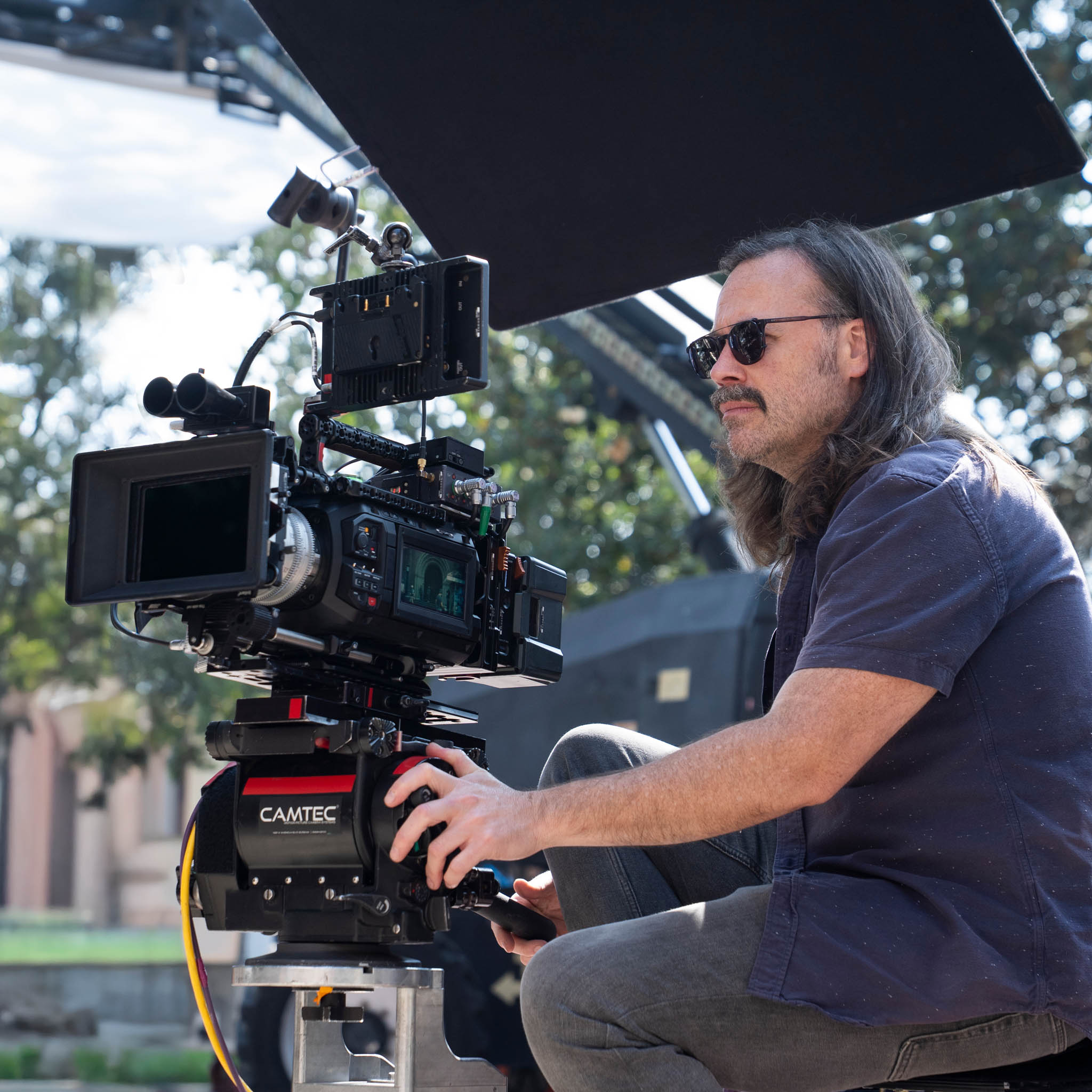
Blake McClure, ASC with Blackmagic URSA Cine 17K 65 on “Rooster.” Photo: Katrina Marcinowski / HBO.
Jon: Tell us about Rooster.
Blake McClure, ASC: It’s a new show for HBO. Bill Lawrence and Matt Tarses are the creators and showrunner. They did Shrinking, Ted Lasso, Scrubs, Spin City, etc. Rooster is about a father-daughter relationship with Steve Carell. He’s an author. His daughter works at a liberal arts college in New England and is going through a divorce. He forces his way back into her life to help her fix this marriage. It’s a comedy, but it’s a drama, a relationship story.
Which college is it in New England?
Bill Lawrence’s is the great-great-grandson of Sarah and William Van Duzer Lawrence, who founded Sarah Lawrence College. He went to William & Mary. Matt went to Williams. Part of the show is based on their college experiences.
When did you start and finish shooting?
Principal photography was from the end of April to the first week of August 2025.
I was on the Warner Bros lot doing All’s Fair, and John Brawley, ACS was there shooting Shrinking with the Blackmagic URSA Cine 12K. My DIT said, “Let’s check out this new camera.” Actually, I had never shot with a Blackmagic camera. But he was excited about the compression and what it could do. I asked John about the URSA Cine 17K 65 because 65mm was interesting to me for Rooster. I was thinking about medium format portrait photography. John connected me with Tim Schumann, Blackmagic Senior Product Manager, and some of the other guys at Blackmagic, and they got me a camera to test. I wondered what was the catch. Why is it so good and so affordable? We ran tests. It was incredible. The workflow was the same as the one that the Shrinking crew had already used with their Blackmagic URSA Cine 12K. We had the same post producer, so that part was easy. They were not scared about anything new and were actually excited about it. In fact, our post producer and the post house Digital Film Tree had a very close working relationship. They’ve been working with DaVinci Resolve and Blackmagic for a very long time.
How did you get the producers onboard?
We had a meeting with HBO and they were incredibly supportive. We talked about the codecs, the workflow and what we could do. At first, we were worried about the 8 terabyte media modules that the camera uses. As you know, 8TB is not ideal for television. You don’t want to roll that much footage on one card because you have to download all that data at once. It could take 10 hours after wrap. We need to turn data cards over quicker—1 terabyte at the most. That would mean we’d have to buy 40 of the 8TB media modules because you have to store them until the studio lets you clear them.
I thought that would be a big ask to ask the rental house to buy three or four of these cameras and all these new 8TB SSD media modules. We asked Blackmagic whether CFexpress cards were an option.
But the camera wasn’t even out at that time. In February 2025, Tim Schumann hand-carried what seemed to be the single working prototype to BSC Expo London.
Tim Schumann, Blackmagic Senior Product Manager, jumped in:
It was just after NAB in April 2025, and fortunately right when we were ready to start shipping production cameras. We got Blake an URSA Cine 17K 65 camera for testing right off the line, walked him and his rental house Camtec through it, and he liked what he saw.
We worked with one of our dealers, Band Pro, and Camtec to make that happen. Because the post house DigitalFilm Tree had been working with Blackmagic RAW and the URSA Cine 12K LF on previous productions, working with the URSA Cine 17K 65 wasn’t a very big leap for them, as the workflow is very much the same between those two cameras.
When production decided to use the URSA Cine 17K 65 cameras, we had Hook Stowers, one of our leading color science and workflow experts, on the ground in LA over the first couple of weeks to make sure that the production, camera team and DigitalFilm Tree were comfortable and happy with the camera and workflow and were getting all of the benefits they could out of the system. We also worked extensively with Band Pro to make sure the production was supported with all accessories and peripherals.
These were some of the first URSA Cine 17K 65 production units to roll out of the factory, so the timing was quite good. Because the URSA Cine 12K LF has been out in the world for quite a while, there are now lots of accessories and third-party items that work with it. And because URSA Cine 17K 65 is essentially the same camera but with a larger sensor, all of those add-ons and peripherals already work, which is nice.
Blake: As you said, the camera was not out yet. But we could only do it if we had CFexpress cards. Asking Camtec, our rental house, to buy lots of expensive media modules wasn’t an option.
Blackmagic did some internal testing and they said CFexpress cards would work if we stuck to the 2:1 aspect ratio that we liked and recorded in 8K instead of 17K. We got that approved by production. This was just two weeks before shooting was to begin and we realized we needed cameras to start prepping. Tim Schumann got us two and then a third camera. At some point we hit them up for a fourth camera.
Were you worried about using cameras so new that they weren’t even shipping yet?
I felt comfortable because Blackmagic was there. Hook was on set with us for the first couple of days during prep, and then every day, all day, for the first two weeks. Everything worked fine, but he was like like a security blanket and very helpful. We knew that Blackmagic is a huge company famous for DaVinci Resolve and they’re not going to put a new camera out there without testing. In fact, Greig Fraser, ASC, ASC, had been testing this camera since November 2024. I had emailed him and he responded three hours later, telling me that he had projected the images in theaters and he fully supports the camera.
All of those combinations converged and we said, “Let’s do this.”
I guess you were updating firmware all along?
We had a couple firmware updates in the first week or two, and then we didn’t have anything after that.
Why did you decide on 65mm format?
The 65mm format was chosen because of the nature of this show. It’s a comedy and with comedies you don’t really have the luxury to move the camera in an aggressive storytelling way. It’s mostly about the dialogue. It’s about the medium shot. They want to see the actors and be able to cut the jokes faster. I knew it was going to be a personal, very heartfelt father-daughter story. Even in the first episode, the first page calls out for a New England campus. It’s warm, rich, and I thought medium format photography. Of course, the 65mm cine format is smaller than medium format stills, but it’s a step closer and you can feel that closeness.
When I first read the scripts, I was already thinking about how to approach this show. What can we do? On every show I do, I’ve tried to do something different. I don’t like to repeat myself. I don’t like to use the same camera with the same lenses. The medium format was an appealing, cool concept and with the Blackmagic camera, it became affordable. To be realistic, I haven’t yet done a television series where we could afford three expensive 65mm cameras.
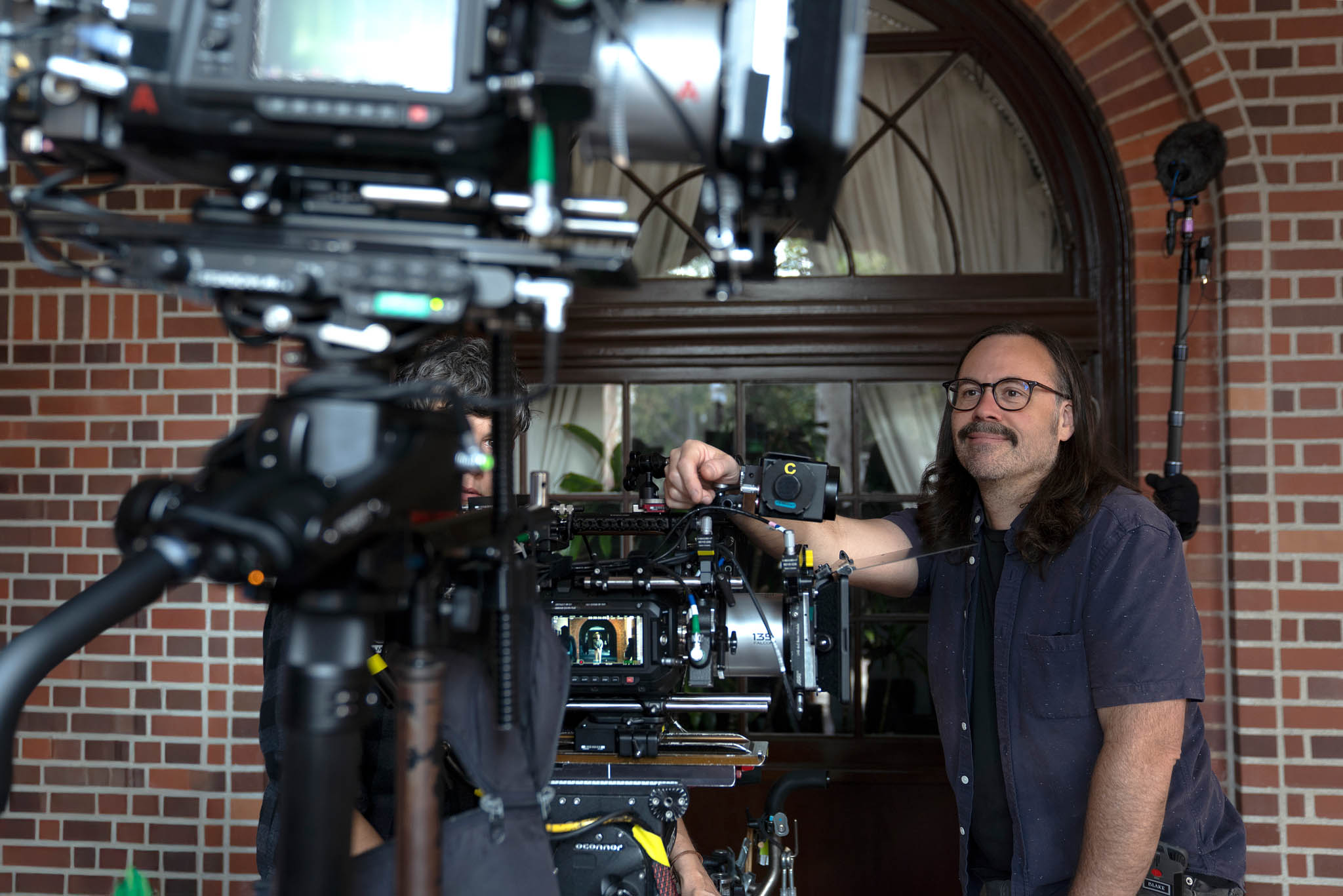
Photo: Katrina Marcinowski / HBO
Are you shooting multiple cameras at the same time?
The majority of the show has two cameras. Often, we’ll bring in a third. We have a couple of classroom sets where three cameras are helpful. I also use the third camera a lot to leapfrog, so they’ll jump ahead to the next setup or location and we can start setting up.
What lenses are you using?
We’re using Camtec Falcons. I was told they are rehoused vintage Canon FD lenses, with a look similar to Canon K35.
But if they are Full Frame lenses, how do they cover the URSA Cine 17K 65 sensor?
Camtec had to shave down the front ring on a few of the lenses to avoid vignetting. The 24mm was the only one that still had a little hard clipping in the corner—a tiny few pixels in our 2:1 aspect ratio. Our set consisted of the 20, 24, 28, 35, 55, 85, 135 and 200 mm Falcons. But the lens we used the most was the 55mm T1.3.
What do you do about the slight vignette?
We only used the 24mm lens once and we just enlarged the image in post, a mere 2%.
How would you describe the look of these lenses?
They’re sharp. They’ve got a decent amount of contrast, but they’re not super contrasty. They have a little bit of veiling glare. They have that swirling sort of focus fall off around the edges that people love; it is especially exaggerated on these lenses. Everybody loves the K35s in full frame, but with this larger sensor, it’s even more beautiful. It’s portraiture.
Any zooms?
We also had a Camtec Custom (Angénieux) Optimo 12:1 Full Frame 36-435mm T4.2 Zoom.
Did you have filters on the lenses?
I used an LED color contrast filter from Camtec called a Color-Con. With the sensor being so large, every lens naturally has a bit of shading toward the edges of frame. The Color-Con filter exaggerates that. I could focus more LED light on the center of the filter. So it’s a little bit brighter in the center and that enhances the shading. Depending on our stop, some shots almost look like there’s a hole punch while others are very gentle.
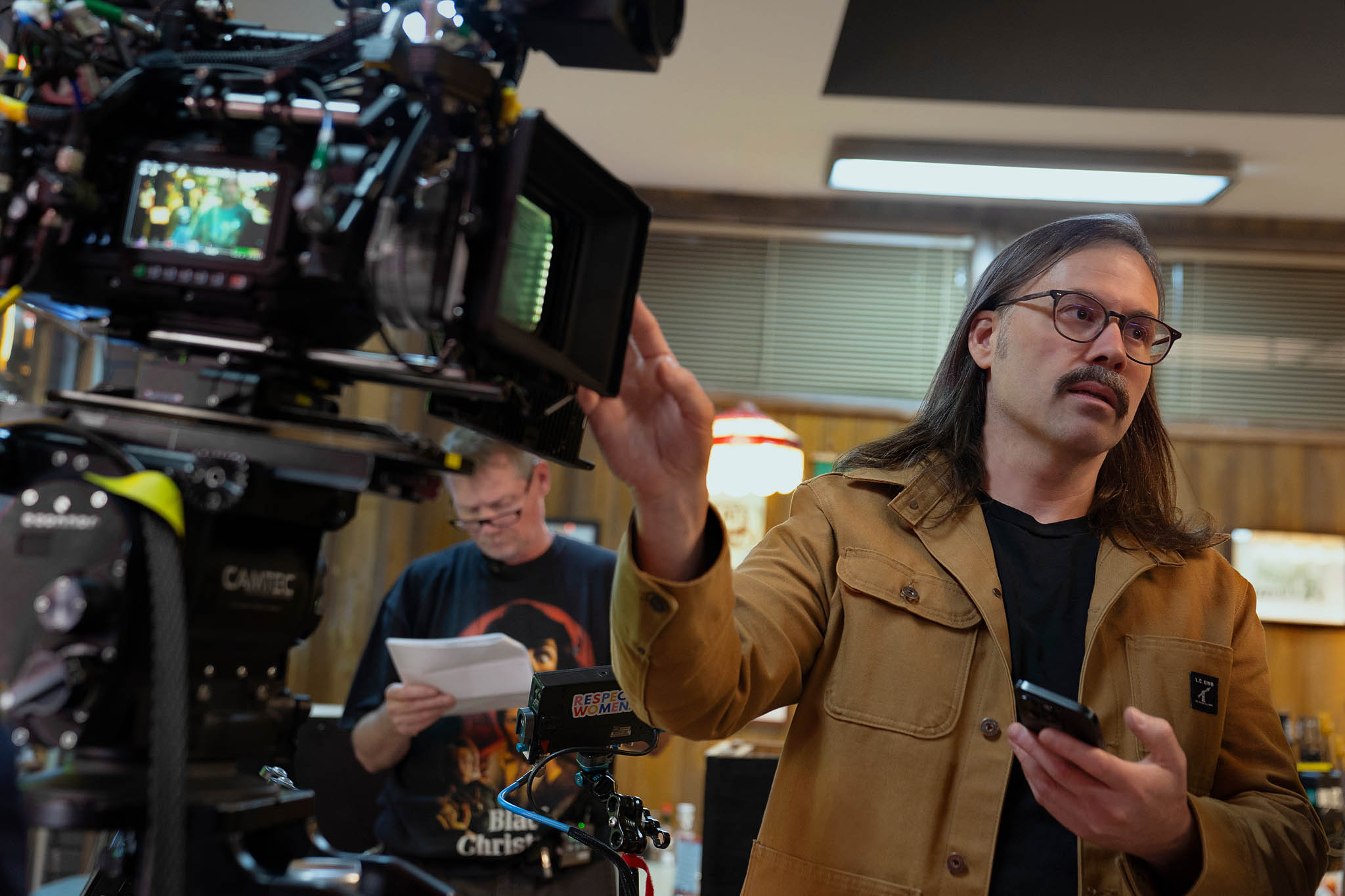
Color-Con. Photo: Katrina Marcinowski / HBO.
[The Color-Con consists of a diffusion filter surrounded by LEDs in a filter holder that occupies two spaces in your mattebox. In addition to controlling color and contrast, the LEDs can create a controllable, directional hot spot. It is like a modern version of the Lightflex that Freddie Francis, BSC used on The French Lieutenant’s Woman (1981 film) and that ARRI with their Varicon.]
What were your recording settings?
65mm format; 2:1; 10,752 x 5360 resolution; 46.77 x 23.32 sensor area; 52.26mm diagonal; full sensor height). It’s in the 8K menu settings but it’s actually 10K.
Were the producers worried about more resolution and perhaps the perception of larger amounts of data?
They were. However, we chose Q3 compression, which is a variable bit rate to keep the quality constant. Bit rate is determined by how much information is happening in the frame. We were getting over an hour of recording time for each 1 terabyte CFexpress card. On the last show, I shot 35mm format and was getting about 46 minutes per terabyte. So we’re getting more recording time from a camera with a sensor that is 2.6 time larger. It took our data manager only 20 minutes after wrap to download footage from our CFexpress cards.
Our Color-Con effectively replaces having to shoot with a lot of smoke on set. It reduces a lot of detail in the shadows. I think that might affect the file sizes and make it even smaller.
Blackmagic RAW is pretty economical.
Yeah, it’s incredible. There were no issues with the quality. I was concerned with dropped frames or dead pixels, all the stuff that comes with new gear. There was none of that. And the data rate was fantastic.
Why Q3 and not Q0, the highest constant quality setting?
After testing, my colorist and I couldn’t see a difference. Maybe if you’re projecting theatrically, you’d see the difference. We keyed things, we brought highlights down, stretched it and pulled it, and tried to pull it apart. And he’s said, “This is just as good as every camera we see.”
What ISO did you set the cameras at?
Pretty much every scene, day or night, was rated at 2000 or 2,500 ISO—even the day exteriors, to hold all the highlight details of practical lights and windows.
I expect a producer asked why you need 8K or 10K on a 17K camera if you’re delivering in 4K?
My argument is about data rate. It really doesn’t matter about the Ks. Nobody cares about Ks. It’s really about the compression, the color space and how it can be manipulated. The main thing that most studios care about is data rate so that they can archive the shows to their LTO tapes. That’s really the bottom line. Remember five or six years ago when they told us we could only shoot 1920 x 1080?
Why did they think it’s more expensive?
Someone told me it was because of the LTO tapes that they use for backups and archiving. But why wouldn’t you want to future-proof your show for a few thousand dollars when you’re spending millions per episode?
How much can an LTO tape cost? Maybe $35 for 1.5 TB. But LTO data rates are slow—around 170 MB/s. You can buy a 2TB SSD with a 1000 MB/s write speed for about $320.
It’s archaic thinking from those who buy by the numbers: this is what our budget says; we can only do this many hours.
Your rental house is Camtec?
I made the switch to Kavon Elhami at Camtec because he had been a friendly person and I heard good things about his company. Matty Libatique and some other friends like them as well. They have good customer support. They are willing to do custom stuff.
Are you controlling the Color-Con remotely?
Yes, they made a Wi-Fi version. I have a little box with 8-bit RGB values. They made us a new one with even finer controls that are 16-bit. So instead of going from 1 to 255 in values, it goes from 1 to 65,000.
Did you have it on every shot?
Every shot.
It’s amazing you were able to get the URSA 65 cameras for Rooster.
Blackmagic made it seem so easy and didn’t make it feel like it was a big ask. I don’t think I realized how lucky we were. I just assumed they were all just rolling out a thousand of them.
Camtec bought three URSA 65 cameras from Band Pro. Band Pro kept a fourth one on standby in case we had any issues, and then Camtec ended up buying that one because we needed all four cameras.
How did you rig the four cameras?
The “A” camera lived on the DJI Ronin. We could slide it off and put it on a Steadicam.
What does it do on the Ronin?
It acts as a remote head. I’ve put the “A” camera on a Ronin 2 since 2018 when the DJI Master Wheels first came out. It’s a fantastic tool. You don’t have to take the time to go to underslung mode on a traditional remote head to get low angle shots. You just flip it over and it’s ready to go. I own the Ronin and Master Wheels. We carry a short modular jib arm, so we’re always able to make moves. The producers love it; it’s an affordable remote head setup that works incredibly well.
Since you said that you don’t like to shoot with the same thing twice, I guess your next job might include a Ronin 4D?
That is what cn happen. I hope that DJI is going to come out with a new dedicated remote head, but I haven’t heard any hints.
Pretend you’re pitching 65mm format to a director or producer. What do you say?
I use Cadrage, the directors viewfinder app, and show them a setup with the URSA 65 compared to a Full Frame or Super35 camera—using the same focal length lens. The 65mm format gives you a frame that’s about 1.7 times wider than Full Frame. So that means you get a wider shot in the same spot, and you get a wider field of view with the longer focal length, which also means you can be closer to your actors, with less distortion and greater separation from the background.
A big challenge with shooting 65mm format or anamorphic is how tricky it is to get a tight eye line. For example, we want our camera to be four feet away from the actors, but when you get there with two operators, where’s the light coming from? You’re blocking all of the space that’s right in front of the actor’s face. It’s taken the actors a little bit of getting used to. The first time Connie Britton was doing a closeup, she was amazed how close the cameras were in front of her. That’s what I liked about the 65mm format: you can get in there closer so it feels more intimate and you don’t have to do it on an 18mm lens.
People have shot 65mm before, but typically you think of it for sweeping landscapes or Lawrence of Arabia. I like the idea of it treating it like a large format or medium format still photography.
That’s the easiest way to think about it. That’s what I told the producers. It’s an intimacy thing where the camera’s closer and you feel it. One of our jobs as a DP is to put the camera in the right place.
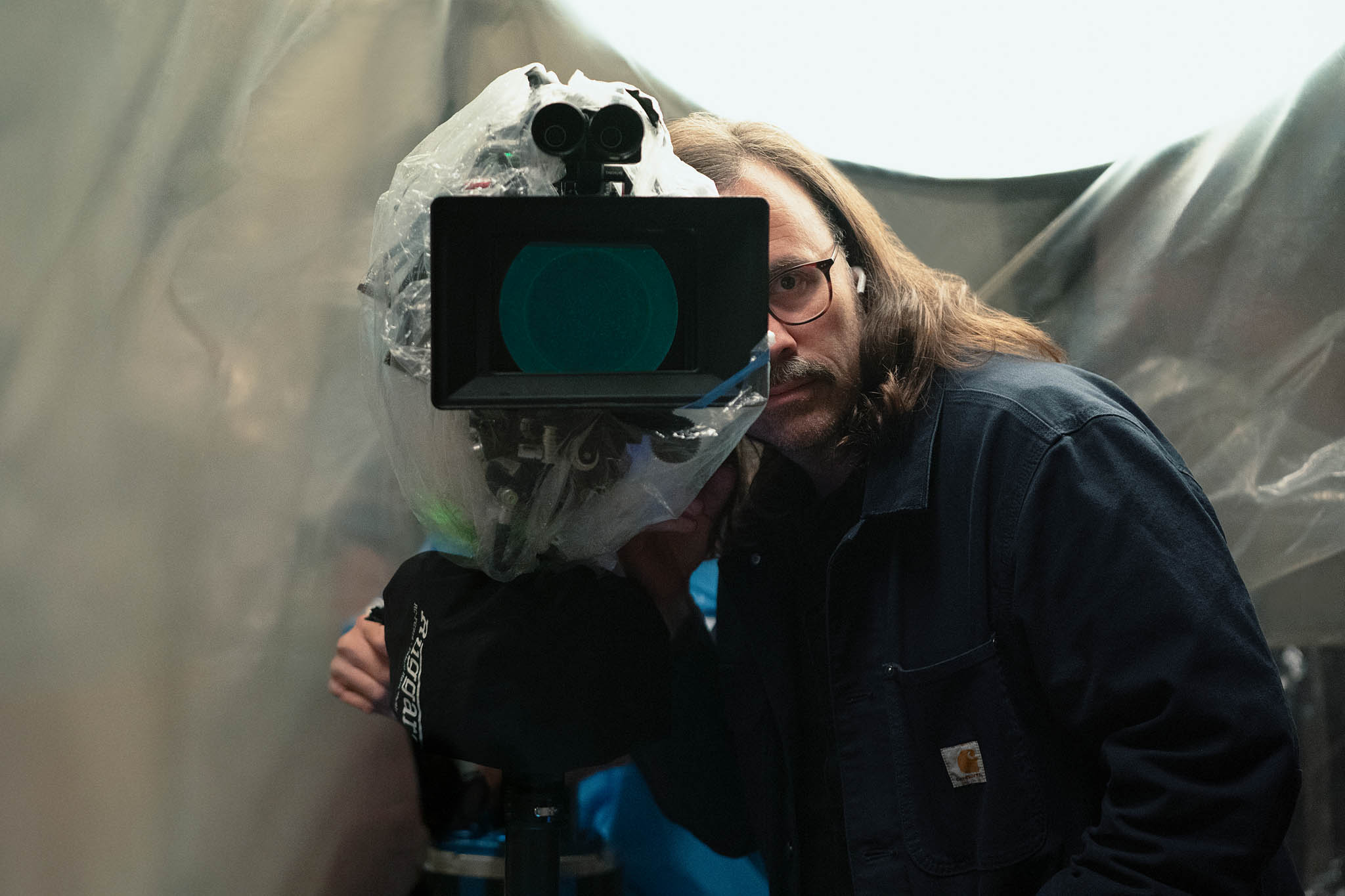
Photo: Katrina Marcinowski / HBO.