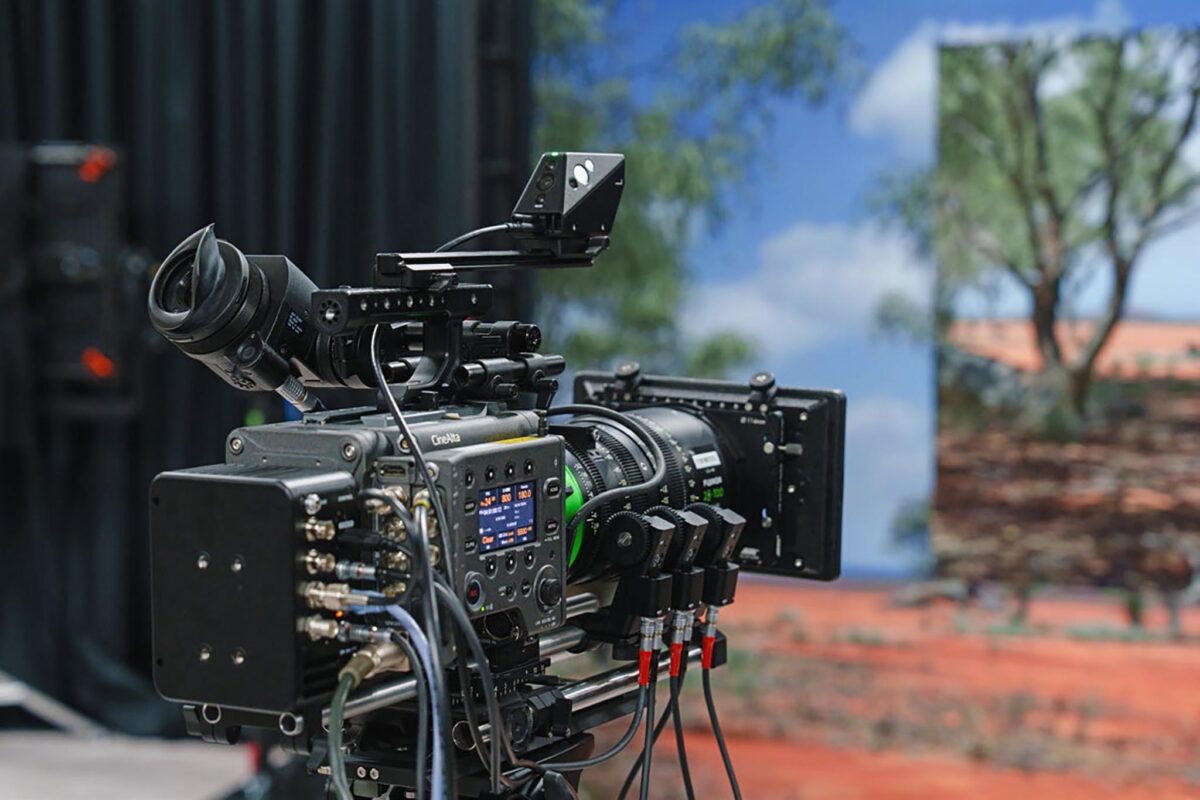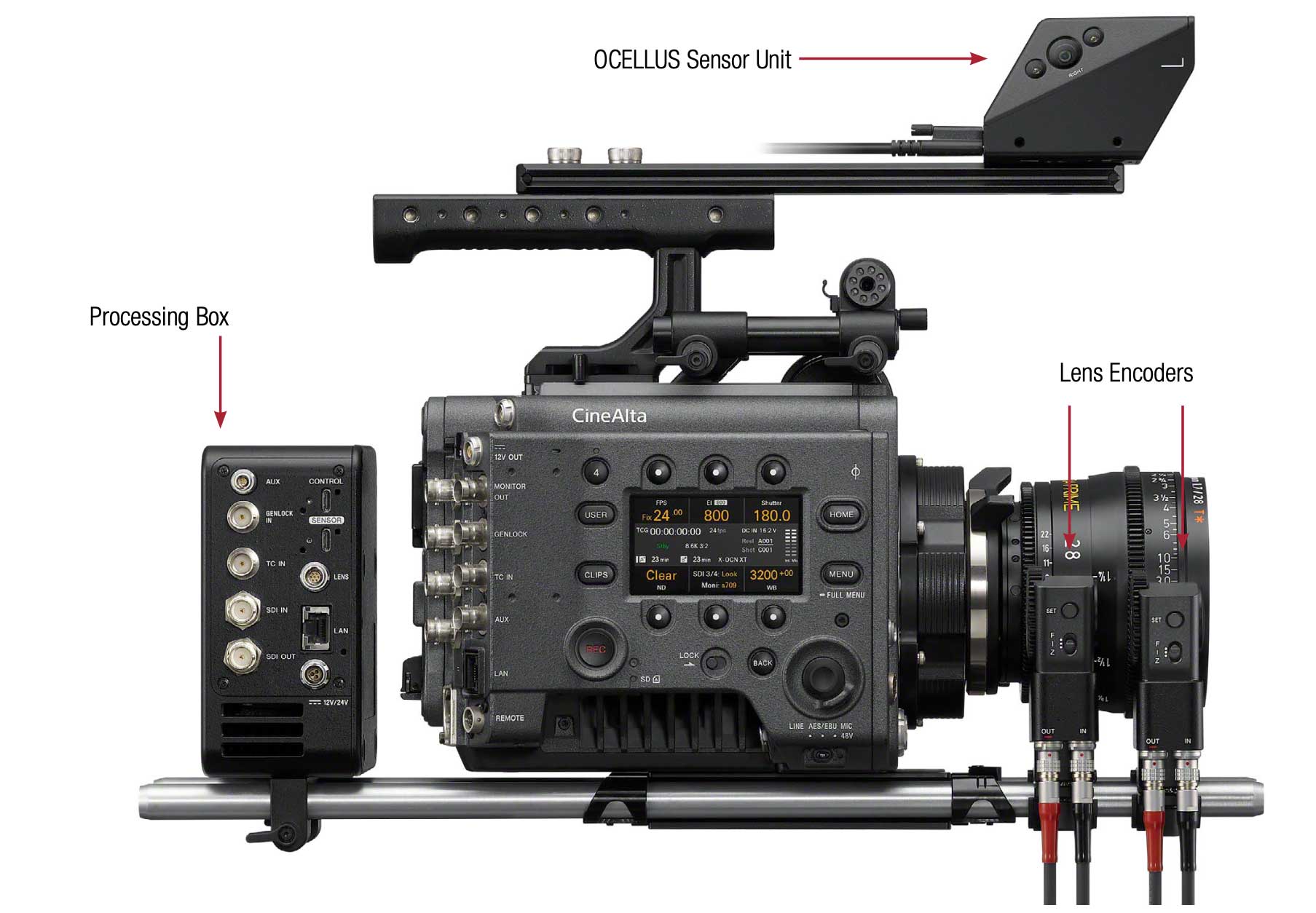
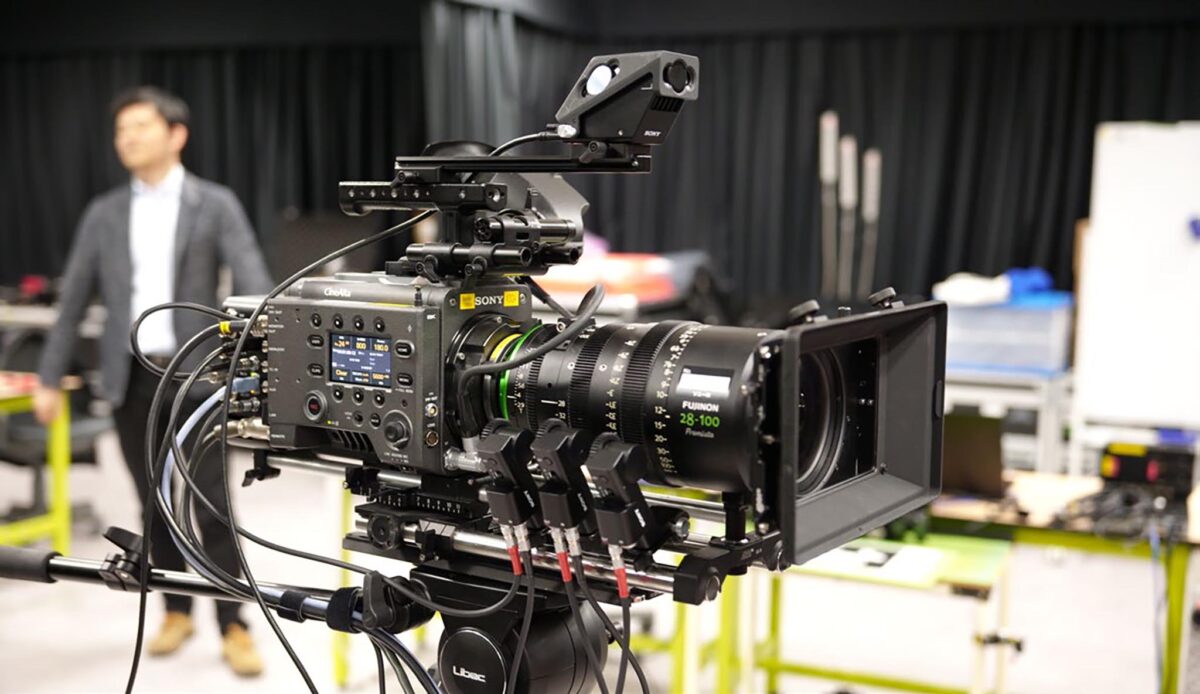
OCELLUS is the new camera tracking system from Sony. It consists of 3 parts: a sensor unit that sits on top of the camera, a processing box to calculate data, and lens encoders.
- OCELLUS is marker-free. It recognizes objects on set and on location, so you do not have to attach targets on ceilings, walls or the ground.
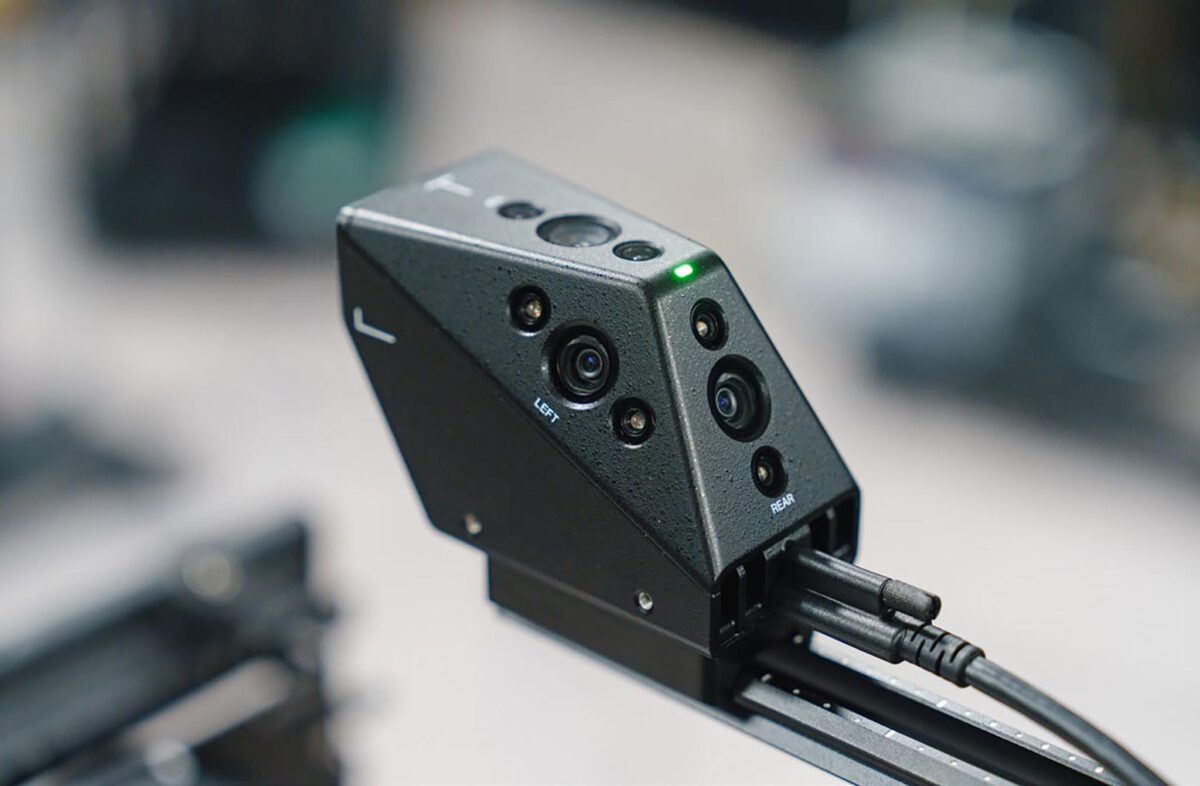
- It has 5 image sensors. But it continues to provide accurate camera position and orientation data even if 4 sensors are blocked.
- It works in extremely low light and crazy lighting conditions like concerts and places with strobes or flashes.
- OCELLUS comes with 3 encoders that look like lens motors—for all your vintage lenses lacking metadata.
When Yutaka Okahashi, Product Planner of the original Sony VENICE camera and others joined Yasuharu Nomura and the team in the Virtual Production/Augmented Reality Department, many of us wondered what he was thinking.
OCELLUS is part of an entire system of Sony products that work together seamlessly—from sensor to screen, from cameras to Crystal LED VERONA displays, with OCELLUS and Sony’s Virtual Production Tool Set to connect everything together.
Quick review. What is camera tracking? Why do we need it?
Is it only for VFX? No.
Camera tracking records the position and movement of a real camera. It’s an efficient replacement for using a tape measure to write down lens height, focal length, zoom, iris, camera tilt angle, distance from object, speed of dolly, etc. It replaces your old camera notebook, is more accurate and saves lots of time.
Once the camera tracking data is recorded digitally, you can use it to re-create the shot during (gasp) dreaded reshoots.
That was a basic scenario. Now, enter the digital world of VFX, composites, match moving, virtual studios (volumes) and augmented reality.
Sony describes OCELLUS as “a stable marker-free tracking system with multiple sensors and seamless camera integration for cinematic and broadcast applications, including sports, news, weather, news and more. Sony launches its first camera tracking system, OCELLUS (ASR-CT1), specifically designed to simplify and facilitate augmented reality and virtual production applications. OCELLUS is camera agnostic and can be used with both cinema and broadcast cameras.”
OCELLUS sends the camera position and orientation data while the camera is shooting. The system comprises a sensor unit, a processing box, and three lens encoders. It can be used with Sony Cinema Line cameras, system cameras, and non-Sony cameras.
With the five image sensors and Sony’s Visual SLAM (Simultaneous Localization and Mapping) technology, the system creates a reference map enabling stable marker-free tracking both indoors and outdoors.
When using Sony cameras, metadata regarding focus, iris and zoom values from the camera and lens can be obtained via the camera’s SDI output and is transmitted in real-time to external devices via Ethernet cable. OCELLUS supports /i lenses, B4 lenses, and E-mount lenses. The camera must support metadata-embedding on the SDI output. If the lens does not support metadata acquisition through the camera, lens encoders can be attached. The system supports recording tracking data, camera/lens metadata, timecode and file name.
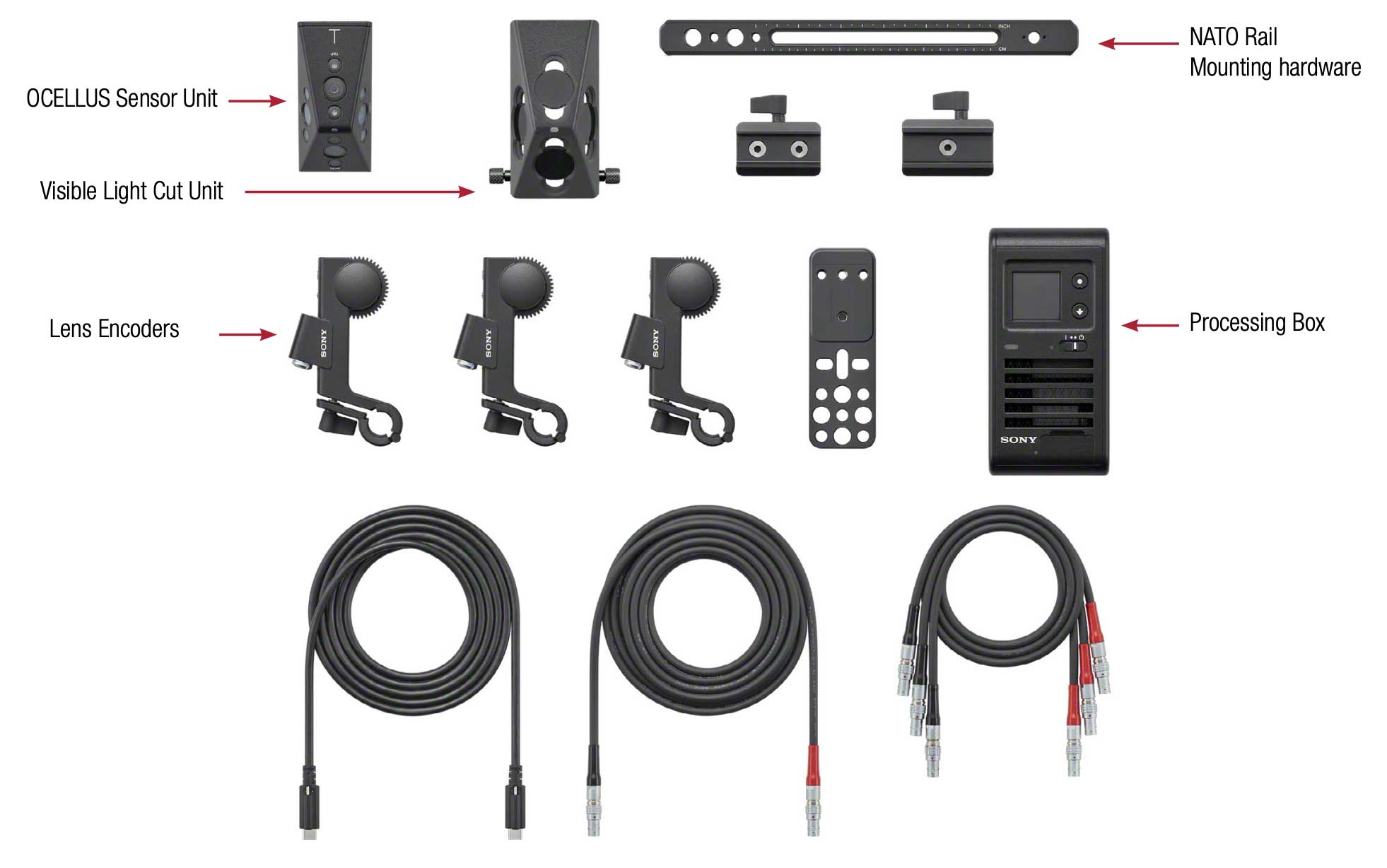
OCELLUS Details
Sensor Unit
- Compact and lightweight sensor unit with five image sensors.
- 4 image sensors out of 5 on the sensor unit are selected to provide stable marker-free tracking with high occlusion resistance.
- If at least one image sensor in use captures valid feature points, tracking data can be extracted.
- IR LEDs on both sides of each image sensor help tracking in low-light setups.
- A Visible Light Cut Unit is included for stable tracking in environments with frequent lighting changes
- Sensor unit size (W×H×D, approx): 86×60×43 mm
3.39×2.36 ×1.69″. - Weight: approx. 250 g / 8.8 oz.
- NATO rail mounting parts (included).
- Connection to the processing box via a single USB-C cable with a lock mechanism, powered by the processing box via same USB-C cable
Processing Box
- Real-time transmission of tracking data and camera+lens metadata to CG rendering software like Unreal Engine via Ethernet cable in free-d format.
- Genlock input, Timecode input, SDI input/output terminals, and lens encoder connection ports.
- Supports recording tracking data and camera/lens metadata as FBX files on SDXC memory cards (UHS-II/UHS-I), synchronized with video files of the main camera.
- OLED display for checking IP address, tracking information, lens data, and more.
Lens Encoders
- Detect precise rotation angles and positions of lens focus, zoom, and iris rings.
- Transmits detected data to the processing box via a LEMO 7-pin cable.
- Enables metadata acquisition for lenses and cameras not supporting lens data embedding on I output.
- Includes five different types of gears for various lenses.
The camera tracking system OCELLUS (official part name ASR-CT1) is at NAB Show 2025 in the Sony booth in North Hall.
The expected release is Fall 2025. Final specifications may change.
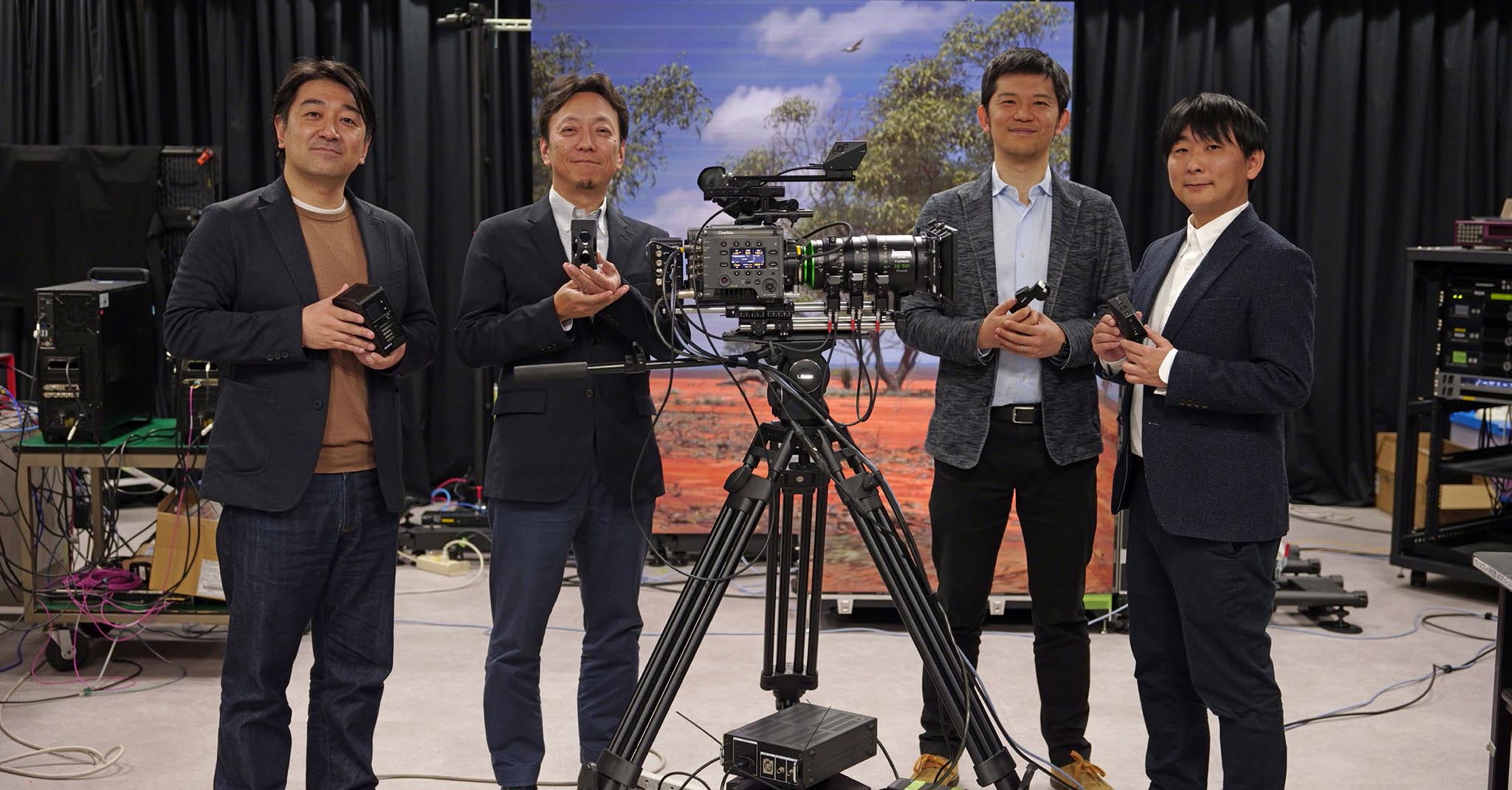
L-R: Takuro Ema, Head of Product Planning. Yasuharu Nomura, Senior General Manager, VP Technology & Services Business Division. Yutaka Okahashi, Senior Manager, VP Technology & Services Business Division. Ichiro Suda, Product Planner for OCELLUS Camera Tracking System.
-

- By using the Virtual Production Tool Set, previz with the VENICE look is possible even on a tablet.

-

- Photo: Keita Yasui.